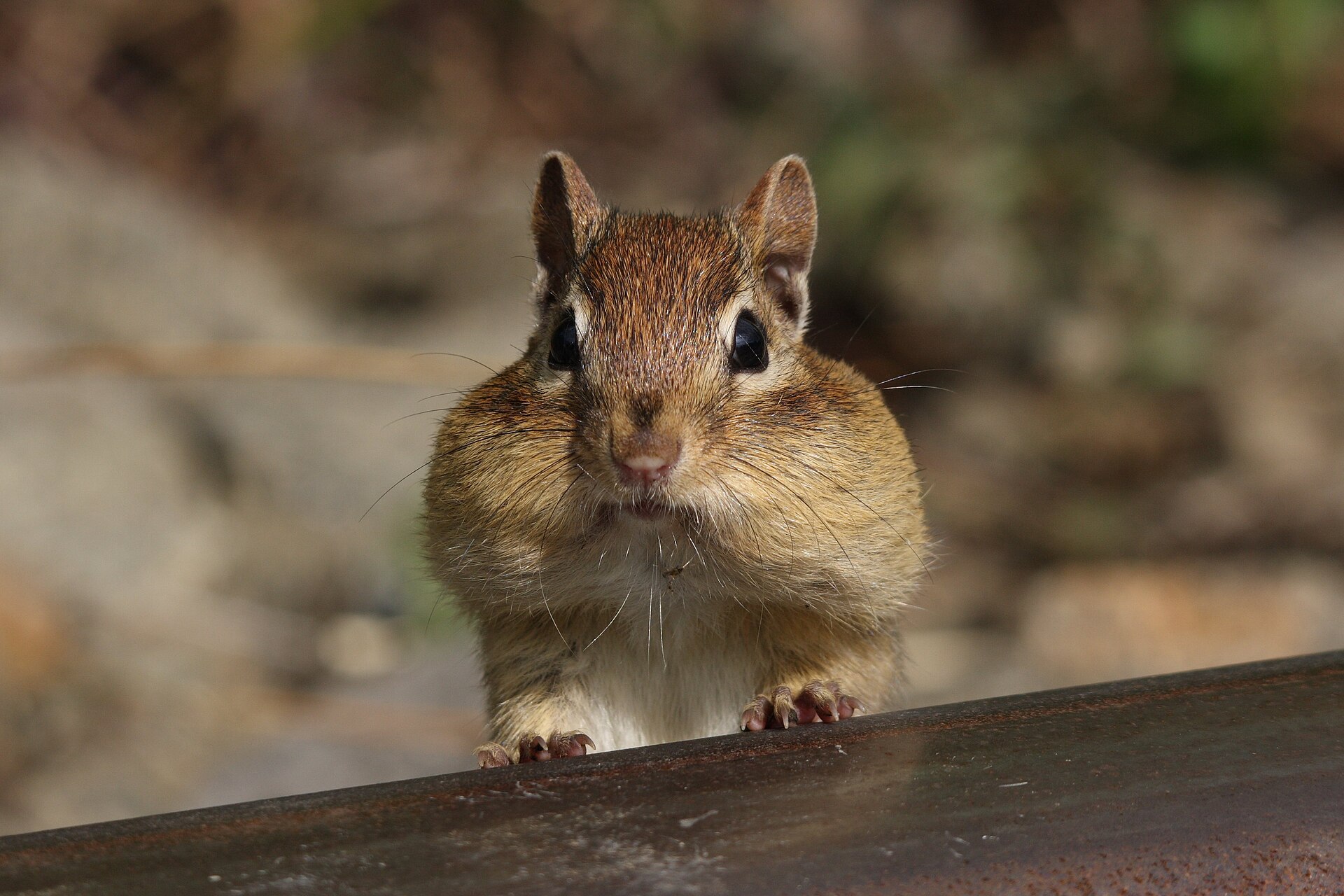
Eastern Chipmunk
Tamias striatus
Characteristics
Temperament
Solitary, territorial and surprisingly pugnacious, quite unlike the cuddly cartoon image. Diurnal and tireless, it spends its days foraging and carrying seeds in its cheeks to the burrow larder. It lives in an underground burrow that it defends from its own kind. In winter it alternates torpor with wake-ups to eat its hoard. Lively, quick and always alert to its many predators.
Diet
Omnivore with a strong preference for seeds. Staple: seeds, acorns, nuts and beechnuts, gathered in bulk in autumn. Also fruit, berries, mushrooms, insects, snails and worms, and occasionally eggs and nestlings. It uses its elastic cheeks to carry a great deal of food in one trip and stores it in a burrow larder (larder hoarding), drawing on it during winter wake-ups. Some forgotten seeds sprout: it is a tree disperser.
The Eastern Chipmunk (Tamias striatus) is a small ground squirrel of eastern North America, among the most recognizable and beloved rodents on the continent. Famous for:
- Its unmistakable stripes: five dark bands alternating with light stripes along the back and flanks, plus stripes on the face around the eyes — a pattern unique among squirrels
- Its elastic cheeks: cheek pouches that, when full, can double the width of its head and carry dozens of seeds in a single trip
- The hoarder: it stores large food reserves in an underground larder in its burrow to get through winter
- The "chip-chip": the sharp, repeated call that gives it its English name, used as an alarm against predators
- The forest gardener: by forgetting some of its buried seeds, it helps woodlands regenerate
- A cartoon icon: it inspired famous characters such as Chip 'n' Dale and Alvin and the Chipmunks
IUCN status: Least Concern (LC), with abundant, widespread populations. A solitary and territorial animal, surprisingly pugnacious despite its cute looks, it plays an important ecological role as prey for many carnivores (including the Bobcat and Coyote) and as a seed disperser.
Classification and category
Order Rodentia, family Sciuridae (squirrels, marmots and prairie dogs), genus Tamias. It is, in every sense, a ground squirrel, related to tree squirrels but adapted to live in burrows dug in the soil. There are about 25 species of chipmunk, almost all North American (mostly in the genus Neotamias, in the west) plus one Asian species, the Siberian chipmunk. The Eastern Chipmunk (Tamias striatus) is the only species in genus Tamias proper and is the chipmunk of eastern North America. Similar animals to tell it from: ground squirrels (some are striped but lack the facial stripes typical of chipmunks); the golden-mantled ground squirrel (similar but striped only on the body, not the face). Etymology: "Tamias" is Greek for "the steward, the one who stores and keeps", a perfect reference to its food-storing habit; "striatus" is Latin for "striped"; the English name "chipmunk" probably derives from an Ojibwe word. Parameters: Body 14-19 cm. Tail 8-10 cm. Weight 70-150 g. Longevity 2-3 years in the wild (high juvenile mortality), up to 8 in captivity. 1-2 litters a year (spring and summer), gestation ~31 days, litters of 3-5 raised by the female alone and independent in about two months.
Habitat and distribution
The Eastern Chipmunk ranges across all of eastern North America: from southeastern Canada (Quebec, Ontario, the Maritimes) through the entire eastern half of the USA, south toward northern Florida and west to beyond the Mississippi. Preferred habitats: deciduous and mixed forests (its prime habitat, rich in acorn-, nut- and beechnut-bearing trees); understory and woodland edges (with fallen logs, rock piles and stumps to burrow under); and gardens, parks and suburbs (it adapts very well to people and is a regular at parks and bird feeders). The heart of its life is the underground burrow: a tunnel system that can stretch several metres, with separate chambers for the nest, the larder and waste, and hidden entrances kept clean (it carries away soil in its cheeks so as not to leave tell-tale mounds). It is solitary and territorial, each animal defending the area around its burrow. IUCN: Least Concern, abundant, stable and well adapted even to human-modified environments.
Diet
An omnivore with a strong preference for seeds, with a varied, seasonal diet: seeds, acorns, nuts and beechnuts (the staple, gathered in bulk especially in autumn); fruit and berries; mushrooms (a favourite, whose spores it spreads); insects, snails and worms; and occasionally eggs, small amphibians and nestlings. Feeding strategies: the cheek-pouches let it gather and carry a great deal of food in one trip (dozens of seeds or several acorns), cutting the time spent exposed to predators; larder hoarding (unlike the grey squirrel, which scatters caches, the chipmunk concentrates them in one large store in the burrow); and near-hibernation (in winter it does not sleep continuously but enters torpor for days, waking periodically to eat from its hoard). Crucially, some buried seeds are forgotten and sprout, so the Eastern Chipmunk is an important tree disperser and a valuable cog in the regeneration of eastern forests.
Physical features
A small, agile, darting rodent with an unmistakable pattern. Coat: reddish-brown ground colour on the back, paler and whitish on the belly; five dark stripes alternating with light stripes along the back and flanks (the central stripe reaching the tail); stripes on the face too, around the eyes — the trait that separates chipmunks from other ground squirrels; rump and tail base with reddish tones. Body: compact build, large dark eyes, rounded erect ears; extensible cheek pouches that bulge the head conspicuously when full; deft forepaws with handling dexterity for seeds; an upright tail held straight when running, used for balance and signalling. Performance: a digger (building tunnel networks with specialized chambers); a climber (though ground-dwelling, it climbs shrubs and low trees for seeds and fruit); quick (fast short sprints from cover to cover); and vocal (a rich repertoire of "chips", "chucks" and trills for alarm and communication).
Behaviour and curiosities
Solitary, territorial and surprisingly pugnacious, quite unlike the cuddly cartoon image. Each animal defends the territory around its burrow, and encounters between adults outside the breeding season are often quarrelsome. It is diurnal, most active in the morning and late afternoon.
Prodigious cheeks: the chipmunk's pouches are so elastic that a single animal can carry an astonishing amount of food — individuals have been recorded with over 30 seeds, several acorns or dozens of corn kernels packed in at once. It is its way of "shopping" fast and getting back to safety. The "steward": the genus name Tamias means "one who stores and keeps" — perfect, as it spends autumn filling its underground larder with kilos of seeds to draw on during winter wake-ups, concentrating everything in one store rather than scattering it. Stop-start hibernation: contrary to belief, it does not sleep all winter; it enters torpor to save energy but wakes periodically to eat from its hoard and may even emerge on mild days — a "stop-start" hibernation made possible by that larder. The accidental gardener: by caching seeds and inevitably forgetting some, it effectively plants new trees, a key player in dispersing oaks, beeches and nuts and in regenerating eastern deciduous forests, as well as spreading fungal spores. Prey at the centre of the web: small and abundant, it is essential prey for hawks and owls, foxes, weasels, snakes, house cats and, of course, the two great North American mesopredators, the Bobcat and the Coyote; its cautious life of short dashes and alarm calls is shaped by that constant predation. Cartoon star: few wild animals have entered pop culture like the chipmunk, inspiring Disney's Chip 'n' Dale and the singing trio of Alvin and the Chipmunks, which made its bulging cheeks and high voice familiar worldwide.
Pros
- Roditore inconfondibile e simpaticissimo, simbolo dei boschi orientali
- IUCN Least Concern: popolazioni abbondanti e diffuse
- Disseminatore di semi: aiuta la rigenerazione delle foreste
- Facile da osservare in parchi e giardini del Nord America orientale
Cons
- Non è un animale domestico (selvatico, solitario e territoriale)
- Può scavare tane in giardini, prati e fondamenta
- Rosicchia bulbi, semi e a volte raccolti negli orti
- Vita breve in natura e alta mortalità per predazione