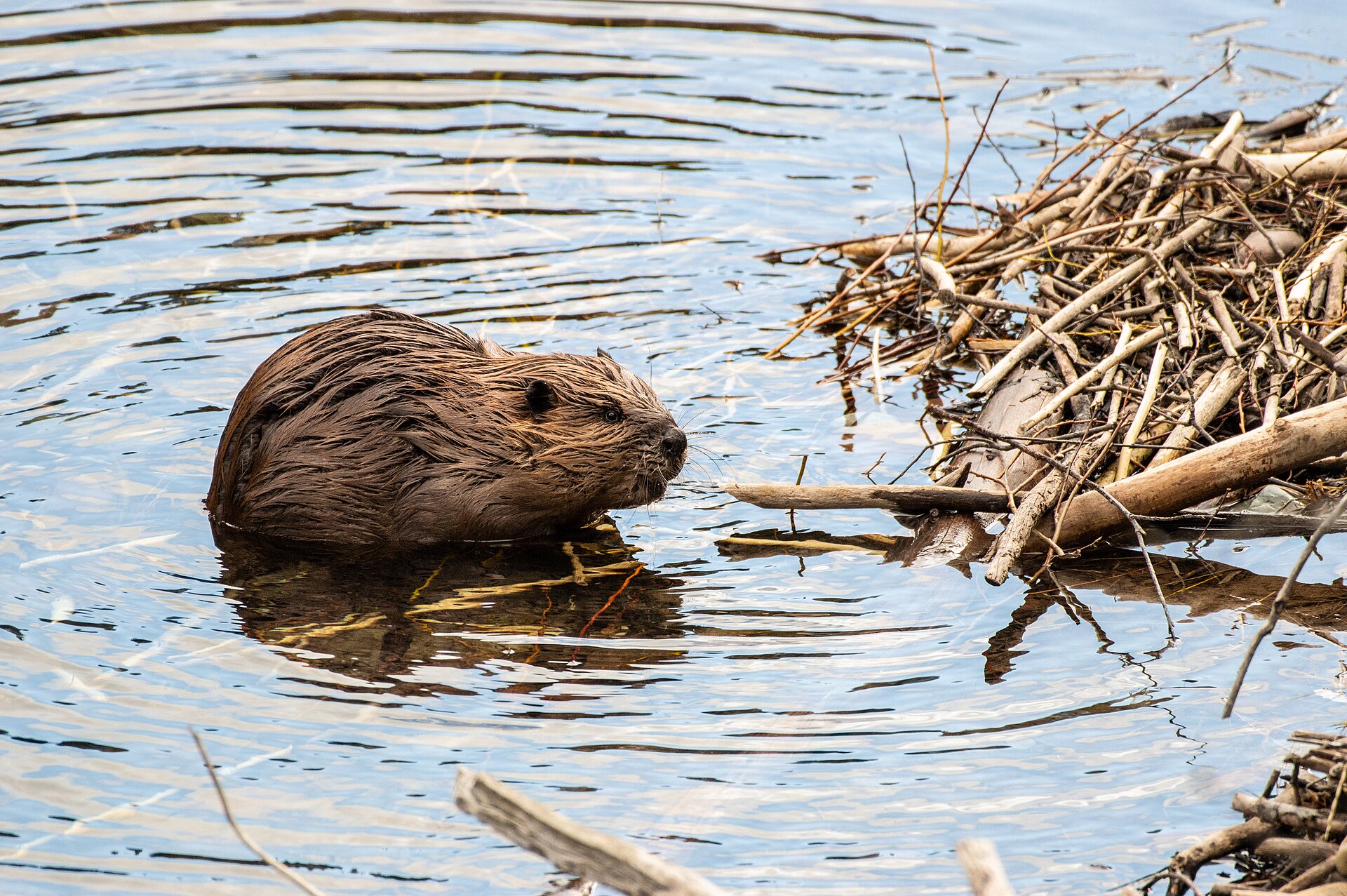
American Beaver
Castor canadensis
Characteristics
Temperament
Social, family-oriented and a tireless worker. It lives in colonies with a monogamous pair and its offspring, which cooperate to build and maintain dams and lodge. It marks its territory with mounds of mud and castoreum. Nocturnal and crepuscular, it does not hibernate and stays active all winter under the ice. Clumsy on land but very agile in water. A peaceful herbivore, yet able to radically modify the environment: a true engineer. Not a pet: a wild semi-aquatic rodent.
Diet
A strictly vegetarian herbivore. It feeds mainly on the bark and cambium of softwood trees (aspen, willow, poplar, birch), plus twigs, buds, leaves, aquatic plants, roots and tubers. It fells trees by gnawing the trunk with its powerful orange incisors, to reach the higher branches. In autumn it builds a large branch larder on the pond bottom near the lodge, drawing on it in winter under the ice. Like other rodents it practises caecotrophy to better absorb its tough plant diet.
The American Beaver (Castor canadensis) is North America's largest rodent (the world's second-largest after the capybara) and one of the very few animals able to transform the environment as humans do. Famous for:
- The ecosystem engineer: it builds dams that block watercourses, creating ponds and wetlands that host a very rich fauna
- Dams and lodges: barriers of branches and mud, and domed shelters with underwater entrances, its unmistakable works
- The paddle tail: flat, broad and scaly, used to swim, balance, store fat and — slapped on the water — raise the alarm
- Orange teeth: ever-growing, iron-strengthened incisors with which it fells whole trees
- A semi-aquatic life: perfectly adapted to swim and dive
- The symbol of Canada: the national animal, depicted on the five-cent coin
IUCN status: Least Concern (LC): once decimated by fur hunting, it is now abundant again. It is the American "cousin" of the European Beaver already in this portal: two almost identical species that, on either side of the Atlantic, perform the same crucial role as wetland creators.
Classification and category
Order Rodentia, family Castoridae (the beavers), genus Castor. There are only two beaver species in the world, and both are in this portal: the American Beaver (Castor canadensis) of this profile, from North America; and the European Beaver (Castor fiber), the Eurasian twin. The two species are almost indistinguishable by eye, but cannot interbreed: they have a different number of chromosomes (the American 40, the European 48), which keeps them genetically isolated despite the resemblance. Not to be confused, moreover, with the Nutria (a South American semi-aquatic rodent, but with a round, not flat, tail) or the muskrat. Etymology: "Castor" is the Latin and Greek name for the beaver; "canadensis" denotes Canada, the heart of its range; the term comes from an ancient root also linked to castoreum, the animal's famous glandular secretion. Parameters: Body 74-90 cm. Tail 25-35 cm (flat, broad, scaly). Weight 11-30 kg (on average ~16-20 kg; the oldest individuals are the largest). Longevity about 10-15 years in the wild, up to over 20. Reproduction: monogamous; the pair forms a family colony; gestation ~105-110 days; litters of 2-4 kits, born already furred and with eyes open, staying in the colony for a couple of years.
Habitat and distribution
The American Beaver ranges across much of North America: from Alaska and Canada, through almost all of the USA, to northern Mexico; also introduced elsewhere (for example in Patagonia, where it has become invasive). Preferred habitats — always tied to fresh water: rivers, streams, lakes and ponds surrounded by woods (its prime habitat); wetlands and wooded swamps, often created by its own dams; it favours banks rich in softwood trees (poplars, willows, birches, aspens), its food and building material. The beaver does not just live in its habitat: it builds it. By damming watercourses, it floods wooded areas and creates deep, calm ponds, ideal for protecting the underwater entrance of its lodge and for floating logs around. It is mainly nocturnal and crepuscular, does not hibernate and stays active all winter, even under the ice, living in the lodge and feeding from the submerged branch cache. IUCN: Least Concern. After being hunted almost to extinction for its valuable fur (a trade that drove the exploration of North America), thanks to protection and reintroductions it is once again common and abundant across the continent.
Diet
The American Beaver is a strictly vegetarian herbivore, tied above all to trees. It eats: the bark and cambium (the living layer under the bark) of softwood trees — aspen, willow, poplar, birch; twigs, buds and leaves; and aquatic plants, roots and tubers (important especially in summer). Feeding strategies: felling trees (with its powerful incisors it gnaws all around the trunk until it falls, to reach higher branches, bark and leaves); the underwater larder (in autumn it piles a large store of branches on the pond bottom near the lodge; in winter, under the ice, it draws on this without going outside); and caecotrophy (like other rodents, it re-ingests some of its soft droppings to better absorb the nutrients of its tough plant diet). Crucially, by felling trees and building dams to obtain food and safety, the beaver profoundly modifies the environment, and this is what makes it an ecosystem "engineer" rather than a mere consumer.
Physical features
A large, stocky rodent perfectly adapted to aquatic life. Water adaptations: a flat, broad, scaly "paddle" tail (rudder and fin for swimming, support when gnawing upright, fat store, and an alarm "slapper" on the water); webbed hind feet for swimming, and deft, prehensile forefeet to handle branches and mud; thick, waterproof fur, insulating even in icy water; and a transparent nictitating membrane ("third eyelid") for underwater vision, closable nostrils and ears, and lips that close behind the incisors to gnaw even when submerged. The teeth: large orange incisors (the colour comes from iron-strengthened enamel, making them very hard); ever-growing (worn down and re-sharpened by gnawing wood). Performance: swimming and diving (it can stay underwater for several minutes); building (it handles branches, stones and mud with surprising skill); woodcutting (it fells trees even of considerable diameter); and clumsiness on land (slow and awkward on dry ground, it is by contrast extremely agile in water).
Behaviour and curiosities
The American Beaver is a social, family-oriented, tireless worker. It lives in colonies made up of the breeding pair (monogamous and lasting) and the young of one or two generations, which cooperate in maintaining dams and lodge. It marks its territory with mounds of mud soaked in castoreum, its scent secretion. It is famous for its industry, so much so that "to work like a beaver" has become a saying.
The "ecosystem engineer": the beaver is one of the very few animals, along with humans, able to radically modify its environment — by building dams it turns streams into ponds and creates vast wetlands; these water-rich environments become oases of biodiversity, where fish, amphibians, waterbirds, insects and plants thrive, and the retained water reduces floods, counters drought and recharges aquifers; this is why beavers are now reintroduced in many areas precisely as "allies" in water management and ecosystem restoration. The multipurpose tail: the beaver's famous flat tail is an extraordinary tool — in water it acts as rudder and fin; on land, as a supporting tripod while the animal gnaws a tree upright; it stores fat for winter; it helps disperse heat in summer; and, slapped hard on the water surface, it produces a loud "slap" that warns the whole colony of danger, sending the beavers diving to safety. The teeth that never stop growing: the beaver's incisors are orange because their enamel is iron-strengthened, making them exceptionally hard and tough; they grow throughout life and wear down and sharpen themselves as the animal gnaws wood; thanks to these natural "chisels", a beaver can fell trees of considerable diameter, though for the largest it may work several nights. The lodge with the secret entrance: the beaver's lodge is a masterpiece of animal architecture — a dome of branches and mud, often built in the middle of the pond, with a dry inner chamber above the waterline and underwater entrances; this makes it almost impregnable to land predators, which cannot reach the entrance, and protected from frost; the dam serves precisely to keep the water level high enough to cover these accesses. Castoreum: the beaver produces, from special glands, an intensely scented secretion called castoreum, which it uses to mark its territory together with mud; in the past castoreum was much sought after by humans and used in perfumery and traditional medicine, helping, along with the fur, to make the beaver a prey of great commercial value. The hunt that made history: few species have influenced human history like the beaver — its warm, waterproof fur was for centuries a most precious commodity, and the rush for beaver pelts drove the exploration and colonization of vast regions of North America, giving rise to companies, cities and conflicts; this intensive hunting brought the American beaver to the brink of extinction, from which it later recovered thanks to protection.
Pros
- Ingegnere degli ecosistemi: crea zone umide e biodiversità
- Reintrodotto come 'alleato' per la gestione delle acque e il ripristino ambientale
- IUCN Least Concern: ripresa esemplare dopo la caccia alla pelliccia
- Il più grande roditore del Nord America; simbolo nazionale del Canada
Cons
- Le sue dighe possono allagare strade, campi e proprietà (conflitti con l'uomo)
- Dove introdotto fuori areale (es. Patagonia) è invasivo e dannoso
- Non è un animale da compagnia (roditore selvatico)
- Storicamente cacciato quasi all'estinzione per pelliccia e castoreo