Doberman Pinscher
Canis lupus familiaris
Characteristics
Temperament
Exceptionally intelligent (top 5 breeds), loyal, vigilant, protective. Strong attachment to "human alpha". Suspicious of strangers: early socialisation essential. Top breed for dog sports, police, military. Cropping/caudotomy practices banned in EU.
Diet
Omnivore, fast metabolism. 1,500-2,200 kcal/day in 2-3 meals. Kibble for active large dogs (28-32% protein, 15-20% fat). STRONG predisposition to DCM (dilated cardiomyopathy >40% adults). DNA tests and annual cardio screening mandatory.
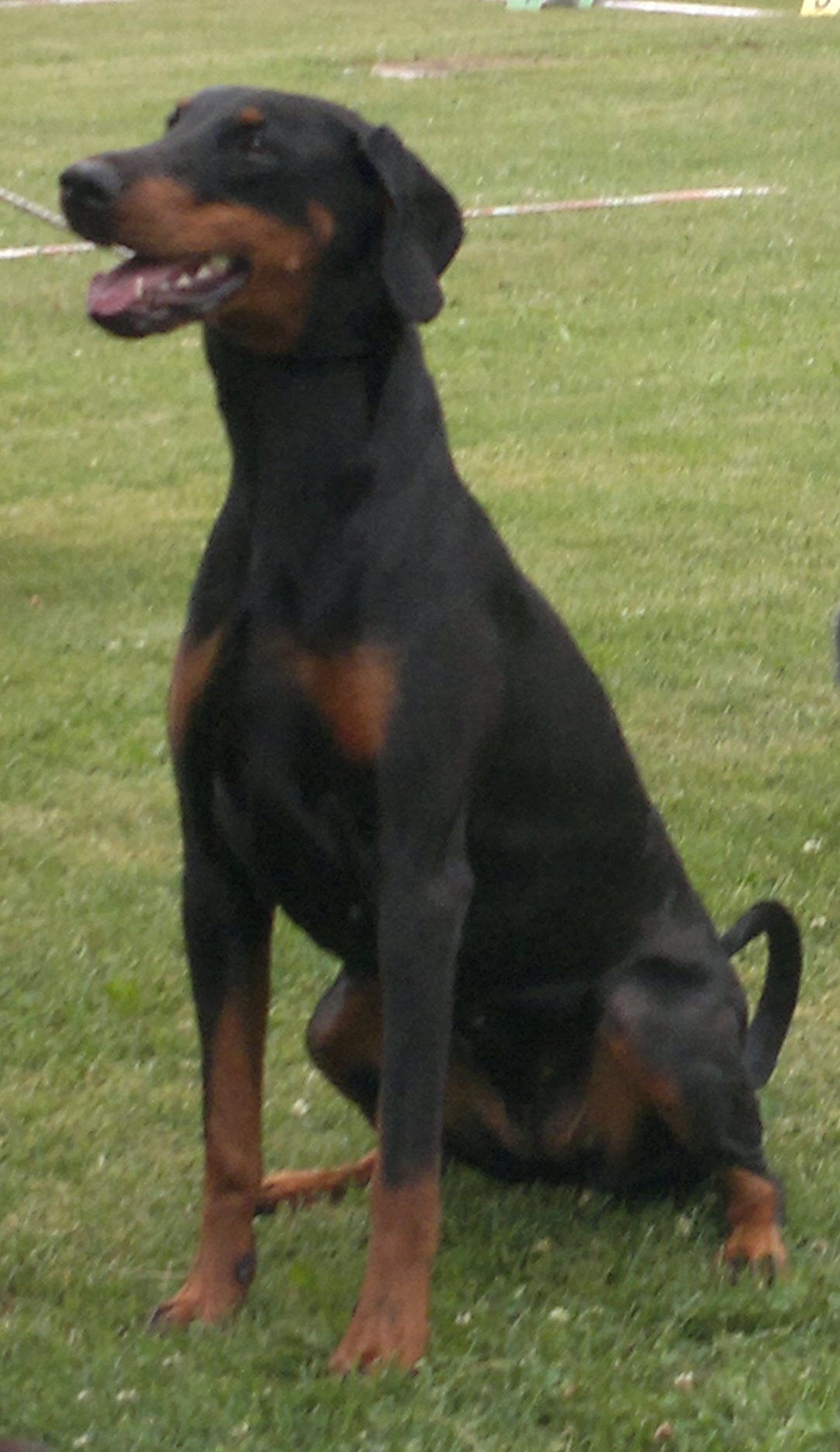
The Doberman Pinscher (Canis lupus familiaris), also known as Doberman or simply Dobermann (in the FCI European variant), is one of the most athletic, elegant and intelligent dog breeds in the world. Created in the late 19th century by German tax collector Friedrich Louis Dobermann in the city of Apolda (Thuringia), who wanted a personal protection dog during his risky professional activities, it has become one of the most sought-after guard/work/sport dogs in the world. It combines explosive strength, sports dog agility, exceptional intelligence (top 5 most intelligent breeds according to Stanley Coren), unwavering loyalty and distinctive physical elegance: muscular slender body, shiny black or brown coat with characteristic tan markings (fire-colour) above the eyes, cheeks, chest, legs. Iconic in popular culture as "police dog" or "guard dog", the modern Doberman is also an excellent family dog if well socialised.
Classification and category
The Doberman Pinscher belongs to the species Canis lupus familiaris, the domestic subspecies of the grey wolf. It is classified by the FCI in Group 2 — Pinscher, Schnauzer, Molossian-type and Swiss Mountain Dogs, section 1 (Pinscher and Schnauzer). The official standard provides for a withers height of 68-72 cm for males and 63-68 cm for females, with a weight of 40-45 kg for males, 32-35 kg for females. The structure is square, athletic, "noble and muscular". The FCI standard was deposited by Germany (country of origin). The breed has been officially recognised by the FCI since 1955. There is an American variant recognised by the AKC as Doberman Pinscher, with small differences (slimmer, slightly different expressions). The standard colours are four: black with tan markings (most common), brown (chocolate/liver) with tan markings, blue (dilution of black, rare), isabella/fawn (dilution of brown, rare). The "blue" and "isabella" colours are associated with colour dilution alopecia (CDA), inherited skin problem; the European FCI excludes them from the standard.
Habitat and distribution
The Doberman is a dog perfectly adapted to active family life: its exceptional intelligence and need for physical/mental exercise make it ideal for active families (not sedentary). It lives well in apartments provided it receives 1.5-2 hours per day of intense exercise (running, dog sports, training). It is not a breed for sedentary families: it gets bored easily and can develop destructive behaviours. It needs intensive early socialisation with people and other animals to avoid excessive suspicion towards strangers (inheritance of its past as a protection dog).
The history of the breed is rich and well documented. Friedrich Louis Dobermann (1834-1894) was a tax collector of the municipality of Apolda (Germany), who also managed a municipal kennel and had access to numerous breeds. In the 1880s, wanting a robust, courageous and intelligent dog to accompany him in his risky tax collection activities, he started a selection programme by crossing: ancient German Shepherd (for intelligence and size), German Pinscher (for agility), Rottweiler (for strength and protection), Greyhound (for speed), Manchester Terrier (for the black-tan coat), Beauceron (for endurance). The result was a medium-large sized dog, athletic, elegant, with a character strongly attached to the owner and suspicious of strangers. The breed was standardised in the 1890s by Dobermann's successor, Otto Goeller. They were used as military dogs by the German army in World War I, and by the US army in WWII (the US Marines had a "Combat Doberman" as official mascot for their engagement in the Pacific). In the 70s-90s it was extremely popular as "luxury guard dog"; today popularised both as sports dog (IPO/Schutzhund) and as family dog. Today it is widespread globally, with concentrations in Germany, USA, Italy, UK, Russia. The average price of a pedigree FCI puppy is 1,500-3,000 euros; specimens from elite working or show lines 4,000-8,000 euros.
Diet
The Doberman is a domestic omnivorous dog with fast metabolism for its size: the daily caloric requirement of an active 40 kg adult is 1,500-2,200 kcal, distributed in 2 meals (preferably 3 in puppies to avoid bloat). The ideal diet consists of high-quality kibble for active large-sized dogs (28-32% protein, 15-20% fat, low in cereals), or wet feeding or BARF under veterinary supervision.
The breed is particularly predisposed to numerous hereditary pathologies: Dilated Cardiomyopathy (DCM) — the most widespread pathology, affects >40% of specimens over 5 years and causes sudden death (DNA test existing for genetic variants, annual echocardiographic screening from 3 years mandatory for breeders), von Willebrand Disease type 1 (coagulation problem, DNA test), Wobbler Syndrome (cervical instability, causes paralysis of hind limbs), hip/elbow dysplasia, hypothyroidism, gastric torsion (bloat) (frequent in large breeds with deep chest). Recommended: annual cardio screening from 3 years, DNA test pre-mating, feeding divided in 2-3 meals (never one), rest after meals. The average longevity is only 10-13 years (shorter than other large breeds due to DCM). Foods to avoid: chocolate, grapes, onions, fatty foods. Water always available.
Physical features
The Doberman has an athletic, elegant, slender, muscular body, defined by the standard as "square" (body length equal to withers height). The head is long, lean, in the form of an elongated wedge, with muzzle parallel to skull (never accentuated stop), black nose (or brown in brown Dobermans). The ears were traditionally cropped and erect (cropping), historical tradition now prohibited in many EU countries (Italy since 2007); in modern standards natural ears are attached high, drooping, slightly folded forward. The eyes are oval, dark, expressive, with "intelligent, firm, determined" gaze. The tail was traditionally docked (caudotomy) at the third segment — also prohibited in Italy/EU since 2007.
The coat is the most distinctive characteristic (together with markings): short hair (1-2 cm), smooth, shiny, dense. Adheres to the body, does not form significant undercoat. The base colour is jet black (most common) or chocolate brown, with characteristic tan markings (bright fire colour) well defined and located: above the eyes (forming "eyebrows"), on muzzle and throat, on the chest (two "V"-shaped patches), on legs (inner parts), under the tail. Tan markings must be strictly outlined, not blurred. Other colour variants (blue, isabella) have tan markings but are excluded from FCI standard. The body is square (withers height = body length), athletic, with well-defined muscles, straight back, retracted belly. The legs are long, straight, well proportioned, with feet of "cat foot" type (compact like a cat's). The gait is elegant, fluid, dynamic: the Doberman can run at 50 km/h in sprint, sustain 30-35 km/h for kilometres. The normal cruising speed is impressive: 25 km/h in trot.
Behaviour and curiosities
The Doberman has an exceptionally intelligent, loyal, vigilant temperament. It is ranked among the top 5 most intelligent breeds in the world by Coren ranking (1994), with learning capacity "working/obedience intelligence" equal to Border Collie. It learns new commands in less than 5 repetitions and obeys known commands on first call in 95% of cases. It is strongly attached to the owner (often to a single "human alpha"), shows great affection towards the family, is protective towards children of its own family. It is naturally suspicious of strangers: it needs intensive early socialisation (3-16 weeks of age) to properly manage this suspicion. Without adequate socialisation it can become hyper-protective or paranoid.
Sports capabilities are exceptional: top breed for dog sports (IPO/Schutzhund, mondioring, French Ring, agility, obedience). It is also a sought-after breed by police and military forces (although less popular today compared to Belgian Malinois). Excellent olfactory capabilities: some Dobermans are used for drug, explosive, person searches. The US armed forces have had famous combat Dobermans: "Cappy" (US Marines, saved 250 marines in the Battle of Guam 1944, decorated post-mortem), "Andy" (USA, person search in natural disasters). The literary-cinematographic history is rich: the character "Apollo" in "Magnum P.I." (80s) was a Doberman, "Beauty and the Beast" (1991) has a Doberman antagonist, "Resident Evil" (2002+) features the celebrated "Cerberus" zombie-Dobermans. Famous modern owners: John F. Kennedy, Mariah Carey, Forest Whitaker. Health curiosity: the Doberman is today at the centre of a growing ethical debate for the practice of cropping ears and tail (banned in EU for decades, still practised in USA in many states). Animal rights movements push for a global ban. The breed is also the subject of controlled outcrossing programmes to reduce DCM incidence (Dilated Cardiomyopathy), main cause of reduced longevity. In recent years the popularity of the Doberman is in slight decline (from top 15 AKC breeds in the 80s to current top 25), also due to loss of popularity of the "guardian" dog compared to the "companion-sport" dog.
Pros
- Intelligenza eccezionale (top 5 razze), addestrabilità superiore
- Elegante, atletico, simbolo di forza e bellezza
- Leale e protettivo verso la famiglia
- Versatile: cane sportivo, polizia, militare, famiglia
Cons
- FORTE predisposizione a DCM (cardiomiopatia >40%): morte improvvisa
- Longevità ridotta (10-13 anni vs 14+ di razze simili)
- Richiede 1,5-2 ore esercizio/giorno e mente impegnata
- Diffidente con estranei se non socializzato precocemente