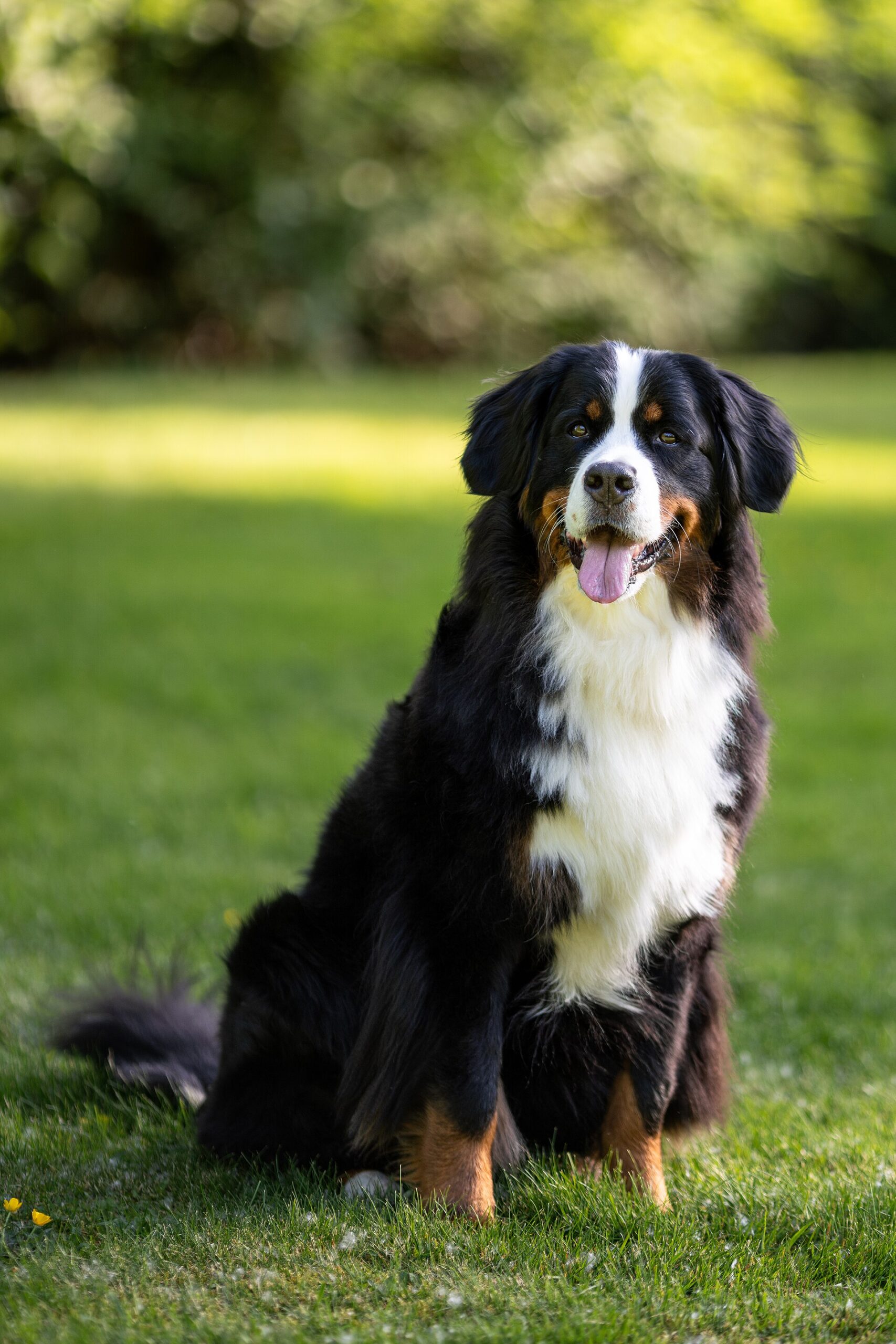
Bernese Mountain Dog
Characteristics
Temperament
A large dog with a sweet, calm, affectionate and patient temperament, deeply bonded to its family and wonderful with children. Tending to be reserved but not aggressive with strangers, it is eager to please and relatively easy to train with gentle methods. It suffers from loneliness and loves to be with its people. A "gentle giant" that needs space, company, moderate exercise, a cool climate (it suffers in heat) and coat care; it should also be chosen knowingly because of its well-known health fragility and short longevity.
Diet
A large-breed dog needing a complete, balanced large-dog diet suited to age, weight and activity. In the puppy, controlled growth without excess is preferred, so as not to overload forming bones and joints. Keeping ideal weight as an adult is essential to protect hips and elbows. In giant, deep-chested dogs several meals a day are preferred, avoiding intense exercise right after meals to reduce the risk of gastric torsion. Given the breed's delicacy, it is advisable to set diet and growth with veterinary support.
The Bernese Mountain Dog (German Berner Sennenhund) is one of the most loved and recognizable of the large breeds: a gentle giant with a magnificent tricolour coat and a sweet, family-oriented character. Famous for:
- The tricolour coat: jet black, rust-coloured tan and white markings, long and silky
- The very sweet nature: calm, affectionate and patient, it is one of the best family dogs
- Its Swiss farm origins: bred as the all-rounder of the Bernese Alpine farms
- The draft vocation: it historically pulled carts of milk and cheese
- The imposing size: a large, sturdy dog, yet not in the least aggressive
- The downside: sadly, it is among the shortest-lived breeds
It enters the portal among the working dogs, reflecting its origin as a versatile farm and draft dog. It is a dog that wins hearts with its beauty and gentleness, but one that calls for an informed choice, especially because of its known health fragilities.
Classification and category
The Bernese Mountain Dog is a Canis lupus familiaris, one of the four Swiss mountain-dog breeds (the Sennenhunde) and the only one of them with a long coat. It comes from the Canton of Bern, in Switzerland. In the portal it is placed among the working dogs, consistent with its past as a farm, draft and guard dog. It is useful to tell it apart from related or similar breeds: the other Swiss mountain dogs — the Greater Swiss Mountain Dog (Grosser Schweizer Sennenhund), the Appenzeller and the Entlebucher — all tricolour but short-coated, while the Bernese is the only long-coated one; the Saint Bernard and the Newfoundland — other gentle giants, but with different coats and build; and other long-coated tricolour breeds (such as some Australian Shepherds or Border Collies) — smaller and lighter, of different structure. Etymology: "Sennenhund" means "dog of the senn", the Swiss alpine dairyman/herdsman; "Berner" indicates the origin in the Canton of Bern. Parameters: Height at the withers males about 64-70 cm, females about 58-66 cm. Weight males about 38-50 kg, females about 36-48 kg. Build large, sturdy and well-proportioned, never heavy or clumsy. Longevity: this is the breed's sorest point. The average life is sadly short, around 7-8 years (sometimes less), among the lowest of all dog breeds, mainly because of the high incidence of cancer. Reproduction: litters of variable size; it is essential to turn to serious breeders who carry out health screening.
Habitat and distribution
The Bernese Mountain Dog has a very specific geographic origin, but today is found worldwide as a companion dog: origin the countryside and mountains around Bern, in the Swiss pre-Alps and plateau, where it was the all-rounder farm dog; current spread Europe (including Italy) and North America in particular, appreciated everywhere as a family dog. The ideal environment for this dog: ample space (a house with a garden, countryside or settings with room to move; it does not adapt well to small flats); a cool climate (its thick coat makes it sensitive to heat; it loves the cold and suffers in summer); and closeness to the family (it is a dog that wants to be with its people and suffers from loneliness). Historically, the Bernese was a classic mountain farm dog: it droved livestock, guarded the farm and pulled carts laden with dairy products to market. Having almost fallen out of use in the early 20th century with mechanization, it was saved from extinction thanks to the efforts of Swiss enthusiasts and dog experts, who reconstituted the breed. Status: a widespread, well-established domestic breed; there are no "conservation" issues, but rather important health and welfare matters tied to breeding, on which good breeders actively work.
Diet
The Bernese Mountain Dog is a large breed and its feeding must be managed carefully, especially in the delicate growth phase. In general: a complete and balanced diet for large-breed dogs, suited to age, weight and activity level; controlled puppy growth (large dogs should not grow too fast, so as not to overload bones and joints still forming); and attention to the joints (keeping ideal weight is essential to prevent hip and elbow problems). Practical tips: split rations (in giant, deep-chested dogs several meals a day are preferred, avoiding intense exercise right after eating, to reduce the risk of gastric torsion/bloat); no overweight (excess weight is particularly harmful to an already demanding structure); and veterinary advice (given the breed's delicacy, it is wise to be guided in setting diet and growth). Crucially, as with all giant dogs, correct dietary management during growth and maintaining ideal weight as an adult are among the most important factors for long-term health, which is already fragile in this breed.
Physical features
A large, harmonious dog of great visual impact, made unmistakable by its coat. The tricolour coat — the distinguishing trait: a jet-black base, glossy and deep; rust/brown tan markings on the cheeks, above the eyes, on the chest and legs; white markings (the classic blaze on the muzzle, a white "cross" on the chest, the paw tips and the tail tip); and a long, silky, slightly wavy coat. The structure: a sturdy, compact body, slightly longer than tall, well muscled; a strong head with a sweet, intelligent expression, triangular drop ears; and a bushy tail, carried low at rest. The general look: imposing but never heavy (it conveys strength and balance); a gentle gaze that well reflects the good-natured character; and considerable shedding (the thick coat needs regular brushing and sheds a lot, especially at the change of seasons).
Character, curiosities and care
The Bernese Mountain Dog is famous above all for its sweet, balanced temperament. It is a calm, affectionate, patient and eager-to-please dog, deeply bonded to its family. Tending to be reserved but not aggressive with strangers, it is one of the best dogs to live with, particularly appreciated with children.
The draft dog: the Bernese has a historic vocation for pulling; on Swiss farms it pulled small carts loaded with milk, cheese and other produce; today this aptitude is celebrated in "carting" sports and demonstrations, in which the dogs cheerfully pull carts, sometimes with children aboard: a way to keep them active and happy while respecting their working nature. The dog saved from extinction: in the early 20th century, with the mechanization of the countryside, the Bernese Mountain Dog risked disappearing; it was thanks to the efforts of Swiss enthusiasts and scholars — among them Professor Albert Heim, a great expert on mountain dogs — that the breed was recognized, selected and saved, becoming the much-loved dog we know today. The "Swiss cross" on the chest: the Bernese's white markings are not random in the popular imagination: the white patch on the chest is often described as a little "Swiss cross", a fond nod to the breed's Helvetic origins, together with the white blaze on the muzzle and the white-"socked" paws. The (bitter) short longevity: against so many qualities, the Bernese Mountain Dog carries a great sorrow: it is one of the shortest-lived dog breeds, with an average life of just 7-8 years and a worrying predisposition to cancer (in particular histiocytic sarcoma), as well as hip and elbow dysplasia; it is something to understand well before choosing this breed, and one of the reasons it is essential to rely only on serious, health-focused breeders. Practical care: the Bernese needs moderate but regular exercise, company (it tolerates loneliness poorly), a cool climate (it suffers in heat) and coat care with frequent brushing. In return it offers total devotion: the classic "gentle giant" that lives to be beside its family.
Pros
- Carattere dolcissimo, calmo e affettuoso: eccellente cane di famiglia
- Splendido e paziente con i bambini
- Bellissimo mantello tricolore, di grande impatto
- Intelligente e desideroso di compiacere, relativamente facile da educare
Cons
- Longevità molto breve (~7-8 anni) e alta predisposizione ai tumori
- Taglia grande: richiede spazio e non adatta a piccoli appartamenti
- Perde molto pelo e necessita di spazzolature regolari
- Soffre il caldo e mal sopporta la solitudine