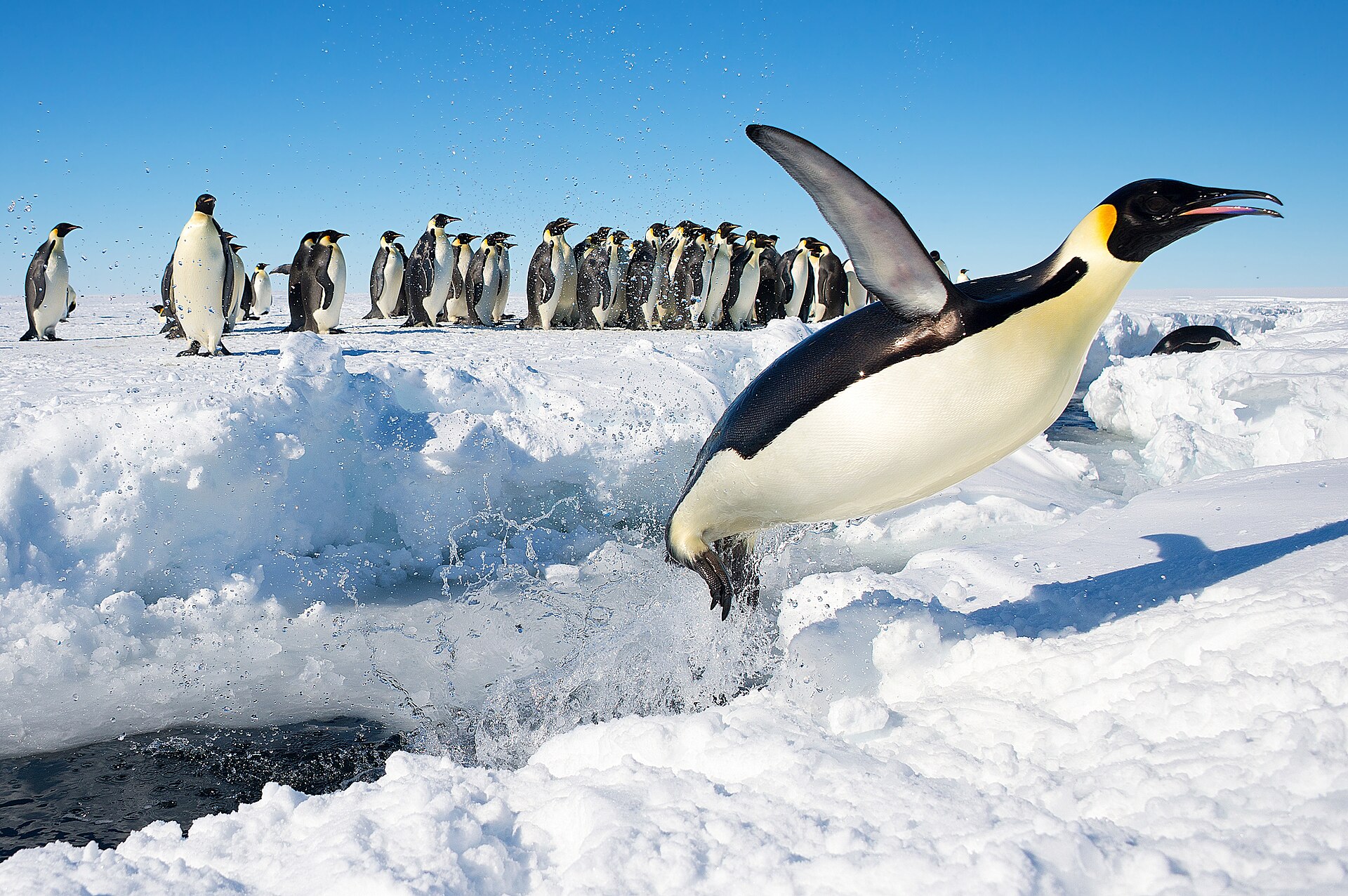
Emperor Penguin
Aptenodytes forsteri
Characteristics
Temperament
Social, gregarious, seasonally monogamous. Marches 50-120 km to inland colonies. Paternal incubation 65-75 days with total fasting up to 4 months. Forms rotating "huddles" for heat sharing.
Diet
Specialised marine predator: Antarctic krill, ice fish, squid. Hunts underwater up to 564 m depth and 22 min apnea. Up to 4 kg of food for chick per single trip.
The Emperor Penguin (Aptenodytes forsteri) is the largest of the 18 existing penguin species and one of the most iconic birds on the planet. Endemic to Antarctica, it is the only vertebrate that breeds during the Antarctic winter, facing temperatures down to -60 °C and katabatic winds of 200 km/h. Its social organisation, the march of hundreds of kilometres to breeding colonies and the extraordinary paternal incubation make it one of the most studied and admired animals in the world.
Classification and category
The Emperor Penguin belongs to the order Sphenisciformes, family Spheniscidae, genus Aptenodytes. The genus includes only two living species: the Emperor and the King Penguin (A. patagonicus), found instead on the sub-Antarctic islands. It is an exceptionally large bird for its family: standing height ranges from 110 to 130 cm, weight varies from 22 to 45 kg with marked seasonal dimorphism — males weigh up to 45 kg before the winter fast and drop to 22 kg after incubation. Females are slightly smaller.
Habitat and distribution
The Emperor Penguin's habitat consists exclusively of the coastal ice platform of Antarctica for breeding and the waters surrounding the Antarctic Ocean for feeding. Breeding colonies (about 60 known as of 2023) are generally located on fast ice, stable enough to support the long incubation and weaning season.
Distribution is limited to the Antarctic coasts and the main coastal glaciers of the Antarctic Peninsula. The global population is estimated at 270,000-280,000 breeding pairs (Census 2020, satellite count). Conservation status was upgraded to Near Threatened (NT) by the IUCN in 2012 and, recently, assessments are underway for upgrade to Vulnerable or Endangered: climate change is considered the main threat, because the loss of fast ice during the breeding season could lead to the collapse of 70% of colonies by 2100.
Diet
The Emperor Penguin is a specialised marine predator. Its diet consists mainly of Antarctic krill (Euphausia superba, up to 50% in some seasons), ice fish (Pleuragramma antarcticum) and squid. It hunts exclusively underwater, and is one of the most extraordinary swimmers in the animal kingdom: it can reach depths of over 500 metres (documented record 564 m) and stay underwater for up to 22 consecutive minutes, thanks to an extraordinarily slow metabolism during diving and blood with very high oxygen-holding capacity.
During the breeding season, the adult can travel up to 200-300 km from the colony to the open fishing area. Among hunting techniques, cooperative bubble-feeding is also documented: groups of penguins coordinate movements to concentrate krill schools. Energy requirements during rearing are enormous: a parent can bring up to 4 kg of food to the chick in a single trip.
Physical features
The Emperor Penguin has a sturdy, hydrodynamic body, with blue-black plumage on the back and white on the belly — the typical countershading colouring that camouflages it both from above (aerial predators such as skuas) and from below (marine predators such as orcas and leopard seals). On the nape and sides of the neck it has striking orange-yellow patches that fade to white on the chest, a distinctive trait of the species.
The beak is long (8 cm), thin and slightly curved, with an orange mandibular coloured band. The legs are short, webbed and positioned very far back on the body — excellent for swimming but awkward for walking, which is why the penguin moves by waddling or sliding on its belly (tobogganing). The plumage consists of three layers: outer waterproof horny feathers, intermediate insulating feathers and inner downy plumage; together they constitute the most efficient insulating system in the animal kingdom, capable of maintaining a body temperature of 38-39 °C in environments at -50 °C.
Behaviour and curiosities
The Emperor Penguin's breeding cycle is one of the most extraordinary in nature. In March-April (end of Austral summer), hundreds of thousands of adults leave the sea and march for 50-120 km towards inland colonies, where they form the famous huddle: a huge aggregation of thousands of individuals that crowd and rotate to share body heat, capable of raising the internal temperature of the group from -50 °C to +37 °C.
After mating (May), the female lays a single egg that she immediately transfers to the male, who incubates it for 65-75 days in the brood pouch above his feet, keeping it isolated from the ice. During this period the male fasts completely (up to 4 months without food, losing up to half of body weight). The female meanwhile returns to the sea, feeds and comes back at hatching time to feed the chick with regurgitated food — a feat of synchronisation between pairs that recognise each other uniquely by individual vocal call. Lifespan is 15-20 years in the wild, with records of 50 years in captivity. The famous documentary "March of the Penguins" (2005) brought the species to global fame.
Pros
- Specie iconica simbolo della conservazione polare
- Adattamento estremo al freddo unico nel regno animale
- Longevo (15-20 anni in natura)
- Comportamento riproduttivo straordinario
Cons
- Specie selvatica e protetta, NON è un animale da compagnia
- Near Threatened IUCN, possibile upgrade a Vulnerable
- Fragilità estrema dell'habitat antartico al cambiamento climatico
- Dipendenza totale dal ghiaccio marino fissato