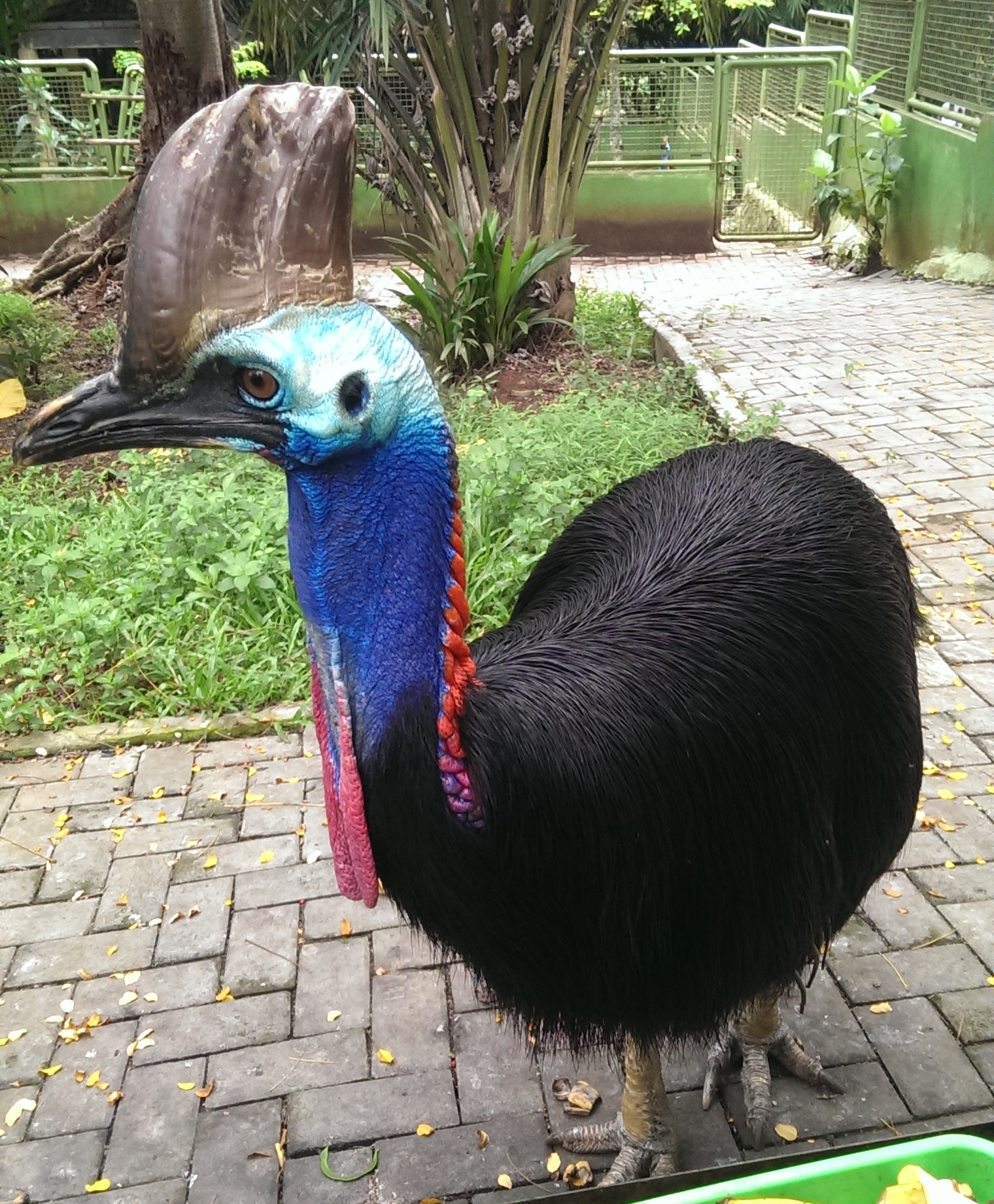
Southern Cassowary
Casuarius casuarius
Characteristics
Temperament
Solitary, territorial, diurnal. "MOST DANGEROUS bird in the world" — middle toe claw 12 cm, can kill man with kick. Unique bony casque. Females larger (dimorphism inversion, like Kiwi). MALE incubates 50-52 days + raises chicks 9-16 months alone. "Keystone species" of rainforest — disperses seeds of 250+ species. "Living dinosaur".
Diet
Specialist frugivore (90% diet). Eats over 250 species of tropical fruits, including some TOXIC to other animals (cyanides, glycosides). Very fast digestion (5 hours). Excreted seeds intact germinate far away — "keystone species" of rainforest. 3-4 kg fruits/day. Fungi 5%, insects/vertebrates 3-5%.
The Southern Cassowary (Casuarius casuarius), one of the three cassowaries (genus Casuarius), is a large flightless ratite bird endemic to the tropical rainforests of New Guinea and northeastern Queensland (Australia). It is often cited as "the most dangerous bird in the world" for its dagger-like claws (12 cm on the middle toe) and lethal kicks — 150+ human victims are documented in history, the last in 2019 (Florida, USA). Imposing measurements: height 1.5-2 m, weight 50-85 kg (females notably larger than males — sexual dimorphism reversal, as in the Kiwi). The plumage is shiny "hair-like" black (feathers lack barbules, similar to mammal hairs), in contrast with the bright blue bare skin of the head and two pendant red "wattles" from the neck. The most iconic feature is the "casque" — a bony crest covered with keratin growing on top of adults' heads, similar to a helmet. It is an important "keystone species" of Australian rainforests: it is the sole disperser of over 250 species of tropical trees (many whose fruits are too large for other birds). Survives thanks to its frugivorous diet (90% fruits). IUCN status: Least Concern (LC) globally but Vulnerable in Australia (sub-population, only 1,500-2,500 individuals). "Living dinosaur" species for its prehistoric appearance.
Classification and category
The Southern Cassowary belongs to the order Casuariiformes (cassowaries), family Casuariidae, genus Casuarius. The genus comprises 3 living species:
- Casuarius casuarius — Southern Cassowary (main species, subject of this entry)
- Casuarius unappendiculatus — Northern Cassowary (northern New Guinea, smaller casque, 1 single wattle)
- Casuarius bennetti — Dwarf or Bennett's Cassowary (New Guinea, nearby islands, ~1.5 m, no wattles)
Cassowaries are ratites, like ostriches, emus, rheas and kiwis. Phylogenetically they are most closely related to the Australian emu (Dromaius novaehollandiae) — the two separated about 30-35 million years ago in the late Eocene-Oligocene. The common ancestor of all ratites lived on the Gondwana super-continent ~80 million years ago. Cassowaries remained in tropical forests, while the emu adapted to arid Australian savannas.
Etymology: the name "cassowary" derives from the Malay-Papuan word "kasuari" or "kessuari" meaning "bird with casque". The first cassowary brought to Europe was a Southern Cassowary donated by the king of Java to Maurice of Nassau in 1597 — exhibited as a "curiosity" at the Amsterdam zoo. Linnaeus formally described the species in 1758 as "Struthio casuarius" (in the ostrich genus); reclassified in its own genus Casuarius by Brisson in 1760.
There are 3 recognised subspecies of C. casuarius:
- C. c. casuarius — Nominal subspecies (Aru Islands, south-eastern New Guinea)
- C. c. johnsonii — Johnson's Cassowary (north-eastern Queensland, Australia)
- C. c. sclaterii — Sclater's Cassowary (south-eastern New Guinea)
The morphological parameters:
- Height: 1.5-1.8 m (F record 2 m)
- Weight: F 58-85 kg (record 85 kg), M 29-55 kg (M is ~30% smaller than F!)
- Head-tail length: 1.3-1.7 m
- Casque (crest): 13-18 cm tall in adults, grows throughout life
- Legs: 3 toes per foot; the middle toe has a claw 10-12 cm long, sharp as a dagger
Longevity: 30-40 years in nature (exceptional for a terrestrial bird), up to 61 years in captivity (record). Sexual maturity: 3-5 years. Gestation → 50-52 days of incubation. Litter: 3-8 green eggs (record 12).
Habitat and distribution
The Southern Cassowary is a specialist of tropical rainforests. Ideal habitat:
- Primary rainforest: dense, tall, mature forest, with dense understorey layer
- Swamp forests: wetlands with water all year
- Gallery forests: along rivers
- Secondary tropical forests: to a limited extent, especially if rich in fruits
- Mangroves: occasional, in coastal Queensland
- Altitude: 0-1,500 m, rarely up to 3,000 m (New Guinea)
Does NOT tolerate: deciduous forests, open savannas, steppes, urban areas. Tropical rainforests are its obligate habitat — does not survive in altered habitats.
Geographical distribution:
- New Guinea: Papua New Guinea and Western Papua (Indonesia) — main population, estimated 50,000-100,000 individuals
- Aru Islands (Indonesia): sub-population
- Northeastern Queensland (Australia): "Wet Tropics" area (Daintree, Cape York), critical sub-population of 1,500-2,500 individuals (Vulnerable local IUCN)
Global IUCN status: Least Concern (LC) since 2017 (previously Vulnerable). Total estimated population: 50,000+ mature individuals. However, the Australian sub-population is particularly vulnerable due to:
- Habitat loss: historical deforestation of Queensland (60% of rainforests lost), today protected but fragmented
- Road accidents: main cause of adult mortality in Australia (15-20% annual). Roads through tropical forests cut cassowary corridors
- Feral dogs: predation on chicks
- Wild pigs: compete for fruits and destroy nests
- Cyclone Yasi (2011): Category 5 cyclone destroyed vast portion of habitat — 70% of adult cassowaries died of starvation in following months
- Climate change: alteration of fruit phenology, increase of extreme events
CITES: Appendix II. Conservation: the "Cassowary Recovery Project" (Queensland Parks) coordinates emergency feeding, "rescue & rehab" of injured individuals, population monitoring. "Cassowary Crossing" road signs and speed bumps in Daintree National Park.
Diet
The Cassowary is a specialist frugivore — 90% of the diet is composed of ripe fruits. One of the most fruit-dependent bird species in the world. Detailed diet:
- Tropical fruits: 90% of diet — over 250 documented species! Fruits of trees in the Lauraceae, Myrtaceae, Sapindaceae, Moraceae, Eleocarpaceae families. Most consumed fruits: quandong (Elaeocarpus), strangler fig (Ficus), cassowary plum (Cerbera floribunda — TOXIC to humans!)
- Fungi: 5% of diet
- Insects and small vertebrates: 3-5% of diet (occasional for proteins, especially during breeding season)
- Vegetation: leaves, sprouts, flowers (rarely)
Exceptional feature: the cassowary can eat fruits TOXIC to other animals. Species like Tagidakola and Cassowary Plum contain cyanides or glycosides that would kill a human being in a few hours. The cassowary has specialised liver enzymes to detoxify. Furthermore, its digestive system is very fast: food passes through the digestive tract in just 5 hours (compared to 24+ hours in similar mammals). This is important because:
- The cassowary consumes up to 3-4 kg of fruit per day
- Large seeds pass through the intestine intact, and are excreted
- Excreted seeds germinate outside the mother plant, far from diseases and competition — important ecological role
For this reason the cassowary is called "keystone species" of the rainforest: without its dispersal work, over 250 species of trees could not efficiently expand. The loss of the cassowary in an area causes ecological collapse of forest regeneration. A 2010 study (Westcott et al.) has shown that the "cassowary dependent flora" represents 20-30% of the biomass of some Australian forests.
Physical features
The Cassowary is a bird of prehistoric, intimidating appearance, often described as "living dinosaur" — indeed reflects its ancient origin. Extraordinary physical features:
Bony casque (crest) on the head:
- Bone-keratinised structure similar to a helmet
- Height 13-18 cm, grows gradually throughout life (age is estimated from the casque)
- DEBATED function: (1) sexual display — F with higher casque are dominant; (2) thermoregulation — internal blood vessels dissipate heat; (3) "crash helmet" for traversing dense forest at speed; (4) acoustic resonator for low-frequency calls (natural subwoofer)
- 2019 studies by Eastick et al. (Australian National University): thermal images show that the casque actively loses heat — support for thermoregulation theory
The plumage:
- Adults: long, thin, "hair-like" black feathers (no barbules) — they look like mammal hairs! Provide only insulation, not aerodynamics (no flight)
- Chicks: brown feathers with longitudinal black stripes (camouflaged among the leaves of the undergrowth)
- Juveniles: uniform brown feathers, casque begins to grow at 2-3 years
The head and neck:
- Bare skin: from the top of the skull to the neck
- Colour: bright blue on the head (more intense in males), red/orange at the neck, lilac-purple toward the shoulder
- Wattles: 2 lobes of red skin hanging from the neck (15-20 cm); communicative function, can change colour (redder when agitated)
- Beak: short, tall, black, robust — for tearing fruits
- Eyes: large, brown, frontal
The legs are the weapon of the cassowary:
- 3 toes per foot (characteristic of cassowaries, compared to 2 toes of ostriches and 4 of emus)
- Middle toe (II): straight claw, sharp as a dagger, length 10-12 cm
- Function: defensive weapon — a cassowary kick can eviscerate a man. The kick is lateral or frontal, delivered from the powerful legs
- Speed: 50 km/h in sprint (record for forest birds!)
- Jumps: up to 1.5 m vertical (can overcome obstacles and attack predators)
- Swimming: excellent, crosses rivers and lakes
The wings are vestigial: reduced, with stiff "stiletto" feathers (modified guard feathers) used as "hooks" to climb fallen branches. Not functional for flight.
Behaviour and curiosities
The Southern Cassowary is a solitary, territorial, diurnal animal. Except during reproduction, lives isolated. Territory: 1-7 km² per individual, marked with faeces and secretions from the supracaudal gland. Density is low (1-4 cassowaries/km²) — a cassowary needs a large area for its varied frugivorous diet.
Defensive behaviour: the cassowary is generally shy and timid — prefers to flee rather than fight. However, if it senses its offspring threatened (in particular the male with chicks), or if it is injured/trapped, it can attack with extraordinary ferocity:
- Intimidation display: puffs up the black feathers, emits deep sounds, shows the red wattles
- Warning vocalisation: low, deep growl (frequencies 23-26 Hz, sometimes below human hearing — one of the lowest calls among birds)
- Charge: lunges towards the target at 30-50 km/h
- Kick: jumps into the air 1-1.5 m high, delivers a frontal kick with the leg, the middle toe with 12 cm claw enters the target. Described as a "biological butcher"
- Pecking: if necessary, attacks with the short but strong beak
Human attack statistics: ~150 documented attacks since European discovery (1597), of which 2 fatal (1926 in Queensland and April 2019 in Florida, USA — specimen in private captivity). Most attacks are defensive when humans approach chicks or when the cassowary is regularly fed by tourists ("habituation" risk). In Australia, national parks warn visitors to keep a distance of 20+ m.
Reproduction is extraordinary. Season: May-October (austral winter-spring). Unique features:
- POLYANDRY: each female mates with 1-3 males per season (reverse polygamy — different from most birds)
- Female leaves the male: after laying eggs, the female abandons the male and goes to mate with another
- Only the MALE incubates: the male incubates the eggs for 50-52 days alone, rarely getting up (loses 25% of body weight during incubation)
- Only the MALE raises chicks: for 9-16 months! Fiercely defends the young
- Precocial chicks: born already with feathers, open eyes, can walk and follow the father a few hours after hatching
This is one of the most extreme parental cares among birds. Feature shared with other ratites (ostrich, emu, kiwi) — ratites have a tendency to male incubation.
Famous curiosities: the "most dangerous bird in the world". The Cassowary is officially considered the most dangerous bird in the world by Guinness World Records. Fatal attacks are rare (2 documented) but serious injuries are common. Famous attacks:
- 1926: 16-year-old boy, Mossman (Queensland) — first documented death. The injured cassowary defended itself
- 1989: Calabasas, California — tourist injured during zoo visit
- 2019: Florida (USA) — 75-year-old private owner killed by his captive cassowary while feeding it
Casque curiosity: the evolutionary significance of the casque is one of the most studied mysteries. The 4 main theories are:
- Thermoregulation: 2019 studies with thermal images show that the casque dissipates heat
- Sexual display: F with higher casque are dominant, choose smaller males
- "Crash helmet": protects the head when the cassowary runs in dense forest at 50 km/h
- Acoustic resonator: amplifies low frequency vocalisations (23-26 Hz, sometimes infrasounds) that can propagate km in the forest
Low frequency vocalisations curiosity: the cassowary emits sounds with frequencies between 23-26 Hz — close to infrasound (below 20 Hz is inaudible by man). These low frequencies propagate better through dense vegetation. Communication between cassowaries at distances of kilometres in the rainforest.
Green eggs curiosity: the cassowary lays unique green-blue eggs (12-19 cm, weight 600-650 g — among the largest in the avian world, second only to ostrich). The green colour is considered mimetic among the leaves of the undergrowth. The male incubates them in a ground nest (simple depression on leaf litter).
"Keystone species" curiosity: the cassowary is one of the very few birds to be considered "keystone species" — its presence/absence profoundly alters the ecological structure. Its local extinction causes a trophic cascade: the seeds of the 250 dependent species do not disperse, trees do not reproduce, the forest progressively changes. Swimming curiosity: the cassowary is one of the few ratites that swims well — has crossed 8-10 km channels between New Guinea islands (verified by ethological observations). It is supposed that historical migration between Aru Islands and Australia occurred via swimming in the Pleistocene era. "Living dinosaur" curiosity: the cassowary's appearance is extraordinarily similar to non-avian carnivorous dinosaurs (e.g. Velociraptor): powerful legs, sharp claws, posture, short beak. It is used as a living model in palaeontology to study behaviour of extinct dinosaurs. Footprints curiosity: the cassowary footprint in the rainforest is unmistakable — 3 well separated toes, evident claws, length 18-25 cm. Identical to fossil footprints of theropod dinosaurs. Commerce curiosity: the cassowary is rarely hunted (it's dangerous, and the meat is considered of inferior quality). Its feathers are however collected in some Papuan cultures for ritual ornaments. "Edinburgh Zoo cassowary" curiosity: in the Edinburgh Zoo (UK) lived the oldest documented cassowary — "Casanova", died in 1986 at 61 years old (absolute record for the species). Molecular biology curiosity: the cassowary genome was sequenced in 2017 (Cracraft et al.), showing specific genes for metabolism of toxic fruits (cyanides) and bone growth of the casque. Daintree National Park curiosity: the Daintree Rainforest (Queensland, Australia) is the "Cassowary Heartland" — protected area with the highest density of cassowaries in the world. Park roads are equipped with speed bumps and "Cassowary Crossing" signs. "3rd most popular zoo animal" curiosity: according to international surveys, the cassowary is among the 3 most popular animals to observe at the zoo (behind giant panda and tiger) — for its fascinating "prehistoric" appearance.
Pros
- Aspetto 'preistorico' affascinante — 3° animale più popolare nei zoo
- Keystone species: indispensabile alla foresta pluviale (250+ specie alberi dipendenti)
- Longevità eccezionale (40+ anni natura, record 61 in cattività)
- Maschio padre devoto — incuba e cresce pulcini da solo per 1,5 anni
Cons
- 'Uccello più pericoloso al mondo': artiglio 12 cm può uccidere
- Subpopolazione australiana Vulnerable (solo 1.500-2.500 individui)
- Dipendenza assoluta da foreste pluviali (no habitat alternativo)
- Vulnerabile a cicloni (Yasi 2011: 70% Casuari Queensland morti)