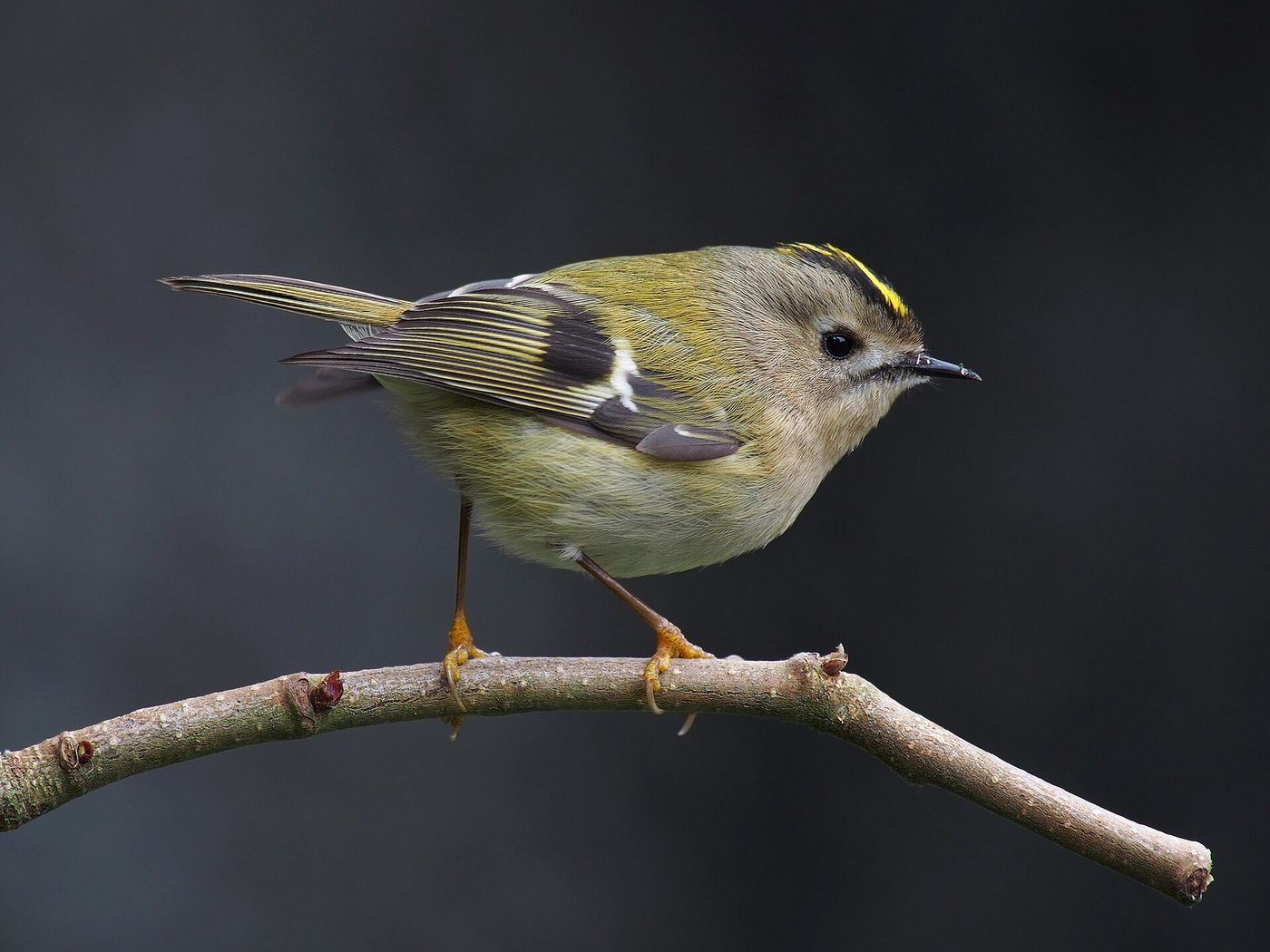
Photo: Francis C. Franklin · CC BY-SA 3.0
Goldcrest
Regulus regulus
The goldcrest is Europe's smallest bird, a tiny passerine with a vivid golden crest, a tireless dweller of conifer woods.
Characteristics
Temperament
Hyperactive, tireless, confiding
Diet
Insectivore: tiny insects and spiders
Description
The goldcrest is Europe's smallest bird, just 9 centimetres long and weighing only a few grams. It has a rounded little body, olive-green above and paler below, with two white bars on the wings. Its most striking feature is the stripe of yellow feathers (orange in the male) in the centre of the head, edged with black, resembling a small crown, hence its name, which means "little king".
Habitat and distribution
It occurs across much of Eurasia, with populations even on the Atlantic islands. It lives mainly in conifer woods, where it moves nimbly among the needles of firs and pines. Populations from the north and east migrate south in winter.
Behaviour
It is a hyperactive, tireless bird: given its very high metabolism, it must feed almost continuously so as not to run out of energy, a serious problem on cold winter nights. It feeds on tiny insects and spiders, which it seeks mainly under the branches. It utters a thin, very high-pitched song, at the limit of human hearing.
Did you know?
In European folklore the goldcrest is "the king of the birds": one legend tells that it won the contest to become king by hiding among the eagle's feathers and flying just a little higher. Despite its tiny size, some populations undertake surprisingly long migrations.
Conservation
It is classed as least concern. Populations can suffer sharp declines after particularly harsh winters, but recover quickly thanks to their high productivity.
(Note: the mass value given by Wikidata, 0.77 kg, is clearly wrong: the goldcrest actually weighs about 5–7 grams.)
Pros
- Europe's smallest bird
- Useful predator of tiny insects
- Confiding, allows close approach
Cons
- Vulnerable to very harsh winters
- Extreme metabolism, must feed constantly
- Very high-pitched song, hard to hear