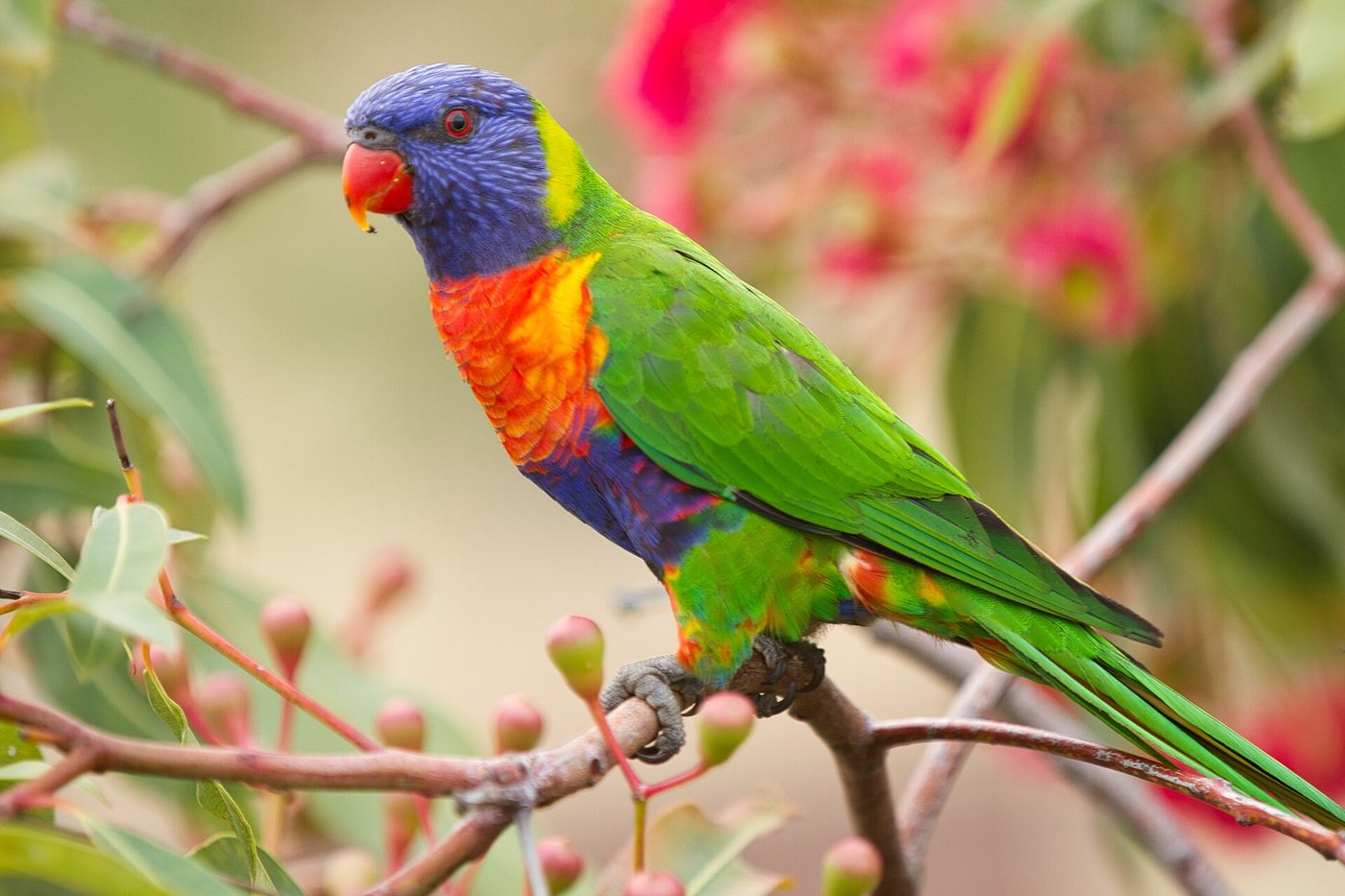
Rainbow lorikeet
Trichoglossus moluccanus
A parrot painted in every colour: noisy, lively and fitted with a brush-tipped tongue, the rainbow lorikeet lives on nectar among the flowering trees of Australia.
Characteristics
Temperament
Extremely social, noisy, playful and curious. It lives in lively flocks; it has adapted to urban environments and shows great liveliness and intelligence.
Diet
Nectarivore: nectar and pollen gathered with its brush-tipped tongue, as well as fruit, berries and occasionally insects.
A riot of colour
The rainbow lorikeet is one of the most spectacular and colourful parrots in the world. Its head is deep blue, its collar green-yellow, its breast orange and red, its belly dark blue and its wings a brilliant green: a true rainbow of feathers. It is a medium-sized bird, agile and noisy, living in the forests, parks and gardens of eastern Australia, where it is a common and very lively presence.
A brush-tipped tongue
Unlike most parrots, which crack seeds with a strong bill, the rainbow lorikeet has specialised in a diet of nectar and pollen. For this its tongue is fitted at the tip with tiny papillae like the bristles of a brush, with which it gathers nectar from flowers. It also feeds on fruit, berries and occasionally insects. Moving among the flowering trees, it plays an important role in pollination.
Noisy, social birds
The rainbow lorikeet is extremely social and noisy. It lives in lively flocks that move from tree to tree in search of flowering plants, filling the air with screeches and chatter. It is also very playful and curious, and in some Australian cities it has grown used to the human presence, even coming to be fed in gardens and parks.
In a cage and in the wild
For its splendid colours and lively character, the rainbow lorikeet is popular too as an aviary bird, but it requires particular care, space and a specific nectar-based diet, very different from that of other seed-eating parrots. It is not an animal suited to those looking for an undemanding bird.
Conservation
The rainbow lorikeet is classified as least concern and its populations are abundant and in good health across much of its range. Its adaptability and its ability to exploit urban environments make it a very successful bird, one of the most colourful and recognisable faces of Australian wildlife.