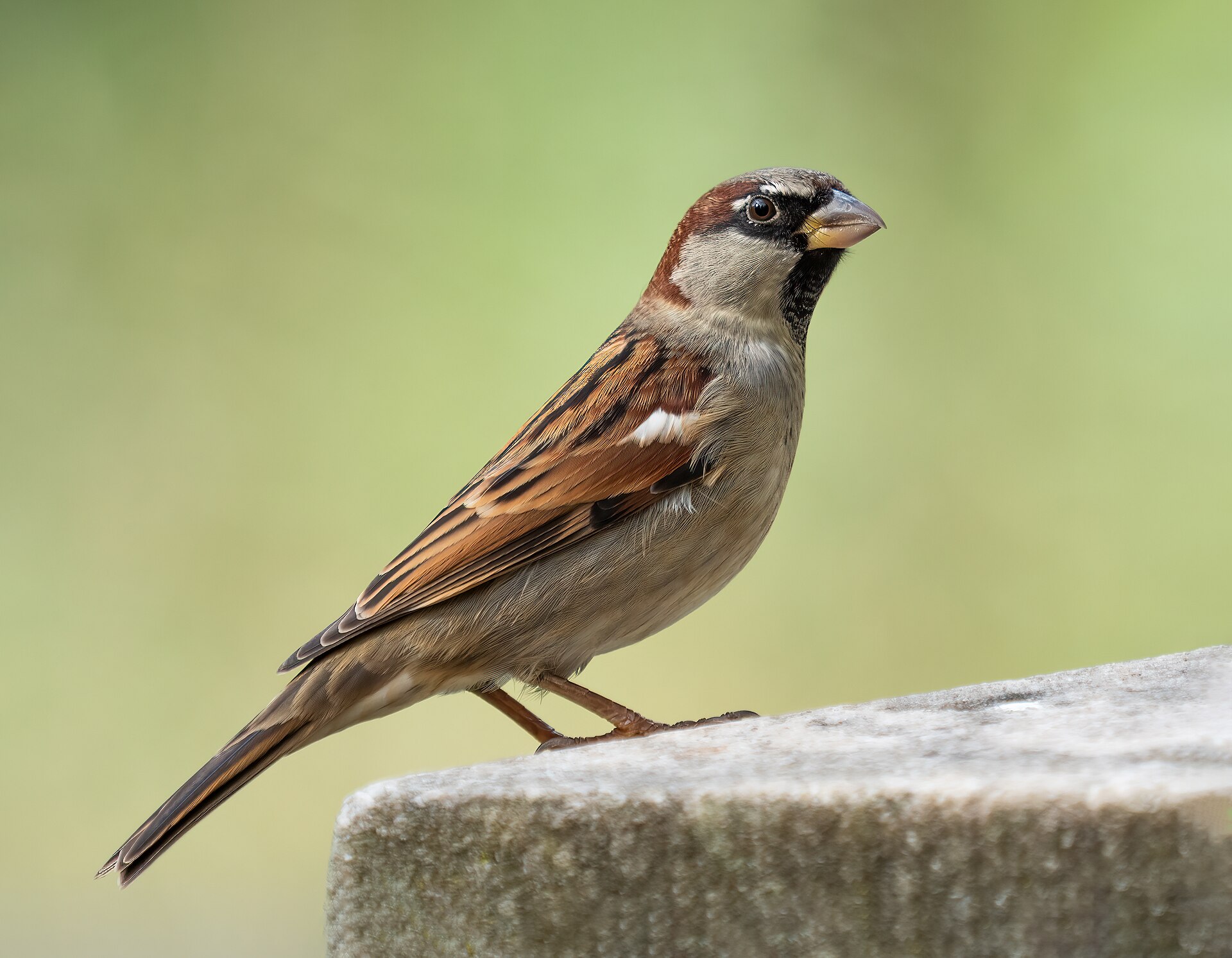
House Sparrow
Passer domesticus
Characteristics
Temperament
A small, lively and extremely social wild bird, a commensal of humans since time immemorial. It is NOT a cage bird, but a free passerine that lives in noisy communities in towns, countryside and gardens. It is alert, opportunistic and confident, used to exploiting food and shelter offered by humans; it moves on the ground in hops and loves dust baths. It almost always lives in a flock, where group life offers safety and information about food. Although one of the most common and adaptable birds in the world, in many cities it is declining: a small, tireless companion of our daily life that nonetheless deserves attention and respect.
Diet
Omnivorous and very opportunistic, with a diet based mainly on seeds and grains (hence the stout conical beak), supplemented by insects and other invertebrates, essential for feeding the chicks in the nest. In urban environments it exploits with great skill crumbs, scraps and human food, as well as shoots, berries and small fruits. It seeks food in flocks, where many eyes help locate resources and predators. Characteristic is the change of diet with age: adults eat mainly seeds, while chicks are fed with protein-rich insects. This flexibility underlies its enormous success.
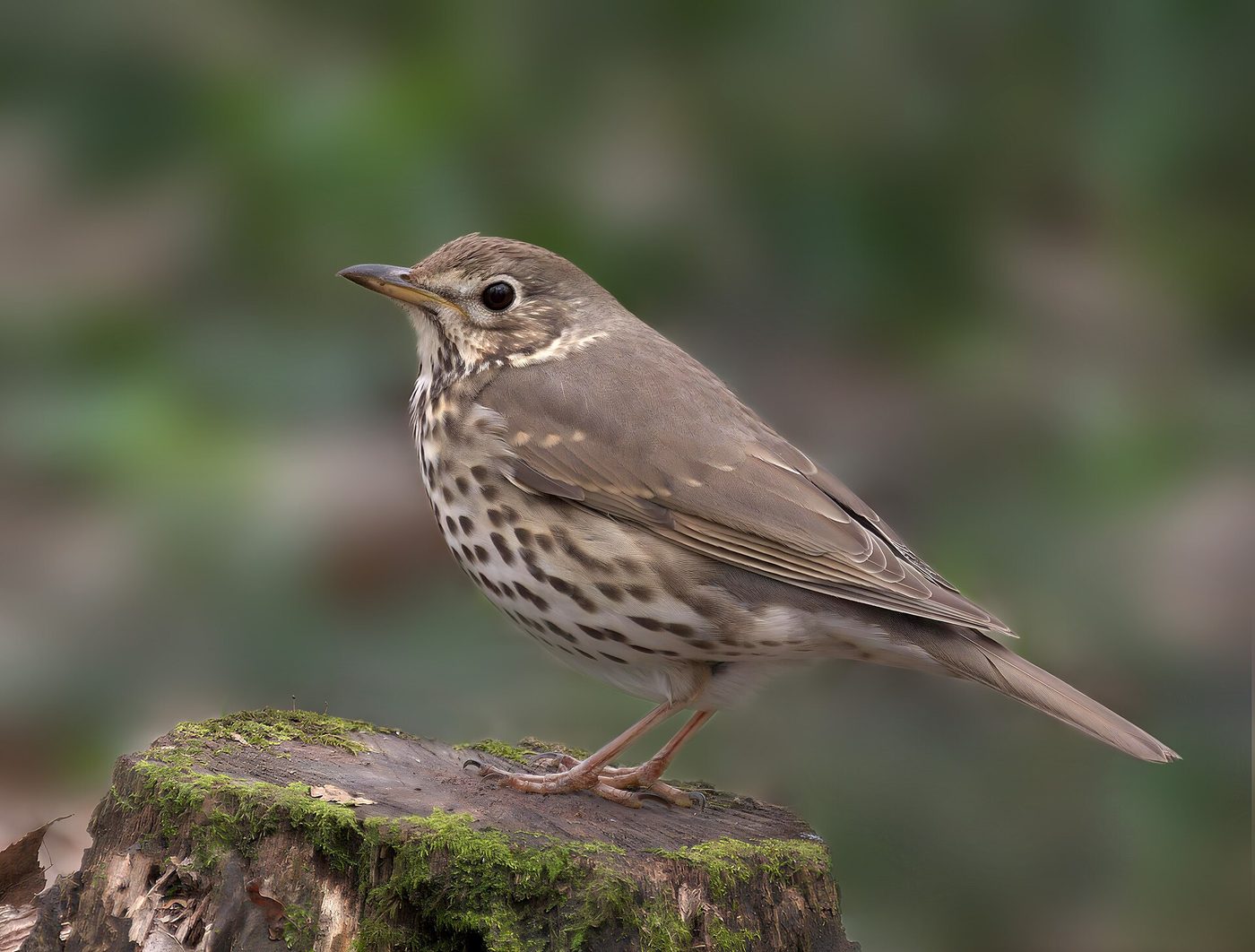
The House Sparrow (Passer domesticus) is probably the best-known and most widespread wild bird on the planet: a small passerine that has accompanied human life for millennia. Familiar to everyone for:
- The bond with humans: it almost always lives near dwellings, in towns and cities
- The black "bib": the male has a striking black patch on throat and breast
- The grey crown: the male has a grey crown and a chestnut-brown nape
- The sociability: it lives in noisy communities, always in the company of other sparrows
- The chirping: its insistent "cheep cheep" is one of the most familiar sounds of our towns
- The worldwide spread: present almost all over the world, even where it has been introduced
IUCN status: Least Concern (LC) globally, although it is declining in many cities. It enters the portal among the passerines, alongside the Goldfinch, Great Tit, Blackbird and Robin: with them it enriches the group of small familiar birds, and is perhaps its most universal representative, the one everyone has seen at least once.
Classification and category
The House Sparrow belongs to the order Passeriformes (the passerines), family Passeridae (the true sparrows), genus Passer. The species is Passer domesticus. In the portal it is placed among the passerines, alongside the other small garden and city birds. It is useful to tell it apart from some similar species with which it can be confused: the Eurasian tree sparrow (Passer montanus) — very similar, but with an entirely chestnut-brown crown and a black spot on the white cheek; in the male house sparrow the crown is instead grey; the Italian sparrow — a form typical of Italy, in which the male has a chestnut-brown crown; the female sparrow — a uniform, drab brown, it may recall other small brown birds, but it has the characteristic stout conical beak. The combination, in the male, of grey crown + black bib + streaked brown back + conical beak is the house sparrow's "identity card". Etymology: the scientific name domesticus ("domestic", "of the house") underlines precisely this bird's close bond with dwellings and human environments. Parameters: Length about 14-16 cm. Weight about 24-40 g. Appearance a small, sturdy, compact passerine, with a conical beak suited to seeds. Longevity: in the wild it lives on average about 3 years, but can exceptionally exceed 10. Reproduction: extremely prolific, it nests in cavities and crevices (roofs, gutters, holes in walls, nest boxes) with several broods a year.
Habitat and distribution
The House Sparrow is a commensal species of humans, and its enormous success is closely tied to our presence: its origin is native to Eurasia and North Africa; its distribution is now almost worldwide, even in the Americas, Australia and elsewhere where it has been introduced by humans; it is missing only where humans do not reach. Preferred habitats — almost always tied to human settlements: cities and towns (squares, streets, roofs, gardens and urban parks); countryside and farms (farmhouses, barns, yards and fields); and human-altered environments in general, where it finds food and nesting sites. It is a resident, diurnal and extremely social bird. It almost always lives in groups, in noisy communities that gather on hedges, bushes and ledges, chirping continuously. It moves on the ground with characteristic hops and loves to take dust and water "baths". Its life is marked by closeness to humans, whose dwellings, food and waste it exploits. IUCN status: Least Concern (LC): globally the sparrow remains one of the most abundant birds. However, in many large European cities its populations are in marked decline, for causes not fully clear but probably linked to the disappearance of nesting sites (modern buildings without crevices), the reduction of green areas and insects, and pollution. The decline of the sparrow in cities has become a matter of concern for environmentalists, a symbol of how even the most common species can suffer from environmental change.
Diet
The House Sparrow is omnivorous and very opportunistic, with a diet based mainly on plants but supplemented with animal proteins. It feeds on: seeds and grains (the main component of the diet, hence the stout conical beak); insects and other invertebrates (important above all for feeding the chicks in the nest); crumbs, scraps and human food (it exploits with great skill the resources offered by cities); and shoots, berries and small fruits. Features of its feeding behaviour: an urban opportunist (it has perfectly adapted to exploit human-related food, from cultivated fields to crumbs in cafés and parks); group foraging (it seeks food in flocks, where many eyes help locate resources and predators); and a diet that changes with age (adults eat mainly seeds, but the young are fed with protein-rich insects). It is precisely this extraordinary dietary flexibility, together with sociability and the ability to live alongside humans, that has made the sparrow one of the most successful birds in the world.
Physical features
The House Sparrow is a small, sturdy, compact bird, familiar to everyone. The male — more colourful and recognizable: a grey crown on the top of the head, with a chestnut-brown nape; a black bib on throat and breast (whose extent signals social rank); pale cheeks and a brown back streaked with black. The female and young: a brown, drab colouration, more uniform; a pale eyebrow behind the eye, useful for identification; absence of the black bib. The common traits: a compact, rounded body, with brown wings; a stout conical beak, perfect for opening seeds; short legs, suited to the characteristic hops on the ground.
Curiosities and conservation
The House Sparrow is a bird so common that it is often ignored, yet it is one of the oldest and most faithful companions of human life, a familiar presence that accompanies our days with its cheerful chirping.
The human's bird: the house sparrow is one of the species most closely tied to human beings; it has followed humans in their expansion, thriving wherever villages and cities arose; its very scientific name, domesticus, underlines its nature as a "house bird"; few wild animals share our spaces so intimately. The bib that counts: the black patch (the "bib") on the males' breast is not just an ornament; its size is a signal of the individual's social rank: males with a larger, more marked bib tend to be more dominant; it is an example of how a plumage detail can convey important information within the group. The global traveller: native to Europe, Asia and North Africa, the sparrow has been introduced by humans to many other parts of the world, from the Americas to Australia, where it has spread with great success; today it is one of the most cosmopolitan birds on the planet, present in almost every inhabited country. Group life: the sparrow is an extremely social bird; it lives, eats, shelters and takes dust baths in company, forming noisy, close-knit flocks; this sociability offers numerous advantages: more eyes to spot predators, sharing of information about food and greater safety. The silent decline: however incredible it may seem for such a common bird, in many large European cities sparrows have become much rarer than a few decades ago; this "silent decline" has surprised scientists and turned an ordinary bird into a symbol of the fragility of urban ecosystems: if even the sparrow disappears, it means something in our cities no longer works as before. Conservation: globally the house sparrow is classified as Least Concern and is still very abundant; however, the marked decline recorded in many urban areas is a reminder not to take it for granted; maintaining green areas, hedges and bushes in cities, reducing the use of pesticides (which reduce the insects needed by the chicks) and offering nesting sites (such as nest boxes and crevices) are simple measures that can help this small, tireless companion of our cities not to disappear from our lives.
Pros
- Uccello familiare e inconfondibile, presente in tutto il mondo
- Vivace, sociale e di grande interesse per il birdwatching cittadino
- Facile da osservare e da aiutare con mangiatoie e cassette nido
- Simbolo della natura che convive con l'uomo nelle città
Cons
- È un uccello selvatico e libero, NON un animale da gabbia
- In marcato declino in molte città europee, nonostante l'abbondanza globale
- Molto rumoroso e gregario: vive in chiassosi stormi
- Dove introdotto può competere con specie autoctone