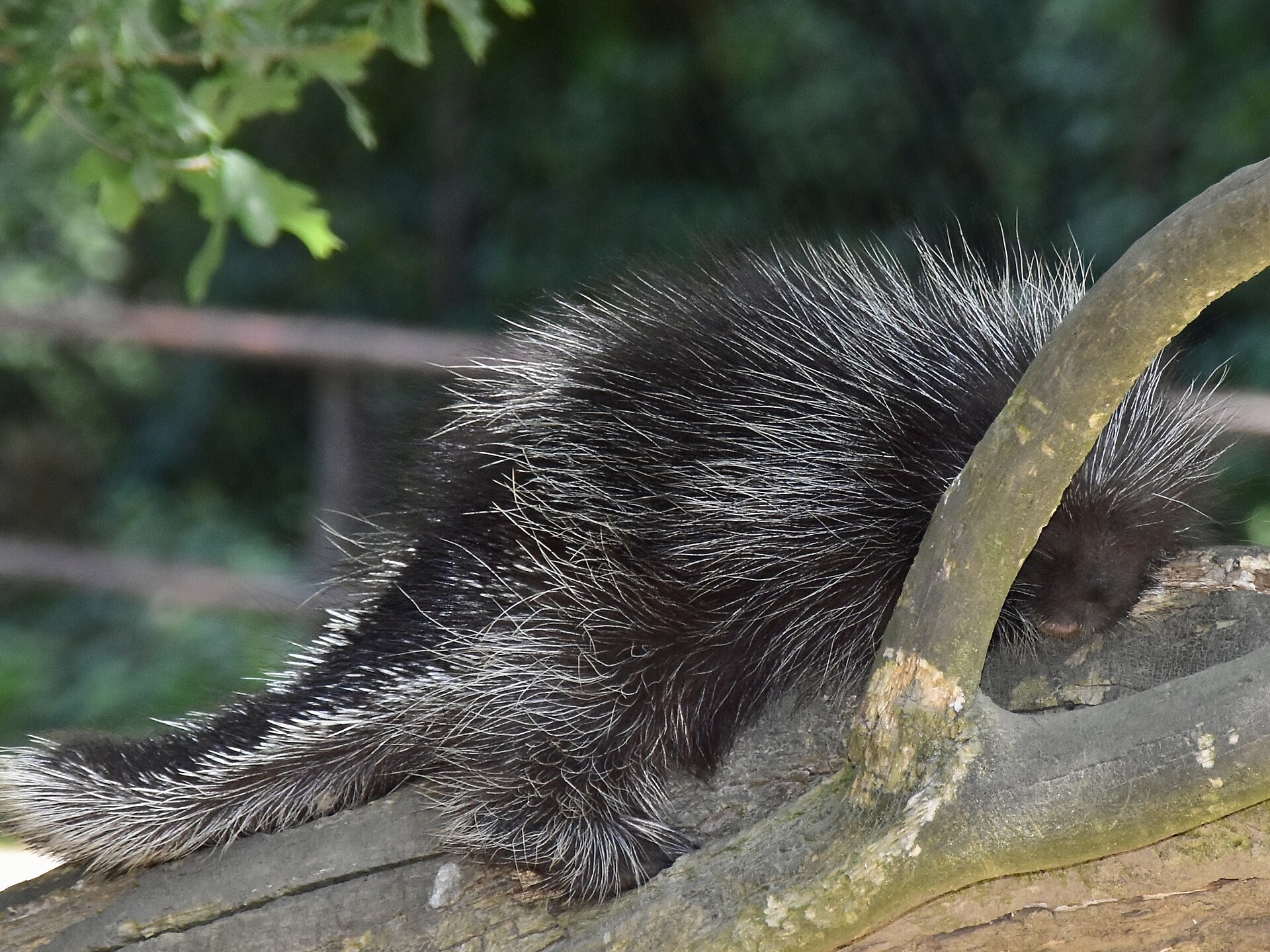
North American Porcupine
Erethizon dorsatum
Characteristics
Temperament
A peaceful, slow, solitary and mainly nocturnal wild rodent, NOT a pet. Its whole life strategy is based on the passive defence offered by its quills: not needing to flee quickly, it moves calmly and methodically, confident in its armour of spines. It is not aggressive and does not seek confrontation: when threatened, it simply turns its back and quill-covered tail toward the attacker. It is a skilled climber that spends much time in trees. It should be respected and observed from a distance: touching or attacking it means getting painful barbed quills. It is a calm, well-defended symbol of North American forests.
Diet
A herbivore with a strongly seasonal diet: in summer leaves, buds, shoots, herbs, flowers and small fruits; in winter above all inner bark and conifer needles, when the rest is scarce, plus twigs and soft wood gnawed with the sturdy incisors. By stripping bark from branches and trunks it can damage trees. It has a very strong need for sodium (the famous "salt hunger") that drives it to gnaw tool handles and objects impregnated with human sweat. Thanks to its ability to feed on bark and needles it stays active all year, without migrating or hibernating.
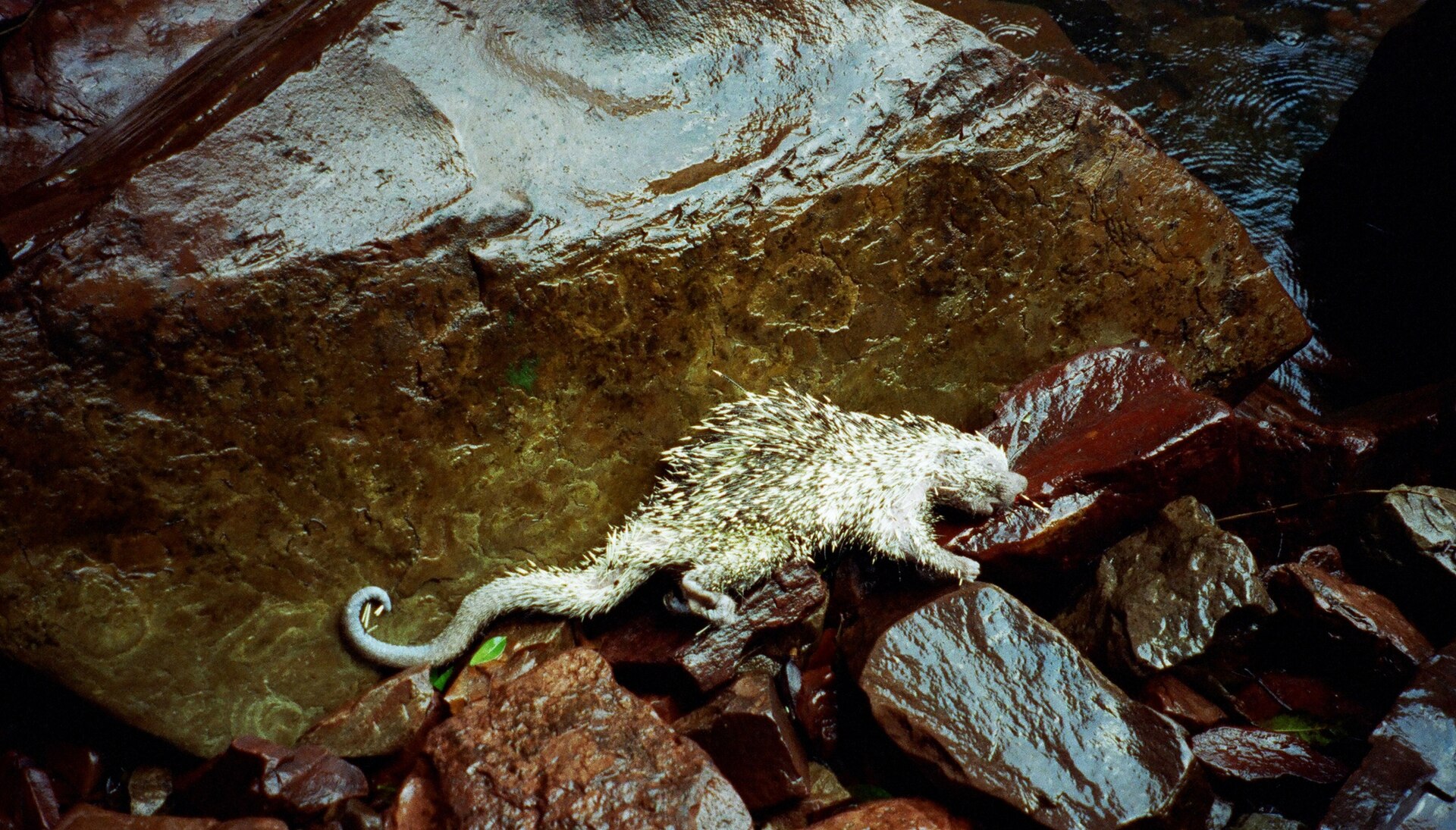
The North American Porcupine (Erethizon dorsatum), also known as the urson, is a large quill-covered rodent, among the most characteristic animals of North American forests. It is the second-largest rodent on the continent, after the beaver. Unmistakable for:
- The quills: tens of thousands of spines, modified from hair, with barbed tips
- The "passive" defence: it does not throw its quills (a myth), but turns its back and quill-covered tail toward the attacker
- The arboreal life: it is a skilled climber and spends much time in trees
- The considerable size: a stocky, heavy body, that of a large rodent
- The slow, solitary character: it moves calmly, confident in its armour of spines
- The herbivorous diet: bark, twigs, conifer needles, buds and leaves
IUCN status: Least Concern (LC). It enters the portal among the New World rodents, alongside the Coendou, Agouti, Paca and Viscacha. Together with the Crested Porcupine (the Old World porcupine) and the Coendou (the Neotropical tree porcupine) it completes the portal's porcupine trio, representing the three great lineages of spiny rodents in the world.
Classification and category
The North American Porcupine belongs to the order Rodentia, family Erethizontidae (the New World porcupines), genus Erethizon. The species is Erethizon dorsatum. In the portal it is placed among the New World rodents. It is important to tell it apart from the portal's other spiny animals, with which it can be confused: the Crested Porcupine (Hystrix cristata) — an Old World porcupine, terrestrial, with very long black-and-white banded quills; it does not climb and belongs to a different family (Hystricidae); the Coendou — also a New World porcupine, but Neotropical, with a characteristic prehensile tail and shorter quills; the North American porcupine has more "woolly" quills mixed with the hair and a non-prehensile tail; the hedgehog (not present among the rodents) — NOT a rodent or a porcupine, but a small insectivore with short spines that rolls into a ball; the North American porcupine is much larger, is a rodent and does not roll up. The combination of large size + quills mixed with woolly hair + arboreal habits + North American distribution is the North American porcupine's "identity card". Etymology: the scientific name dorsatum refers to the quill-covered back; the name "urson" comes from Canadian French. Parameters: Body length about 60-90 cm, including the tail. Weight usually about 5-14 kg, with sturdy individuals exceeding 10 kg. Appearance a stocky, massive rodent, with an arched back covered in spines. Longevity: remarkable for a rodent — in the wild it can live about 15-18 years, and even longer in captivity. Reproduction: after a gestation long for a rodent, usually a single, relatively developed young is born, with soft quills that harden within a few hours.
Habitat and distribution
The North American Porcupine is a North American species, very adaptable: its range covers much of North America, from Canada and Alaska to the northern and western United States, and part of Mexico. Preferred habitats — above all wooded environments, but not only: coniferous and mixed forests, its preferred environment; broadleaf woods and wooded areas; and also tundra, grasslands and semi-desert areas at the edges of its range, showing great adaptability. It is a mainly nocturnal, solitary and slow animal. An excellent climber, it spends much of its time in trees, where it seeks food and rests; on the ground it moves with a clumsy, calm gait. It does not truly hibernate, and in winter it stays active, feeding mostly on bark and conifer needles. Its whole life strategy is based on the passive defence offered by the quills: not needing to flee quickly, it can afford to be slow and methodical. IUCN status: Least Concern (LC): it is a widespread, globally unthreatened species. Locally it can come into conflict with humans, because by gnawing bark it can damage trees, and it is attracted to salt, to the point of gnawing objects impregnated with sweat (tool handles, etc.). Its main natural predators are few and specialized, such as the fisher (a marten), able to attack it from the quill-free belly.
Diet
The North American Porcupine is herbivorous, with a diet that changes greatly with the seasons: in summer (leaves, buds, shoots, herbs, flowers and small fruits); in winter (above all inner bark and conifer needles, when the rest is scarce); and twigs and soft wood, gnawed with the sturdy incisors. Features of its feeding behaviour: a bark eater (in winter it strips bark from branches and trunks, leaving recognizable marks; for this reason it can damage trees); a salt lover (it has a strong need for sodium and seeks salt sources, even gnawing tool handles, objects and structures impregnated with human sweat); and a feeding climber (it reaches the highest parts of trees to feed on buds and needles). Crucially, its ability to use bark and conifer needles as winter food lets it stay active all year, even in the harsh North American winters, without having to migrate or hibernate.
Physical features
The North American Porcupine is an unmistakable rodent, a true "walking fortress" of quills. The quills — the distinguishing trait: tens of thousands of quills (modified hairs) cover the back, flanks and tail; barbed tips (the quills have microscopic barbs that make them embed and very hard to remove, indeed tending to penetrate deeper); mixed with long, woolly hair, especially in winter. The body: a stocky, heavy build, with an arched back; a quill-free belly, its only real weak point; strong legs with curved claws, suited to climbing, and a muscular tail used as support. The head: a stocky, rounded muzzle, with small eyes and ears; sturdy, continuously growing incisors, typical of rodents, orange in colour.
Curiosities and behaviour
The North American Porcupine is an animal as peaceful as it is well defended, whose slow, solitary habits have given rise to numerous curiosities and some tenacious legends.
The myth of "thrown" quills: it is often said that porcupines "throw" their quills at enemies, but this is false; the quills cannot be hurled: they simply detach very easily at the slightest contact and remain embedded in the attacker; when threatened, the porcupine turns its back to the enemy, raises its quills and strikes with its spiny tail: the attacker ends up "collecting" the spines itself. The barbed quills: the quills are not smooth, but have tips covered with microscopic barbs, like tiny hooks; once embedded in a predator's skin, these barbs make them very painful and very hard to remove, and with muscle movements they even tend to penetrate ever deeper; it is a formidable defence that few predators can get around. The specialized enemy: despite its armour of spines, the porcupine has a fearsome predator: the fisher; this agile mustelid has learned to attack it repeatedly on the face and flip it over to strike its belly, the only part without quills; it is one of the few animals able to prey regularly on porcupines. The hunger for salt: the North American porcupine has a very strong need for sodium; this "salt hunger" drives it to gnaw the most unexpected objects impregnated with human sweat: axe and tool handles, oars, saddles, and even wooden or rubber parts of cabins and vehicles. The porcupine trio: the North American porcupine, the crested porcupine and the Coendou represent three different evolutionary lineages of spiny rodents; the crested porcupine is an Old World porcupine (Africa, terrestrial); the Coendou and the North American porcupine are New World porcupines (American, arboreal); similar quills evolved independently are a fine example of convergent evolution: the same "spiny solution" found by different groups. Behaviour and relationship with humans: peaceful, slow and not at all aggressive, the North American porcupine does not seek confrontation and relies entirely on its passive defence; it rarely poses a danger to humans, provided it is not touched or frightened; dogs that attack it, however, often end up at the vet with a muzzle full of quills; it is a fascinating animal, a symbol of North American forests, reminding us that in nature patience and good armour can be worth more than speed.
Pros
- Roditore inconfondibile e ben difeso, simbolo delle foreste nordamericane
- Difesa passiva geniale: aculei uncinati che scoraggiano quasi ogni predatore
- Longevo per un roditore e molto adattabile (foreste, tundra, semideserti)
- Completa nel portale il 'terzetto degli istrici' (con Istrice e Coendou)
Cons
- È un animale selvatico, NON un animale da compagnia
- Gli aculei uncinati possono ferire gravemente cani e curiosi imprudenti
- Rosicchiando la corteccia può danneggiare gli alberi
- La 'fame di sale' lo porta a rovinare attrezzi e oggetti impregnati di sudore