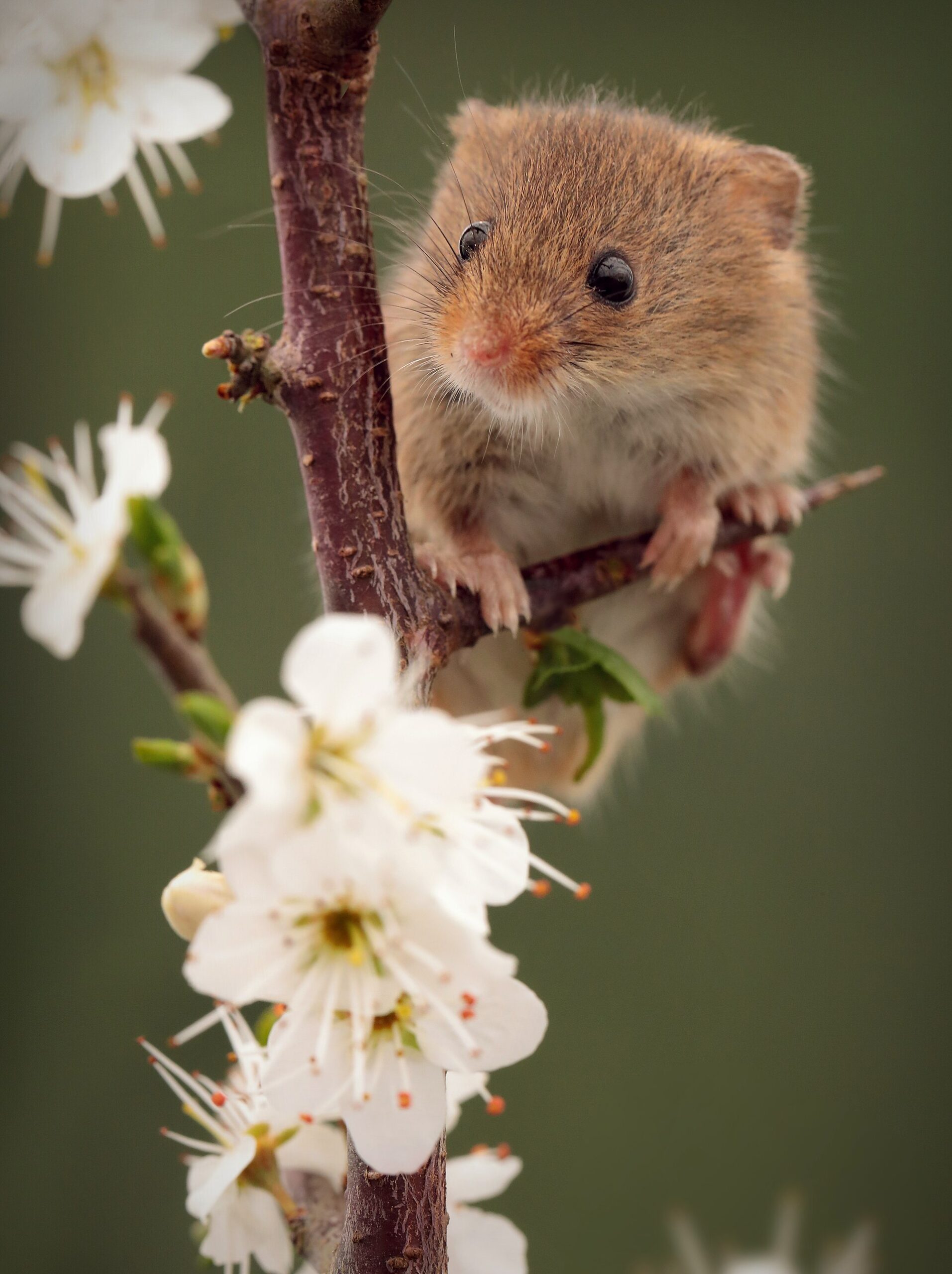
Harvest Mouse
Micromys minutus
Characteristics
Temperament
A tiny wild rodent, shy, nimble and active mainly at dusk and night. It lives an almost entirely "vertical" life among the stalks of tall grass, climbing with great ease thanks to its prehensile tail used as a fifth limb. It is a tireless builder: it weaves a refined spherical nest suspended among the grasses. It is NOT a pet: it is native wildlife, to be observed and safeguarded in its environment, which can be helped by preserving hedgerows, grassy strips, reedbeds and uncultivated field edges.
Diet
A granivore and opportunistic omnivore: it feeds mainly on the seeds and grains of cereals and wild grasses, as well as berries, shoots and tender leaves, supplementing with small insects in spring-summer. It feeds by climbing among the stalks, reaching ears and flowerheads in mid-air thanks to its prehensile tail and very low weight, which let it exploit the tall vegetation other mice cannot reach. In cultivated areas it makes use of cereals and grain, hence the harvest-related names.
The Eurasian Harvest Mouse (Micromys minutus) is one of the smallest and most fascinating rodents in the world: the smallest rodent in Europe, a tiny acrobat that lives suspended among the stalks of tall grass. Famous for:
- The minimal size: it is the smallest European rodent, weighing just a few grams
- The prehensile tail: it uses it as a fifth limb to grip the stalks
- The spherical woven nest: a masterpiece woven among the grasses, suspended above the ground
- Life "in the vertical": it moves nimbly in the "stalk zone" of grasses and cereals
- The russet coat: a rust-coloured back and a white belly
- The bond with fields and wetlands: rice paddies, reedbeds, meadows and hedgerows
IUCN status: Least Concern (LC) globally, but locally declining. It enters the portal among the murines, alongside the house mouse, the wood mouse and the brown rat: with them it shares the family, but it stands apart for its tiny size and its extraordinary grass-climbing lifestyle.
Classification and category
Order Rodentia, family Muridae, subfamily Murinae (the Old World mice and rats). The species is Micromys minutus, the only one of its genus. In the portal it is placed among the murines. It is useful to tell it apart from the other small mice with which it shares its habitats: the wood mouse (Apodemus), also in the portal — larger, with bigger eyes and ears, a non-prehensile tail and more terrestrial habits; the house mouse (Mus musculus) — greyish, tied to human environments, without the harvest mouse's "stalk" specialization; the dormice and other glirids (such as the edible dormouse, in the portal) — arboreal and with a bushy tail, of an entirely different family. The trait that immediately identifies the harvest mouse is the combination of tiny size + prehensile tail + life among the stalks: no other European mouse climbs like this. Etymology: the genus name "Micromys" means "small mouse" and the species "minutus" ("minute") emphasizes its smallness; the English "harvest mouse" and the Italian "delle risaie" (of the rice paddies) recall the bond with cereal fields and rice paddies. Parameters: Head-body length just 5-7 cm. Tail nearly as long as the body (5-7 cm), prehensile. Weight very little, roughly 5-11 g (among the lightest mammals). Longevity: very short in the wild, often only 6-18 months due to high mortality; in captivity it can live a little longer. Reproduction: it builds the famous spherical nest to rear its young.
Habitat and distribution
The harvest mouse is widely distributed across the Palearctic: its range runs from Europe across temperate Asia to East Asia (China, Japan). In Italy it is present in suitable environments, such as the rice paddies and wetlands of the Po plain. Preferred habitats — the "stalk zone" of tall, damp grassy environments: rice paddies, cereal fields (wheat, rice) and tall-grass meadows; reedbeds, rush beds and wetland margins; and hedgerows, fallow land and field edges with dense vegetation. This mouse occupies a special niche: it lives mainly among the stalks, in mid-air, in that band of tall vegetation where few other mammals are so at ease. It is active mainly at dusk and night, but also by day. Its survival depends on the presence of tall, undisturbed grassy vegetation: for this, intensive agriculture, early harvesting and the loss of hedgerows and uncultivated edges can greatly reduce its populations. IUCN status: Least Concern (LC) globally, thanks to its wide range, but in many European areas it is considered in local decline and is of conservation interest, because it is tied to increasingly rare traditional farmland.
Diet
The harvest mouse is essentially a granivore and opportunistic omnivore, adapted to feeding among the vegetation. It feeds on: seeds and grains (of cereals and wild grasses, the basis of the diet); berries and plant parts (shoots, flowers, tender leaves); and small insects (an important protein supplement, especially in spring-summer). Feeding habits: it feeds among the stalks (it reaches ears and flowerheads by climbing, often in mid-air, gripping with paws and tail); it is nimble and extremely light (its minimal weight lets it move on thin stalks that would not support a larger mouse); and it makes use of the fields (in cultivated areas it exploits cereals and grain, hence the names linked to the "harvest"). Crucially, the extreme lightness and the prehensile tail let the harvest mouse exploit an almost exclusive resource — the seeds and insects of the upper part of the grassy vegetation — reducing competition with larger, ground-bound mice.
Physical features
A masterpiece of miniaturization, perfectly adapted to life among the stalks. The size and the tail — the distinguishing traits: a tiny body (5-7 cm) and a weight of a few grams: the smallest rodent in Europe; a prehensile tail, nearly as long as the body, used as a fifth limb to grip and balance. The coat and the muzzle: a russet-rust back, white underparts, a sharp separation between the two colours; a rounded, blunt muzzle, with small hairy ears; and small eyes compared to other mice, of an animal that moves through dense vegetation. The adaptations: paws suited to gripping, with which it grasps the stalks; extreme lightness, which lets it climb grass blades and ears; and great agility in climbing vertically and upside down.
Behaviour and curiosities
The harvest mouse is a shy animal, active mainly at dusk and night, with a life almost entirely "vertical", spent among the stalks of tall grass. Its smallness and its habits make it hard to observe, but deeply fascinating.
The smallest rodent in Europe: with its few grams of weight and 5-7 cm of body, the harvest mouse holds the record as the smallest rodent on the continent; it is so light that it can climb a single grass stalk or an ear of cereal without bending it too much: an impossible feat for mice even a little larger. The tail as a "fifth paw": the harvest mouse's long tail is prehensile, that is, able to wrap around and grip the stalks; it constantly uses it as a fifth limb to climb, balance and anchor itself while reaching seeds and insects among the vegetation; it is a rare adaptation among European mice and one of the keys to its acrobatic lifestyle. The spherical nest: perhaps the harvest mouse's most famous trait is its breeding nest: a sphere of finely woven grass, suspended among the stalks at some height above the ground; the female builds it by shredding and weaving the leaves still attached to the plants, creating a compact, well-hidden structure in which it gives birth and rears the young, safe from ground predators; it is a true masterpiece of miniature natural "architecture". The harvest mouse: the names "harvest mouse" and "delle risaie" (of the rice paddies) tell of its historic bond with cultivated fields; in the past it was often discovered during harvesting, when the cutting of the cereals exposed nests and mice; this very dependence on traditional fields makes it vulnerable today to intensive farming methods. The short, intense life: like many very small mammals, the harvest mouse has a very short life in the wild — often less than a year — and a high mortality, offset by a good reproductive capacity; it is prey to numerous animals (raptors, owls, mustelids, snakes) and occupies an important link in the food chains of grassy and wet environments. The "indicator" species: because of its close bond with tall grassy vegetation, hedgerows and uncultivated edges, the presence of the harvest mouse is considered a good indicator of the quality and "naturalness" of farmland; where it survives in good numbers, it often means the landscape still preserves margins, grassy strips and wetlands precious to many other species.
Pros
- Il più piccolo e tra i più affascinanti roditori d'Europa
- Straordinari adattamenti: coda prensile e nido sferico intrecciato
- Importante anello delle catene alimentari di campi e zone umide
- Buon indicatore della qualità e naturalità degli ambienti agricoli
Cons
- NON è un animale da compagnia: è fauna selvatica autoctona
- In declino locale per agricoltura intensiva, mietitura precoce e perdita di siepi e incolti
- Vita media brevissima e alta mortalità in natura
- Schivo e minuscolo: molto difficile da osservare