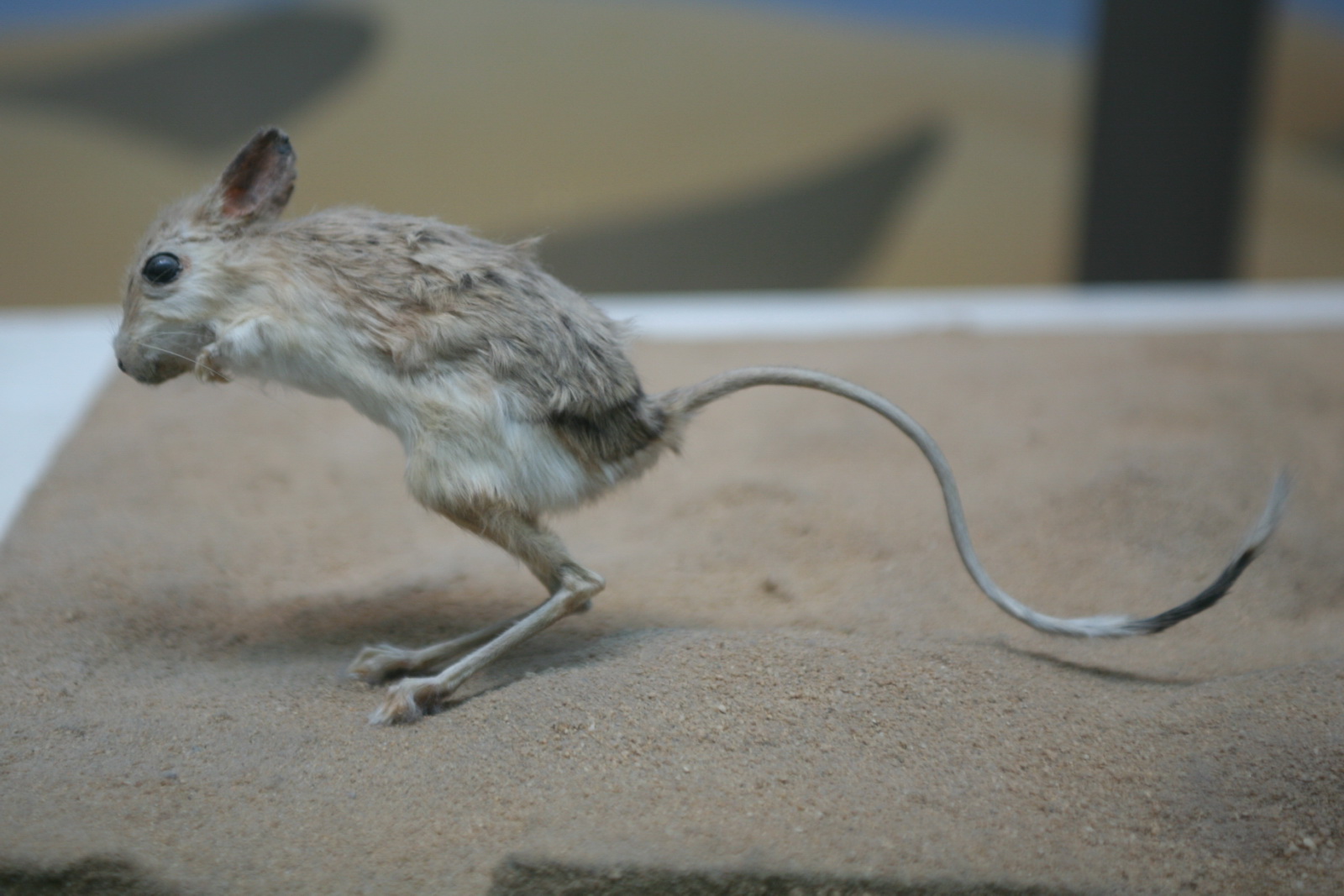
Lesser Egyptian Jerboa
Jaculus jaculus
Characteristics
Temperament
Solitary, nocturnal, territorial. BIPEDAL desert HOPPER (jumps up to 3 m, zigzag escape). Tail longer than body with black-white "flag" tuft (balance/rudder/tripod). EVOLUTIONARY CONVERGENCE with Kangaroo Rat (Americas) + Springhare (Africa) + kangaroos — 4 different families of hoppers! SURVIVES WITHOUT DRINKING (metabolic hydration from seeds). Burrow sealed with sand plug by day. MAIN PREY of the Sand Cat. Winter torpor.
Diet
Desert granivore/herbivore. Seeds (main: desert plants, grasses, legumes), plants (tender leaves, succulent roots = water source), bulbs/tubers, occasional insects (dry season). Nocturnal hopping foraging. Caches seeds in burrow. DOES NOT DRINK: metabolic hydration from seeds/plants (ultra-efficient kidneys, like Kangaroo Rat). Few grams/day.
The Lesser Egyptian Jerboa (Jaculus jaculus) is a small hopping rodent iconic of Old World deserts (Sahara, Arabia, Middle East). Famous for:
- BIPEDAL HOPPER: like a miniature kangaroo, hops on giant hind legs — jumps up to 3 meters to escape predators!
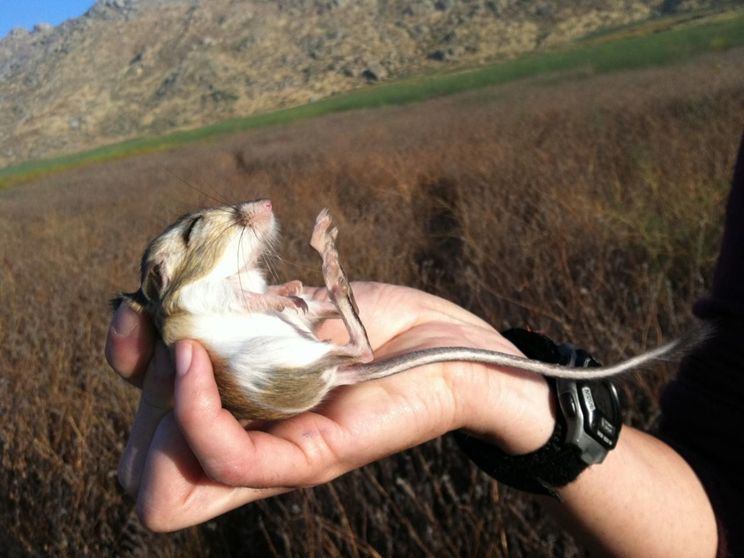
- Very long tail: longer than the body (12-25 cm), with a black-white "flag" tuft at the tip — balance and rudder during jumps
- Spectacular evolutionary convergence: same morphology as American Kangaroo Rat (in catalogue) and African Springhare (in catalogue) — three different families!
- Survives WITHOUT drinking: gets water from seeds and plants (metabolic hydration)
- Nocturnal: digs deep burrows to shelter from daytime heat
- MAIN PREY of the Sand Cat (in catalogue!), desert foxes, owls, snakes
- Large ears and eyes: for hearing and night vision in the desert
IUCN status: Least Concern (LC). Common, adaptable, widespread across North African, Arabian and Middle Eastern deserts.
Classification and category
Order Rodentia, suborder Myomorpha, family Dipodidae (jerboas), genus Jaculus. Dipodidae has ~33 species of bipedal hopping desert/steppe rodents of the Old World. Genus Jaculus: 4-5 species (J. jaculus this entry, J. orientalis, J. blanfordi, etc.). Famous example of CONVERGENT EVOLUTION with other bipedal desert hoppers of completely different families: Jerboa (Dipodidae, Asia/Africa), Kangaroo Rat (Heteromyidae, Americas, in catalogue), Springhare (Pedetidae, Africa, in catalogue), Kangaroo (Macropodidae, Australia, marsupial). Four separate lineages independently evolved giant hind legs, bipedal hopping, long balancing tail, desert life. Etymology: "Jaculus" Latin "thrown/hurled" (jumps). "Jerboa" Arabic "yarbū". Described by Linnaeus 1758. Parameters: Weight 40-75 g. Body 9-12 cm. Tail 12-25 cm (longer than body!). Hind legs 4x longer than front. Longevity 2-3 years natural, 6 captive. Litter 2-5 cubs.
Habitat and distribution
Old World deserts and arid zones: North Africa (Sahara — Morocco to Egypt, N. Sahel), Horn of Africa (Sudan, Somalia, Ethiopia), Arabian Peninsula, Middle East (Jordan, Iraq, Iran, Israel Negev). Habitats: sandy deserts (dunes — main), stony deserts (hammada), arid steppes, wadis, clay/salt flats. Avoids wetlands, forests, dense vegetation, hard rocky ground. Digs deep burrows (1-2 m): summer burrow sealed with sand plug by day (keeps moisture/cool), winter burrow deeper (torpor), temporary refuges, multiple exits. IUCN: Least Concern, abundant.
Diet
Mainly granivore/herbivore. Diet: seeds (main — desert plants, grasses, legumes), plants (tender leaves, shoots, succulent roots — water source), bulbs/tubers (digs), occasional insects (dry season), desert fruits. Technique: nocturnal foraging (hops between plants), uses short forelegs to manipulate seeds, caches seeds in burrow, metabolic hydration (DOES NOT DRINK — gets water from seeds/succulents). Highly efficient kidneys (concentrated urine). Shared adaptation with Kangaroo Rat (in catalogue) and Sand Cat (its predator!).
Physical features
UNIQUE silhouette — "miniature kangaroo-rat". Coat: sand/pale fulvous-orange dorsally (perfect desert camouflage), white belly, long tail with black-white "FLAG" tuft at tip (visible during jumps), white hip patch, soft dense fur. Head: LARGE eyes (night vision), relatively large rounded ears (acute hearing), short muzzle, long vibrissae. Body: GIANT HIND LEGS (4x longer than front, with 3 fused toes, elongated metatarsus like birds — jump propulsion), SHORT forelegs (digging/food), VERY LONG TAIL (longer than body, balance/rudder/tripod prop), FUR on feet (sand walking + heat protection, like Sand Cat). Jumps up to 3 m, zigzag escape, 24 km/h. Metabolic hydration, winter torpor possible.
Behaviour and curiosities
Solitary, nocturnal, territorial. Day in sealed underground burrow, night foraging. Polygamous, rain-dependent breeding. Gestation 25-42 days. 2-5 altricial cubs, fast growth, early maturity (8-12 weeks — unpredictable environment adaptation). Defense: zigzag jump-flight (up to 3 m, abrupt direction changes confuse predators), tail as rudder, black-white tail tuft as decoy. Predators: Sand Cat (in catalogue!), fennec (in catalogue), owls, snakes, monitor lizards, raptors.
Famous: "desert hopper convergence" — niche of small bipedal desert hopper independently filled on every continent (Jerboa Dipodidae, Kangaroo Rat Heteromyidae, Springhare Pedetidae, kangaroo-mice marsupials). All evolved giant hind legs, bipedal hop, long balancing tail, desert/nocturnal life, metabolic hydration. "Never drinks": metabolic hydration from seeds/succulents, ultra-efficient kidneys (shared with Sand Cat its predator!). "Sealed burrow": sand plug by day (moisture, cool, hidden). "Zigzag jump": unpredictable 3 m jumps confuse predators. "Flag tail": balance, rudder, tripod prop, anti-predator decoy. "Bird-like legs": elongated metatarsus, fused toes, foot fur for sand. Sand Cat's main prey: coevolutionary desert predator-prey. Winter torpor in cold regions. Longevity: 2-3 years natural (r-selected, opposite of Sand Cat's K-selection).
Pros
- Saltatore bipede unico — convergenza con canguri e topi canguro
- Sopravvive senza bere (idratazione metabolica)
- Adattamenti desertici straordinari (tana sigillata, salti)
- IUCN Least Concern, popolazione abbondante
Cons
- Preda di numerosi predatori desertici (vita breve)
- Vulnerabile a degradazione habitat desertico
- Cattura occasionale per pet trade
- Sensibile a cambiamenti climatici estremi