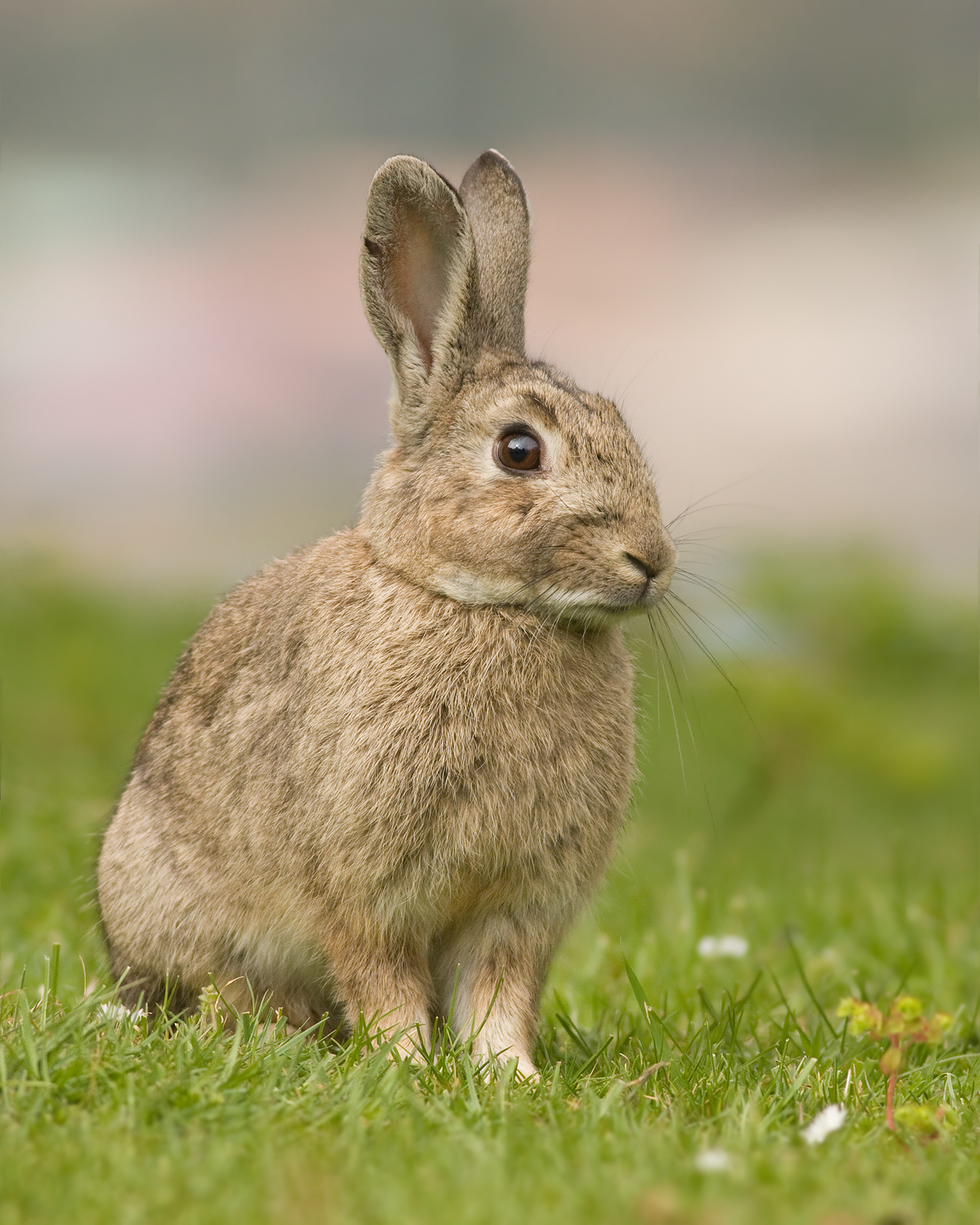
European Wild Rabbit
Oryctolagus cuniculus
Characteristics
Temperament
Social (rare among leporids!) in WARRENS of 6-30 individuals with rigid hierarchy. Crepuscular-nocturnal. Explosive reproduction: 5-7 litters/year, 200-300 offspring/lifetime. ANCESTOR of all domestic rabbits (305 breeds). KEYSTONE SPECIES for Iberian Mediterranean (40+ predators depend on it). CECOTROPHY: re-eats soft faeces to absorb nutrients. Paradox: Endangered in Iberia, plague in Australia.
Diet
Strict herbivore. Grasses (70-90% diet) — graminaceae, legumes, composites. Shrub leaves, bark in winter, roots, seeds. 200-500 g vegetation/day. CECOTROPHY fundamental: produces soft faeces (cecotrophs) rich in nutrients from huge cecum (40% digestive tract), RE-EATS them directly from anus to absorb B vitamins and proteins. Without cecotrophy they would die of malnutrition.
The European Wild Rabbit (Oryctolagus cuniculus) is a species of lagomorph (NOT rodent in strict sense!) of the family Leporidae. It is the progenitor of all ~305 domestic rabbit breeds in the world. Native to the Iberian Peninsula (Spain, Portugal) and the Maghreb (Morocco, Algeria), it is now distributed in 5 continents as an introduced species. Main features:
- Colonial life: complex social system in "warrens" (communal underground burrows) of 6-30 individuals
- Explosive reproduction: a female can produce 200-300 offspring/lifetime — "multiplying like rabbits" is proverbial for good reason!
- Strict herbivore: feeds only on grasses, leaves, bark, roots, seeds
- KEYSTONE species for Iberian Mediterranean ecosystems — 40+ predator species depend on it
- Ancestor of domestic rabbits: domesticated ~600 AD by French monks
- Conservation paradox: Endangered in native Iberia, but invasive plague in Australia/NZ
- Distinct from hares: rabbits are altricial (cubs born naked and blind), hares (Lepus) are precocial
IUCN status: Endangered (EN) since 2019 for native Iberian populations, due to 95% decline from viral diseases (Myxomatosis 1950s, RHDV 1980s, RHDV2 2010s) and habitat fragmentation. Native Iberian population estimated: 5-10 million, vs hundreds of millions in 19th century.
Classification and category
Order Lagomorpha (not Rodentia!), family Leporidae, genus Oryctolagus. Lagomorphs are an ancient order (~50 Mya) separated from Rodentia by at least 60 Mya: share continuously growing incisors (gnawing), but differ by: (1) 4 upper incisors (not 2 like rodents) — 2 large plus 2 small "peg teeth" behind; (2) exclusively herbivorous diet; (3) cecotrophy (re-eating of own special faeces).
The genus Oryctolagus is monotypic: contains only O. cuniculus. Two recognised subspecies: O. c. cuniculus (Europe) and O. c. algirus (Iberia/Maghreb, possibly separate species).
Etymology: "Oryctolagus" from Greek "orýktēs" (digger) + "lagós" (hare) — reference to digging habit. "Cuniculus" from Latin "tunnel". Described by Linnaeus 1758.
Morphological parameters: Weight 1.2-2.5 kg (record 2.8 kg). Head-body 35-45 cm. Tail 4-8 cm (white below, brown above — "scut"). Ears 6-7 cm (shorter than hares!). Longevity: 2-3 years natural, 9-12 captive (record domestic 16). Sexual maturity: 3.5-6 months (precocious!). Gestation 28-32 days. Litter 3-12 (avg 5-6). 5-7 litters/year. Total 200-300 offspring/lifetime!
Habitat and distribution
Native range: Iberian Peninsula + Maghreb. Survived last glaciation in Mediterranean refugia, then expanded into Europe ~10,000 years ago. Current distribution: Iberian Peninsula (native, declining), Europe (introduced Roman/Medieval period, naturalised), Mediterranean islands, Australia (introduced 1859 — plague), NZ, Chile, Argentina, S. Africa, USA, 800+ islands worldwide. Habitats: Mediterranean scrubland, dehesa, grasslands, forest edges, fields, coastal dunes. Avoids dense forests, swamps, high mountains, urban areas.
IUCN: Endangered (EN) since 2019 (native populations). Threats: Myxomatosis (1952 France, 95-99% initial mortality), RHDV (1984 China, 1988 Iberia), RHDV2 (2010), overhunting (10M legally killed/year), habitat loss, fragmentation. Australia paradox: 24 introduced 1859 → 10 billion by 1920s → 200-400 million today. "Rabbit-Proof Fence" 1907 (1,833 km). Eradication via myxomatosis 1950 + RHDV 1995. $200M AUD/year economic damage.
Diet
Strict herbivore. Diet: grasses (70-90%), shrub leaves, bark (winter), roots, seeds, crops, wild fruits. Daily consumption 200-500 g. Key feature: cecotrophy — two types of faeces. Hard pellets (day, residual) + cecotrophs/soft pellets (night/morning, nutrient-rich). Rabbit re-eats cecotrophs directly from anus. Enormous cecum (40% digestive tract) ferments cellulose, produces B vitamins. Without cecotrophy, rabbits would die of malnutrition. Feeding technique: evening emergence, grazing within 20-50 m of warren, constant vigilance, rapid flight to burrow at threat.
Physical features
Compact silhouette typical of digging leporids. Coat: brown agouti base, white belly, BLACK ON TOP/WHITE UNDERNEATH tail ("scut" — visible flight signal). Ears 6-7 cm SHORTER than hares (diagnostic). 4 upper incisors (Lagomorph diagnostic). Large lateral eyes — 340° field of view. Short forelimbs with claws for digging. Long muscular hindlimbs for running 40-55 km/h. Jump 1.5 m vertical, 3 m horizontal. Excellent hearing/smell, mostly silent (stress scream, hindleg thumping for alarm — heard 100+ m).
Behaviour and curiosities
SOCIAL (rare among leporids!) — lives in warrens of 6-30 individuals (max 300+ in some). Rigid hierarchy: alpha male monopolises mating, alpha female monopolises best nesting sites. Combat: hindleg kick-boxing, neck bites. Marking: chinning (submandibular glands), urine, faeces, anal secretions. Reproduction polygenic, year-round in mild climates. Gestation 28-32 days. Litter altricial (naked, blind, 30-40 g). Eyes open day 10-11. Independence day 28. Sexual maturity 3.5-6 months — can reproduce same year as birth.
Famous curiosities: "multiplying like rabbits". One female 5-7 litters/year × 5-6 cubs = 25-42 cubs/year, lifetime 75-126. With offspring reproducing at 6 months, theoretical 1,000+ descendants/year, millions in 2-3 years. Australian explosion 24→10 billion in 60 years confirms biology. Keystone species: 40+ Iberian Mediterranean predators depend on rabbits (Iberian Lynx, Iberian Eagle, foxes, badgers, weasels, golden eagles, peregrine falcons). Rabbit collapse 1988 → cascade decline in 30+ predator species. Domestication: ~600 AD French monks for "laurices" (newborn rabbits classified as "fish" for Lent!). 305 breeds today. Australian invasion: 1859 Thomas Austin's 24 rabbits → 10 billion by 1920s. Rabbit-Proof Fence (1,833 km, 1907) failed. Myxomatosis 1950, RHDV 1995. Cecotrophy: re-eats soft faeces to absorb fermented nutrients — without it, rabbits die. Superfetation: female can be pregnant with two litters simultaneously. Watership Down (1972, Richard Adams): 50+ million copies sold, scientifically accurate rabbit biology. Easter Bunny: pagan-Christian origins, Germanic Ostara, German Osterhase migrated to America 18th century.
Pros
- Antenato di tutti i conigli domestici (305 razze)
- Specie keystone per ecosistemi mediterranei iberici
- Model organism per studi biomedici e genetica
- Icona culturale (Pasqua, Watership Down, simboli)
Cons
- IUCN Endangered nelle popolazioni native iberiche
- Vulnerabile a malattie virali (Myxomatosi, RHDV, RHDV2)
- Specie invasiva devastante in Australia/NZ
- Danni a colture quando popolazioni esplodono