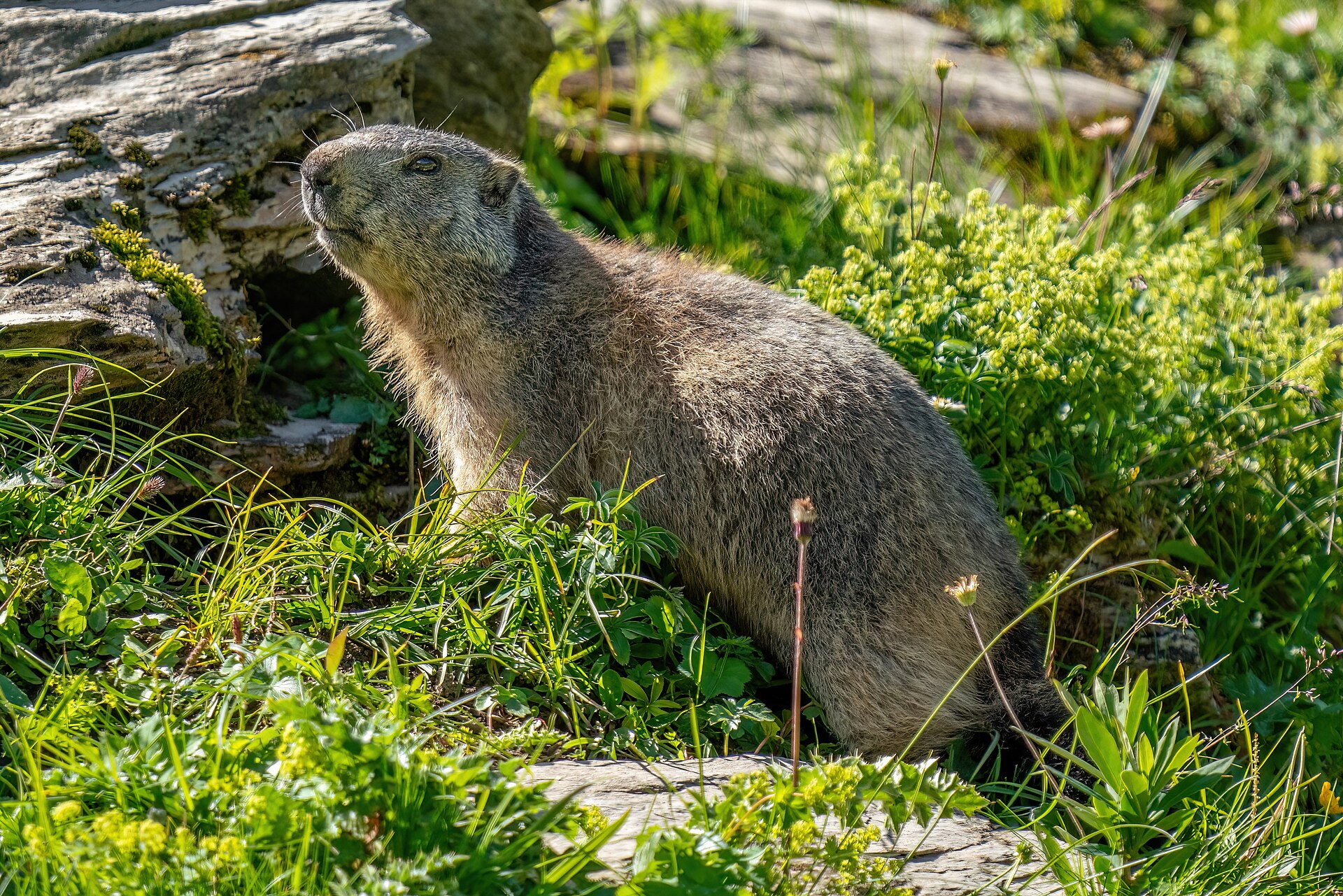
Alpine Marmot
Marmota marmota
Characteristics
Temperament
Diurnal, social, territorial. Lives in family colonies. Vigilant sentinel: coded alarm whistle for each predator type. 6-7 months of hibernation per year.
Diet
Strict herbivore: grasses, flowers, shoots. 1.5 kg of vegetation per day in summer to accumulate brown fat for hibernation. Never drinks (water from food and dew).
The Alpine Marmot (Marmota marmota) is a large rodent typical of the high-altitude meadows of the Alps. Famous for its sharp alarm whistle echoing through the valleys, it is one of the most beloved species of European alpine fauna, a symbol of sunny pastures and rocky moraines. It spends more than half of its life in deep hibernation, surviving the alpine winter in tightly communal underground burrows.
Classification and category
The Alpine Marmot belongs to the order Rodentia, family Sciuridae (squirrels), subfamily Xerinae, genus Marmota. The genus comprises fourteen species distributed between Eurasia and North America, including the Bobak Marmot of Asian steppes and the Vancouver Island Marmot (Critically Endangered). It is one of the largest European rodents: body length is 40-60 cm, plus a tail of 13-16 cm. Adult weight varies greatly with the seasons: 4-5 kg upon spring awakening, up to 8-10 kg before autumn hibernation.
Habitat and distribution
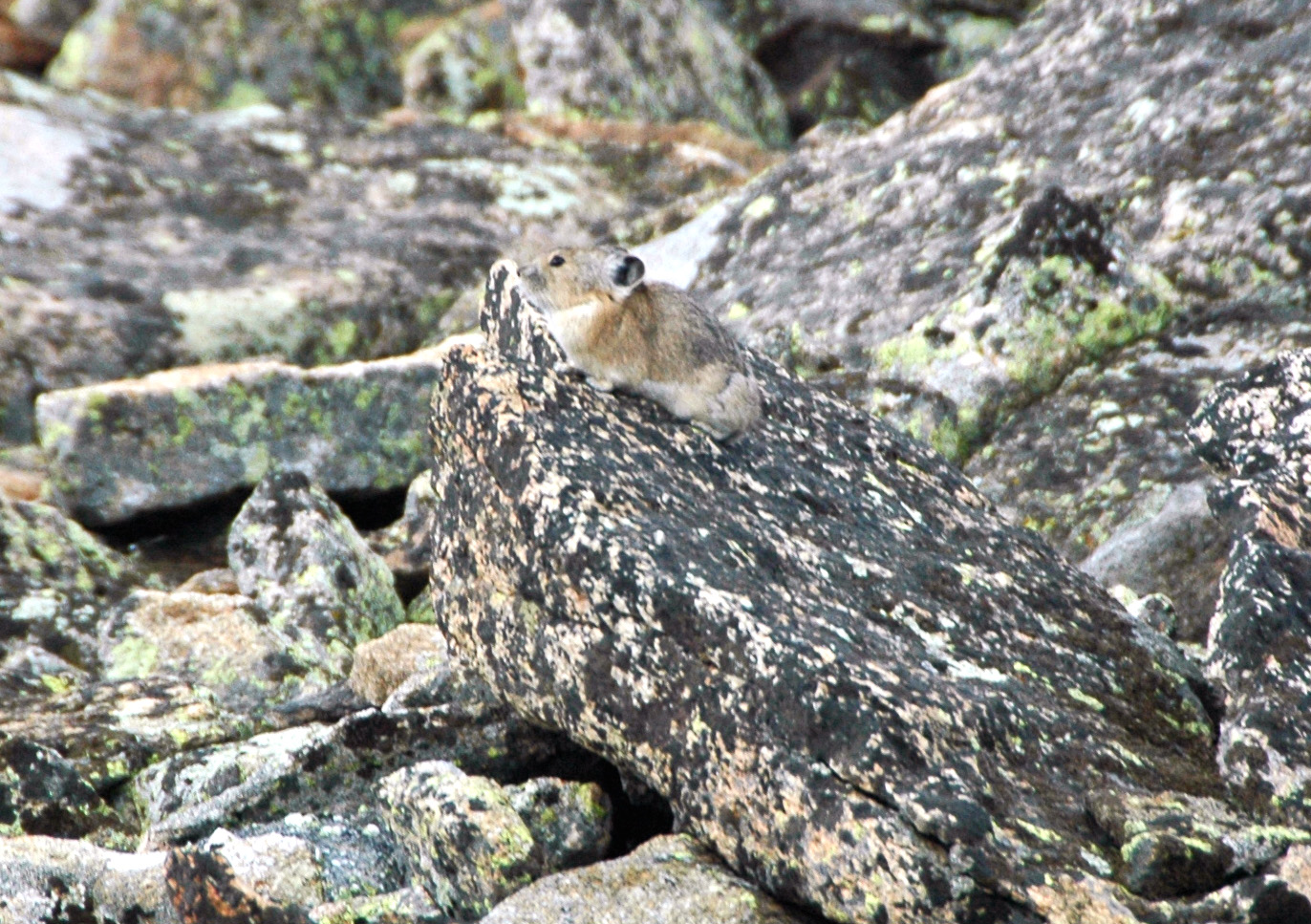
The Alpine Marmot's habitat consists of high-altitude alpine meadows, above the tree line, generally between 1,500 and 3,000 metres. It prefers sunny slopes with good herbaceous cover, interspersed with rocks, boulders and moraines useful as lookout points and for placing the entrance of its burrows. The soil layer must be deep enough to allow the construction of underground galleries extending up to 10 metres in length and 2-3 metres in depth.
The natural range covers the entire Alpine arc: Italy (Alps and northern Apennines after recent reintroduction), France, Switzerland, Austria, southern Germany, Slovenia and Liechtenstein. Successful reintroductions have returned the species to the Pyrenees (France/Spain), the Carpathians, the French Massif Central, the Vosges, the German Black Forest and some Apennine sectors. Conservation status is listed as Least Concern (LC) by the IUCN; the species can be hunted in some Alpine arc countries (excluding Italy, where it is protected since 1992 in national parks and by many regions).
Diet
The Alpine Marmot is strictly herbivorous. Its diet consists mainly of grasses, flowers (especially legumes and Asteraceae), shoots, tender leaves, occasionally berries and incidentally ingested insects. During the active season, from April to September, an adult marmot consumes about 1.5 kg of vegetation per day, accumulating a thick layer of body fat that will allow it to survive the 6-7 months of hibernation.
It does not build real food caches like squirrels or beavers: the accumulation is entirely in the form of brown fat, particularly efficient at releasing energy during hibernation. Only a small amount of dry grass is carried into the den to serve as insulating bedding. Water is obtained entirely from dew and fresh vegetation: the marmot never needs to drink.
Physical features
The Alpine Marmot has a stocky, sturdy body with short, powerful legs, a wide head and eyes set high on the sides of the skull for panoramic vision. The coat is dense and of two types: a woolly insulating undercoat and longer, coarser guard hairs, varying in colour from grey to brown with reddish tones on the flanks. The tail is covered with black hairs at the tip.
The jaws are equipped with four orange incisors with continuous growth (as in all rodents), extraordinarily strong for chewing roots and bark. The front feet have five toes with sturdy claws suited for digging: a marmot is capable of excavating galleries through hard soil, even among stones. The hind feet are webbed only on the pads and serve as propulsion during escape. Males and females are very similar, with males only slightly larger.
Behaviour and curiosities
The Alpine Marmot is a diurnal, social and territorial animal. It lives in family colonies composed of a dominant pair and 5-15 related individuals (sub-adults, yearlings from the previous year, and pups). Each colony defends a territory of 1-3 hectares, marking it with secretions from cheek glands rubbed onto rocks and bushes.
The famous alarm whistle (actually a cry produced by the larynx, not by the nose as once believed) varies in frequency, duration and number of emissions depending on the type of predator: a single prolonged whistle signals a golden eagle or another aerial threat; a series of short whistles indicates a ground predator (fox, ermine, dog). Other colony members respond by fleeing to the nearest burrow.
Hibernation is the most extreme phase of its life: from mid-October to early April, the entire group seals itself into an underground chamber plugged with earth and faeces; body temperature drops from 38 °C to about 5 °C, heart rate from 200 to 5-15 per minute, breathing from 16 to 2-3 breaths per minute. During hibernation, marmots wake up periodically every 2-3 weeks to expel urine, warm up and resume sleep. Weight loss is 40-50%. Sexual maturity is reached at 3 years; females breed at most every 2 years, giving birth to 2-7 pups. Lifespan is remarkable: 15-18 years in the wild, up to 20 in captivity.
Pros
- Specie iconica della fauna alpina
- Facilmente osservabile in alta quota
- Reintroduzione di successo in molti massicci europei
- Longeva (oltre 15 anni in natura)
Cons
- Specie selvatica, NON è un animale da compagnia
- Protetta in molti paesi europei
- Necessita ambienti alpini specifici
- Vulnerabile al cambiamento climatico