Fishing Cat
Prionailurus viverrinus
Characteristics
Temperament
Solitary, nocturnal-crepuscular, SEMI-AQUATIC. UNIQUE fish-specialised felid (75-80% diet fish). PARTIALLY WEBBED front paws, WATERPROOF double-layer coat, semi-retractable claws (unique among felids). Lure hunting technique (claw-created concentric ripples attracting fish). Swims 100+ m, dives 10-30 sec. Endemic to South Asian mangroves/wetlands. National animal of West Bengal. IUCN Vulnerable.
Diet
Fish-specialist carnivore (UNIQUE among felids). Fish 75-80% diet, crustaceans, amphibians, water snakes, aquatic reptiles, water birds, marsh rodents. Hunting technique: bank perch + "claw luring" (concentric ripples attract fish) + leap + semi-retracted claws for slippery fish + underwater dive 10-30 sec. 800g-1.5 kg meat/day.
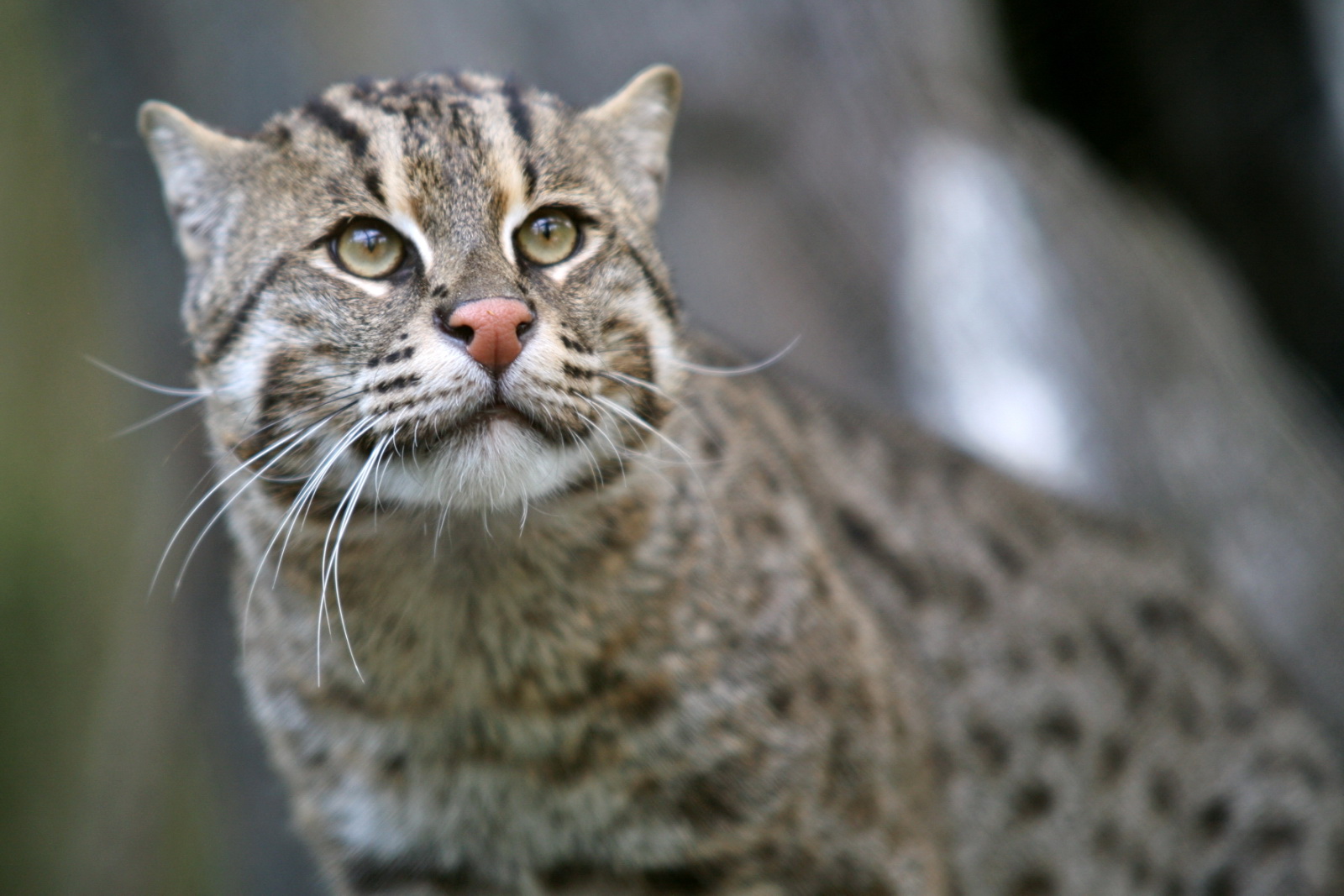
The Fishing Cat (Prionailurus viverrinus), known in Bengali as মেছো বিড়াল ("Mecho Biral"), is one of the most unique felids in the world. Adapted to aquatic life — one of the few felids that deliberately swims and hunts fish. Endemic to South and Southeast Asia, famous for:
- NATURAL SWIMMER: unlike most felids (which avoid water), the Fishing Cat actively seeks water for hunting
- Partially webbed front paws: partial interdigital membranes aiding propulsion in water — unique adaptation among felids
- Double-layer waterproof coat: short dense inner fur (insulating), long outer fur (water-repellent)
- Fish specialisation: 75-80% of diet is fish
- Unique hunting technique: positions on bank, immerses claw to create concentric waves luring curious fish, then leaps
- Specific habitat: mangroves, swamps, canals, rivers of South Asia
- National animal of West Bengal (India)
IUCN status: Vulnerable (VU) since 2008. Global population estimated: less than 10,000 mature individuals, fragmented.
Classification and category
Order Carnivora, family Felidae, subfamily Felinae, genus Prionailurus. Genus contains 5 living species of "small Asian felids": P. viverrinus (this entry, largest), P. bengalensis (Leopard Cat — ancestor of domestic Bengal!), P. rubiginosus (Rusty-spotted Cat, smallest in world), P. planiceps (Flat-headed Cat), P. javanensis (Sunda Leopard Cat). Closest relative: Leopard Cat (P. bengalensis). Etymology: "Prionailurus" Greek "saw" + "cat" (denticulated coat scales). "Viverrinus" Latin "viverra" (civet-like). Described by Bennett 1833. Parameters: Weight 8-16 kg (record 17 kg). Length 70-115 cm. Shoulder 38-43 cm. Tail 25-32 cm (relatively short — 1/3 body). Longevity 10-12 years natural, 14-17 captive.
Habitat and distribution
Endemic to South/Southeast Asia. Main populations: Bangladesh (Sundarbans), India (West Bengal, Odisha, Andhra Pradesh, Tamil Nadu, Kerala wetlands, Assam, Tripura), Sri Lanka, Nepal Terai, Pakistan (residual), Bhutan, Myanmar, Thailand, Laos, Cambodia, Vietnam, Malaysia. Indonesia (Java) POSSIBLY EXTINCT, S. China extinct. Habitats: mangroves (main — Sundarbans capital), swamps and wetlands, slow rivers, paddies, lowland forests, lakes/ponds with vegetation. Avoids dry forests, montane areas above 1,500 m, urban. IUCN: Vulnerable. Threats: wetland loss (90% of S.Asian wetlands lost — main cause), water pollution, persecution, fur hunting ($200-500/skin), road accidents, fishing net entanglement, pet trade, climate change/sea level rise. CITES: Appendix II.
Diet
Most fish-specialised felid in the world. Diet: fish 75-80% (catfish, tilapia, freshwater fish), crustaceans (crabs, shrimp), amphibians, water snakes, lizards, turtles, water birds, aquatic rodents, large insects, occasional chickens/ducklings, rare deer fawns. UNIQUE hunting: bank perch + claw "luring" (creates concentric ripples attracting curious fish) + leap + semi-retracted claws grip slippery fish + underwater diving (10-30 seconds) + bank consumption. 800g-1.5 kg meat/day.
Physical features
Stocky robust silhouette adapted to aquatic life. Coat: olive-grey base (mangrove camouflage), black elongated spots in longitudinal stripes, ringed tail, cream-white belly with spots. DOUBLE WATERPROOF LAYER: short dense inner (insulating) + long outer (water-repellent). Head: short robust muzzle, small rounded ears (smaller than terrestrial felids — swimming adaptation), amber eyes, strong jaws. Body: stocky, muscular, heavier in proportion. FRONT PAWS PARTIALLY WEBBED (interdigital membranes), SEMI-RETRACTABLE FRONT CLAWS (not fully retracted — unique among felids). Strong hind legs for aquatic propulsion. Tail short (25-32 cm = 1/3 body), water rudder. Speed: swims 3-5 km/h, underwater 10-30 seconds.
Behaviour and curiosities
Solitary, nocturnal-crepuscular, semi-aquatic. Territory 4-22 km² F, 10-25 km² M. Polygamous. Gestation 60-70 days. Litter 2-3 cubs in mangrove root cavities. Independence 10-12 months.
Famous: "swimming felid" — actively seeks water, swims 100+ m (record 300 m), underwater 10-30 s. "Lure hunting": dips claws to create concentric ripples — rare example of bait use in non-human mammals. Partial webbing: unique adaptation among felids. Semi-retracted claws: for gripping slippery fish (also Flat-headed Cat). Sundarbans: world's largest mangrove forest (10,000 km²), Fishing Cat capital, coexists with Bengal tigers. National animal of West Bengal (2012). Domestic Bengal relative: Bengal cat descends from Leopard Cat (closest relative), not Fishing Cat. 90% S.Asian wetland loss: main decline driver. Java possibly extinct: last confirmed 1990s. "Bear-fish": Bengali/Tamil legend, hypnotises fish with gaze. Peri-domestic: lives near human villages in Bangladesh/India. Longevity: 17 years Cincinnati Zoo. Fishing Cat Conservation Alliance (2010): main research group.
Pros
- Unico felino specializzato in pesca (75-80% dieta)
- Zampe palmate e pelliccia waterproof — convergenza con lontre
- Uso di esca con artigli — comportamento cognitivo raro
- Animale nazionale del Bengala Occidentale
Cons
- IUCN Vulnerable, <10.000 individui maturi
- 90% delle zone umide del Sud Asia perdute (causa principale)
- Possibilmente estinto a Java (Indonesia)
- Vulnerabile a cambiamento climatico (Sundarbans)