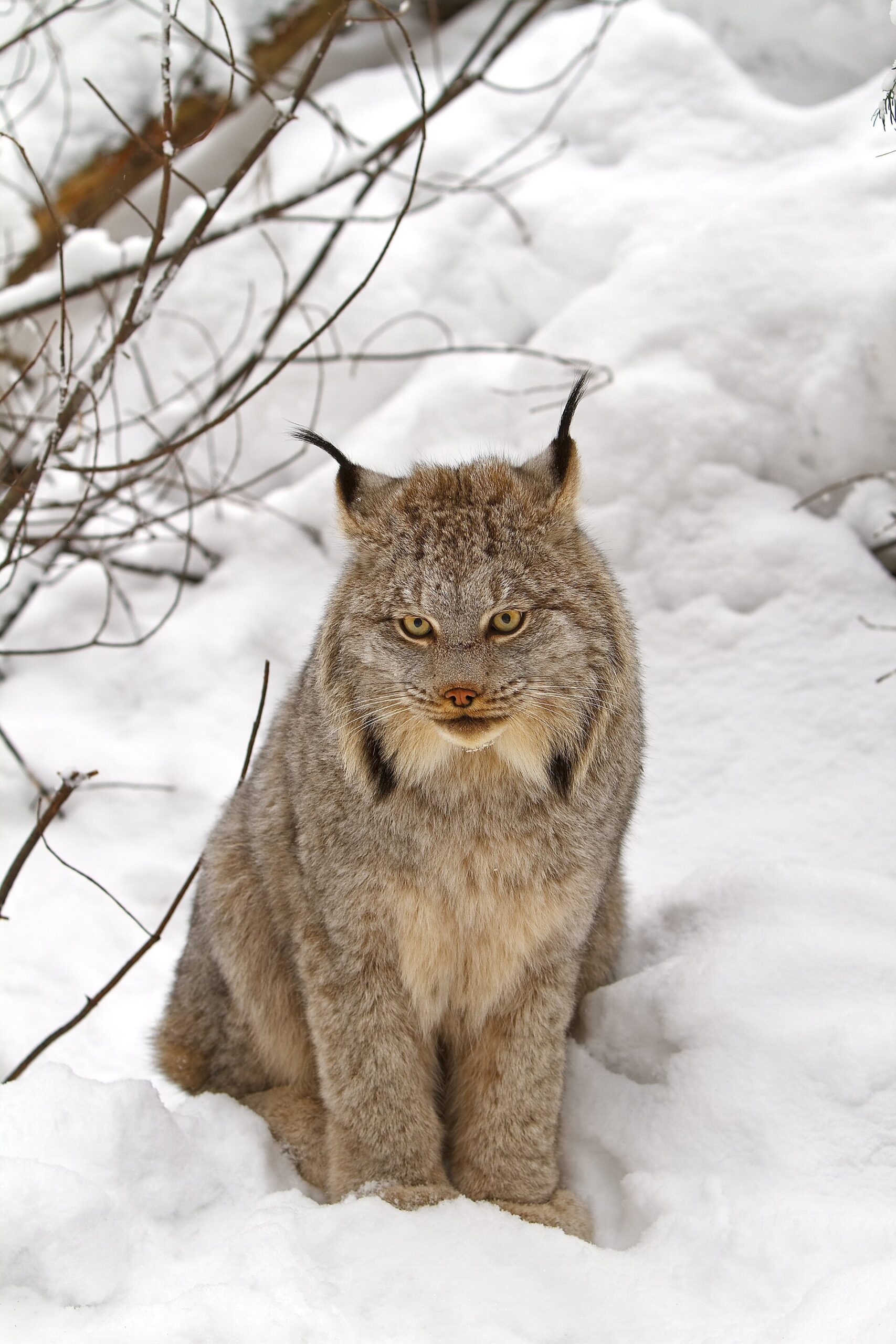
Canada Lynx
Lynx canadensis
Characteristics
Temperament
Solitary, shy and silent, rarely seen in the vastness of the taiga. A nocturnal and crepuscular stalk-and-pounce hunter, perfectly adapted to snow thanks to its snowshoe paws. Territorial, with borders that vary with the number of hares. An almost exclusive specialist on the snowshoe hare, it follows the famous ten-year predator-prey cycle. Not a pet: a wild cat of the boreal forests.
Diet
One of the world's most specialized predators: it depends almost entirely on the snowshoe hare (Lepus americanus), which in winter can make up over 80-90% of the diet. When hares are scarce it supplements with rodents, other lagomorphs and birds (grouse), and occasionally carrion. It hunts by stalk and final pounce on powdery snow, where its snowshoe paws give a decisive advantage. Its dependence on a single prey drives the famous lynx-hare cycle, with populations oscillating together about every ten years.
The Canada Lynx (Lynx canadensis) is the lynx of North America's great boreal forests, a cat superbly adapted to life in the snow. Famous for:
- "Snowshoe" paws: enormous furred feet that spread its weight over powdery snow, letting it move where other predators sink
- Long black ear tufts and a conspicuous facial ruff, even more marked than in other lynxes
- A short, fully black-tipped tail: a detail that sets it apart from the bobcat
- Specialization on the snowshoe hare: few predators depend so heavily on a single prey
- The famous lynx-hare cycle: its populations oscillate with the hare's on a roughly ten-year rhythm
- Completing the "lynx quartet", alongside the Eurasian, Iberian and bobcat lynxes
IUCN status: Least Concern (LC) globally (though in the contiguous USA it is protected as "Threatened"). It is the fourth and last of the world's lynxes in this portal: with it the genus Lynx is complete, from Europe's forests (Eurasian) to the Iberian scrub (Iberian), to America's woods and deserts (bobcat) and the snowy northern taiga (Canada).
Classification and category
Order Carnivora, family Felidae, genus Lynx — that of the four lynxes: the Eurasian lynx (Lynx lynx), the Iberian lynx (Lynx pardinus), the bobcat (Lynx rufus) and the Canada lynx (Lynx canadensis). The species it is most confused with is the bobcat, with which it shares part of its North American range; how to tell them apart: the Canada lynx has much larger, furrier feet ("snowshoes"), longer legs and more marked ear tufts; it has a fully black tail tip all around, whereas the bobcat's is black only on top (white below); its coat is greyer and more uniform, less spotted than the bobcat's more fulvous one; and it is a snow-and-snowshoe-hare specialist, while the bobcat is far more generalist and adaptable. Where the two ranges meet, in southern Canada, Canada lynx and bobcat can even hybridize ("blynx"). Etymology: "Lynx" is from Greek, linked to keen sight; "canadensis" denotes Canada, the heart of its range. Parameters: Body 80-105 cm. Tail 5-12 cm (short, black-tipped). Shoulder height ~48-56 cm. Weight 8-11 kg (males larger). Longevity 10-15 years in the wild, up to about 20 in captivity. Solitary; litter size depends strongly on hare abundance — 1-5 (or more) kittens in good years, very few or none when hares are scarce.
Habitat and distribution
The Canada Lynx is tied to North America's boreal forests (taiga): much of Canada and Alaska, and south into the northern USA (Rocky Mountains, Great Lakes region, New England). Preferred habitats — cold, snowy forests: boreal coniferous forest (taiga, its prime habitat, where the snowshoe hare abounds); mixed forests and areas with dense undergrowth (offering cover for hunting and dens); and areas with deep, persistent snow (where its big paws give a decisive advantage). The Canada lynx's whole lifestyle is shaped by snow and the snowshoe hare. The species' distribution closely mirrors that of its prey and of the taiga. It is solitary, mainly nocturnal and crepuscular, and its movements track hare availability, which can vary enormously from year to year. IUCN: Least Concern overall, thanks to vast Canadian and Alaskan populations. The more southerly populations in the contiguous USA are rarer and protected, threatened by boreal-forest loss and climate change (which reduces snow cover, favouring the more adaptable bobcat at the Canada lynx's expense).
Diet
The Canada Lynx is one of the world's most specialized predators: its diet revolves almost entirely around a single prey. It eats: the snowshoe hare (Lepus americanus), the dominant prey, which in winter can make up the vast majority of the diet (even over 80-90%); other small mammals (rodents such as voles and squirrels, and other lagomorphs), especially when hares are scarce; and birds (such as grouse) and occasionally larger prey or carrion. Hunting strategies: ambush on snow (thanks to its snowshoe paws, it chases and surprises the snowshoe hare on powdery snow, where other predators struggle); waiting along trails (it lies in wait along the hares' usual paths, ready for the final pounce); and dependence on the prey cycle (when hares abound it hunts easily and breeds well; when they crash it struggles, ranges over vast distances and raises few young). Crucially, the heavy dependence on the snowshoe hare creates one of ecology's most famous phenomena, the lynx-hare cycle: the two species' populations rise and fall together, with a lag, on a roughly ten-year rhythm — a textbook example of predator-prey dynamics.
Physical features
The Canada Lynx has the classic look of a "snow lynx": a compact body, long legs and outsized feet. Coat: thick and soft, silvery-grey in winter (browner-fulvous in summer), with faint spotting; long, insulating fur suited to the rigours of the taiga. The distinguishing traits: enormous furred feet (true "snowshoes" that increase the bearing surface and allow walking on snow without sinking); long black ear tufts, more developed than in the other American lynxes; a broad facial ruff (a "collar" of fur); a very short tail with a fully black tip; and long hind legs, giving an "uphill" gait. Performance: locomotion on snow (its superpower, thanks to the snowshoe paws); stalk and pounce (it hunts by approach and a final leap, not by long chases); acute senses (excellent sight and hearing, amplified by the ear tufts); and climbing and swimming (capable of both when needed).
Behaviour and curiosities
A solitary, shy, silent animal, rarely seen in the vastness of the taiga. Each individual holds a territory whose borders expand or shrink with the number of hares. It is mainly nocturnal and, like all lynxes, leads a reserved existence.
The "snowshoes": the Canada lynx's most spectacular adaptation is its feet — broad and covered in dense fur, they work exactly like snowshoes, spreading the animal's weight over a larger area and stopping it sinking into powdery snow; this gives it a huge advantage in chasing the snowshoe hare — itself "snowshoe-footed" — in an environment where heavier, small-footed predators struggle greatly. The lynx-hare cycle: one of the most famous examples in all of ecology, studied thanks to the historical records of furs traded by the Hudson's Bay Company; Canada lynx and snowshoe hare populations rise and fall in coupled fashion on a roughly ten-year cycle — when hares are abundant, lynxes thrive and multiply; over-predation (with other factors) then crashes the hares, and soon after the lynxes crash too, until the hares begin to recover — the textbook model of predator-prey dynamics. The near-twin (the bobcat): the Canada lynx and the bobcat are very close relatives sharing part of North America, but they occupy different "worlds" — the Canada lynx is the snow specialist (big feet, dependence on the snowshoe hare, life in the taiga), the bobcat the adaptable generalist (smaller feet, varied diet, able to live almost anywhere, from deserts to suburbs); so where the climate warms and it snows less, the more flexible bobcat tends to replace the Canada lynx. The "single-diet" predator: very few carnivores in the world depend on one prey as much as the Canada lynx depends on the snowshoe hare; this extreme specialization makes it extraordinarily efficient when hares abound but very vulnerable when they crash — in lean times lynxes travel enormous distances seeking food and may not breed at all. The climate thermometer: the Canada lynx is regarded as an indicator of climate change's effects on the boreal forest — as snow cover shrinks and snowy winters shorten, the competitive advantage of its snowshoe paws diminishes, and the more adaptable bobcat can push north at its expense, so the boundary between the two lynxes is also a line that moves with the climate. The complete quartet: with the Canada lynx, this portal gathers all four of the world's lynx species; it is interesting to compare them — all share the ear tufts, ruff and short tail, but each has adapted to a different environment (Eurasian temperate forest, Iberian Mediterranean scrub, the North American mosaic and the snowy taiga) — a little journey through the habitats of the world's north.
Pros
- Felino splendidamente adattato alla neve (zampe-racchetta uniche)
- Completa il quartetto mondiale delle linci di questo portale
- Protagonista del classico ciclo ecologico lince-lepre
- IUCN Least Concern (vaste popolazioni in Canada e Alaska)
Cons
- Non è un animale domestico (felino selvatico)
- Iper-specializzata: molto vulnerabile ai crolli della lepre delle nevi
- Minacciata dal cambiamento climatico (meno neve favorisce la Lince Rossa)
- Nelle popolazioni USA meridionali è rara e protetta (Threatened)