Photo: Ran Kirlian · CC BY-SA 4.0
Fossa
Cryptoprocta ferox
Agile and mysterious, with a body between a cat and a marten, the fossa is the largest predator of Madagascar, a tireless hunter among the trees.
Characteristics
Temperament
Solitary, agile and elusive; a tireless hunter
Diet
Carnivore: mainly lemurs, then birds and reptiles
The mysterious predator of Madagascar
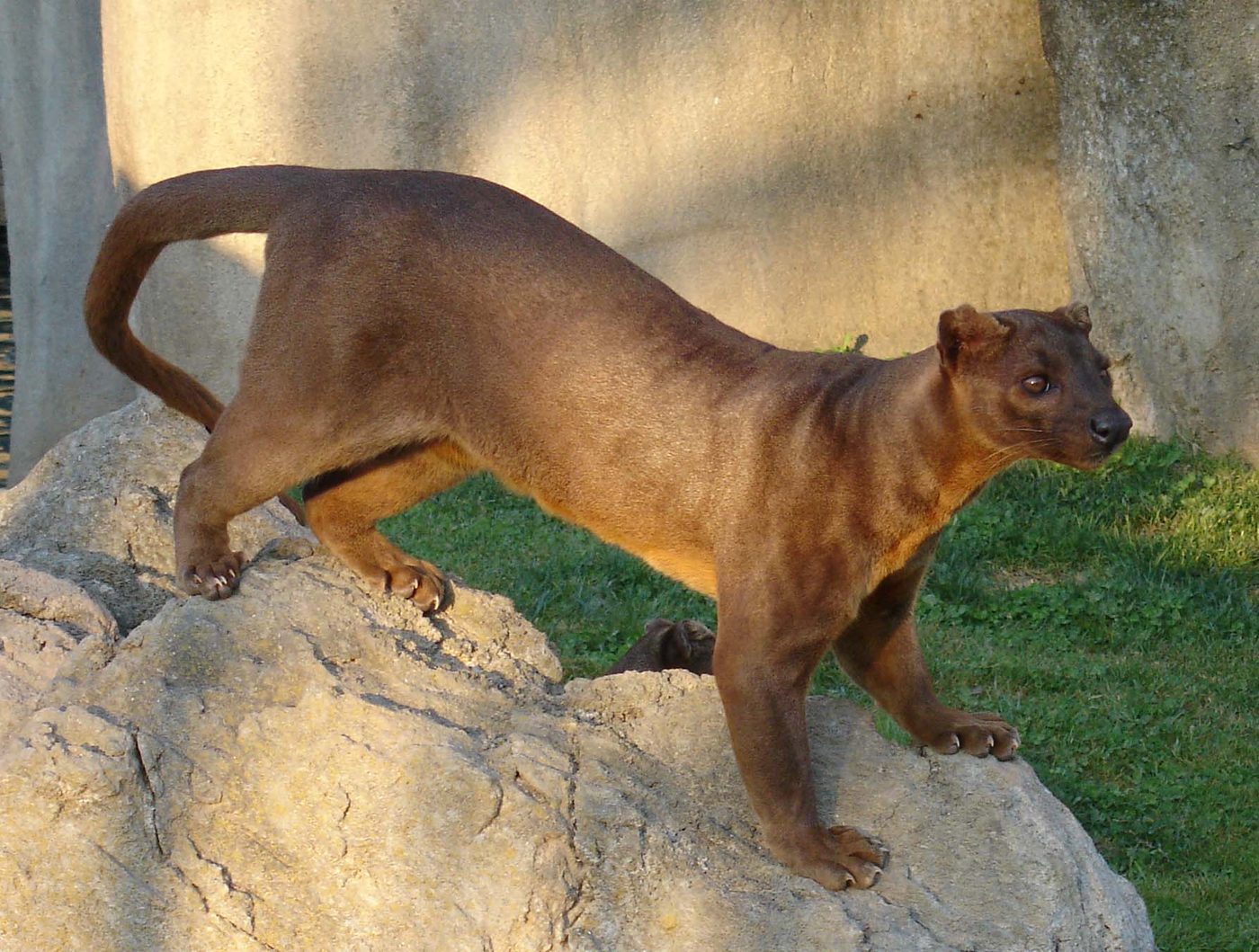
The fossa is a carnivore of unusual appearance, which at first sight recalls a cross between a cat, a marten and a small puma. It has a slender, muscular body, sturdy legs, a short muzzle and above all a very long tail, almost as long as its body, which acts as a balancing pole. Its coat is a uniform reddish-brown. Despite some resemblance to the cats, the fossa belongs to a family of carnivores typical of Madagascar, distantly related to the mongooses.
Habitat and distribution
The fossa is endemic to Madagascar: it lives only on this great island in the Indian Ocean and nowhere else in the world. It frequents mainly forests, from humid rainforests to drier areas, moving with ease both on the ground and among the branches. It is the island's only large land predator, and thus occupies a fundamental ecological role.
Behaviour
It is an extraordinarily agile and mostly solitary hunter, active both by day and by night. Its favourite prey are the lemurs, the famous primates of Madagascar, which it pursues skilfully among the trees thanks to flexible ankles that allow it to climb and descend head-first. It also hunts birds, reptiles and small mammals, however. Its long tail gives it perfect balance during aerial pursuits among the branches.
Curiosities
As the island's chief predator, the fossa plays a key role in maintaining the balance of Madagascar's ecosystems, regulating the populations of lemurs and other prey. Its elusive figure and hidden life in the forests have made it the subject of local legends.
Conservation
The fossa is classified as a vulnerable species. The main threat is the rapid destruction of Madagascar's forests, one of the richest and most threatened ecosystems on the planet, to which are added conflicts with humans and hunting. Protecting the island's forests is essential not only for the fossa, but for the whole extraordinary natural world it dominates.
Pros
- The largest predator of Madagascar
- Extraordinary arboreal agility
- Key ecological role for the island
Cons
- Vulnerable species
- Endemic: lives only in Madagascar
- Threatened by the destruction of forests