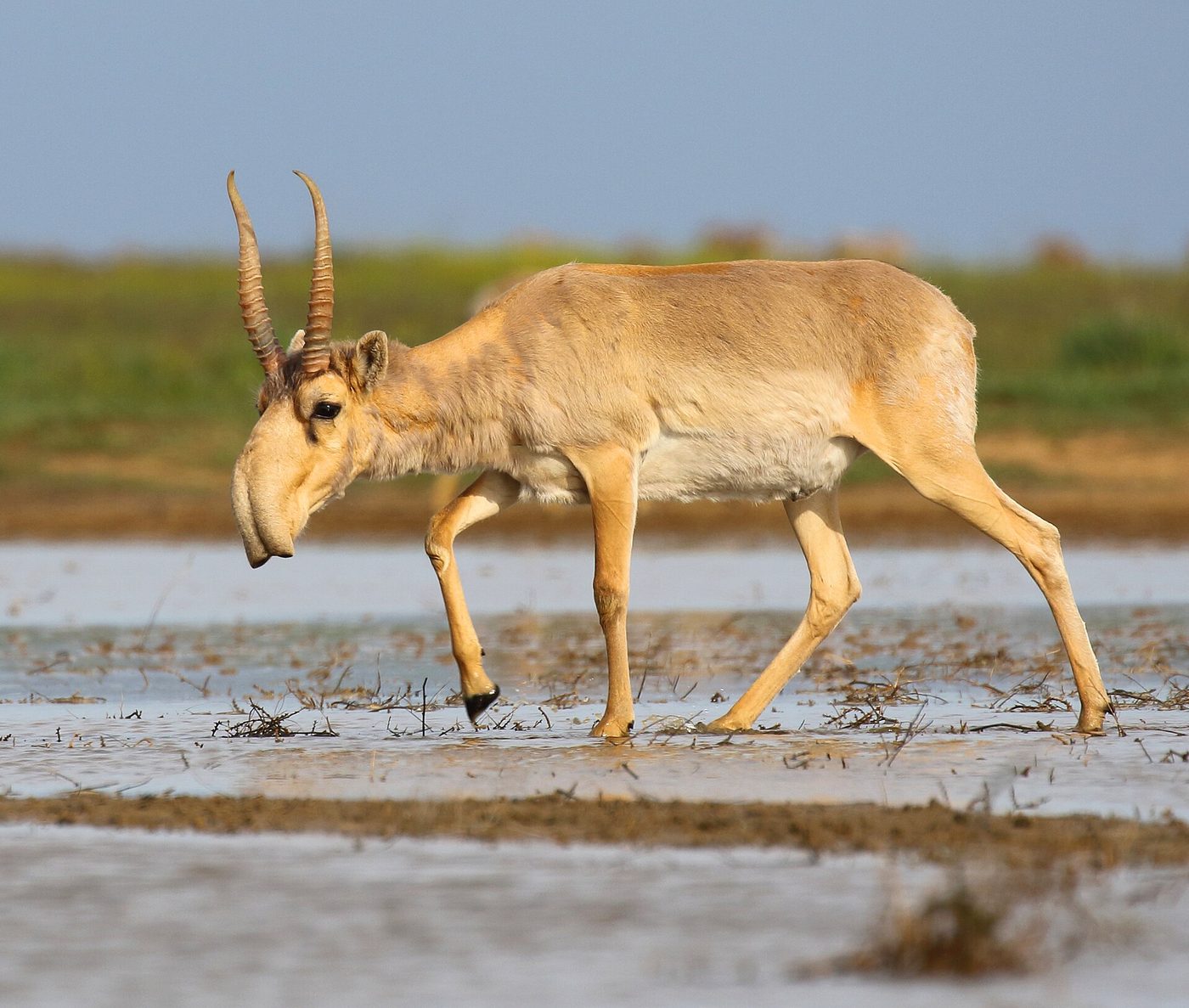
Photo: Andrey Giljov · CC BY-SA 4.0
Saiga antelope
Saiga tatarica
With its unusual bulbous, trunk-like nose, the saiga is an antelope of almost prehistoric appearance, an inhabitant of the steppes of Central Asia.
Characteristics
Temperament
Social, migratory, lives in large herds
Diet
Herbivore: grasses and low steppe plants
An antelope of unique appearance
The saiga is one of the most singular and recognisable antelopes in the world, of almost prehistoric appearance. Its most characteristic feature is its nose: large, bulbous and flexible, it forms a kind of small mobile trunk, with the nostrils pointing downward. This extraordinary nose is not a mere ornament, but a crucial adaptation to life on the steppe. Its body is slender, tawny-sand in colour in summer and paler and thicker in winter, and the males bear waxy, slightly translucent horns.
Habitat and distribution
The saiga lives in the vast steppes and semi-deserts of Central Asia, across a broad range including Kazakhstan, Russia and Mongolia. It is an animal of the open plains, adapted to an extreme climate with scorching summers and freezing winters. It makes long seasonal migrations, moving in large herds in search of pasture and water.
Adaptations and behaviour
The saiga's trunk-like nose is a marvel of adaptation: it filters the dust raised by the running herds during summer migrations and, in winter, warms the freezing air before it reaches the lungs. The saiga is a herbivore feeding on the grasses and low plants of the steppe, including some toxic to other animals. It lives in herds and forms enormous aggregations in the breeding season.
Curiosities
The saiga is a true survivor of the Ice Age: it once shared the steppes with mammoths and other large prehistoric animals now extinct. Its unusual appearance makes it one of the most fascinating and unique antelopes on the planet.
Conservation
The saiga is classified as a near-threatened species. In the past it suffered dramatic crashes due to poaching, disease and mass die-offs that struck the herds. Thanks to intensive protection programmes, the populations have partly recovered, but the species remains vulnerable and closely dependent on the conservation of the steppes and on combating poaching.
Pros
- Unique, fascinating trunk-like nose
- Extraordinary adaptations to the steppe climate
- A survivor of the Ice Age
- Recovering thanks to protection programmes
Cons
- Near-threatened species
- Struck by poaching and mass die-offs
- Depends on the conservation of the steppes