Photo: Didier Descouens · CC BY-SA 4.0
European mole
Talpa europaea
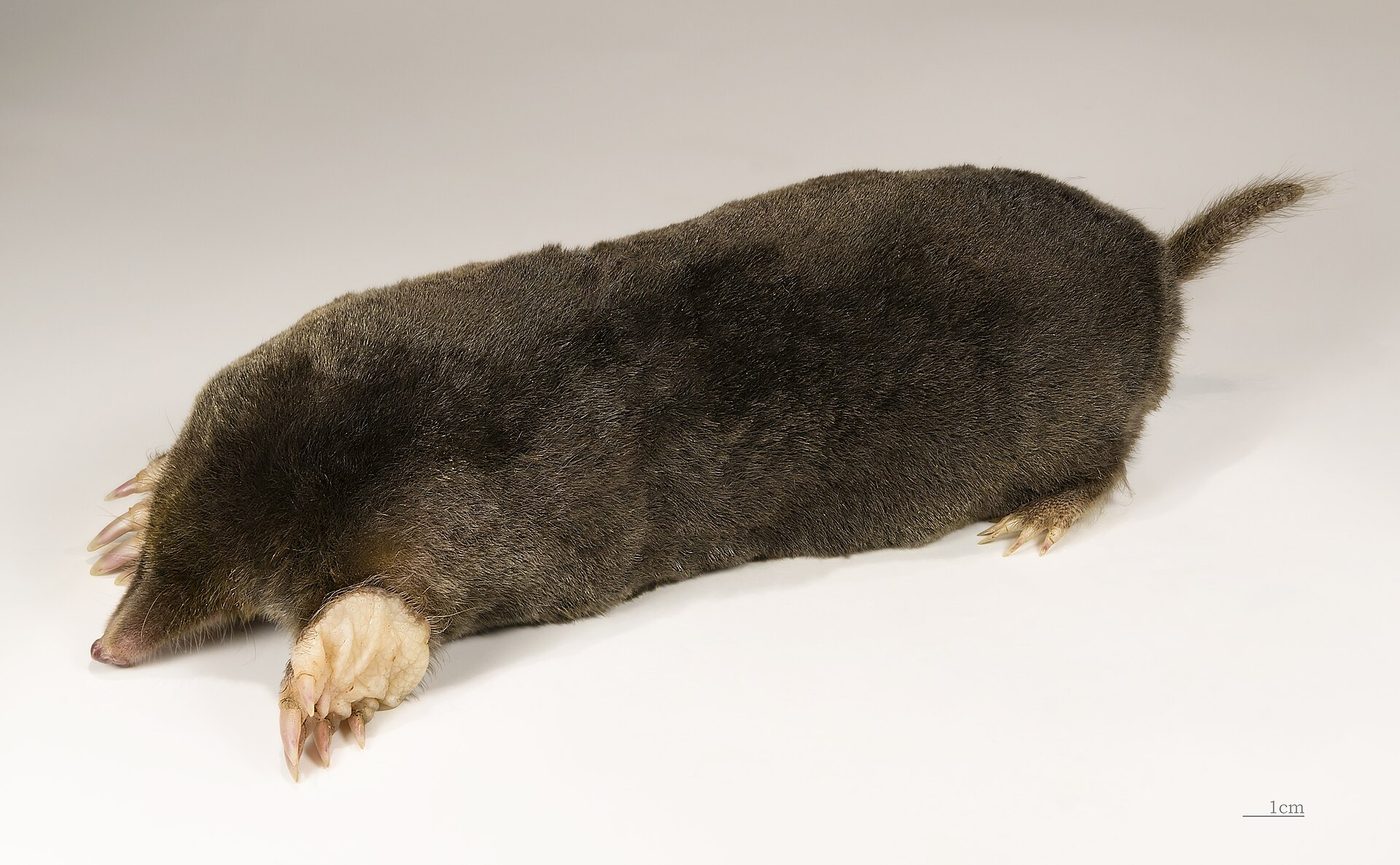
The European mole is a small burrowing mammal with a cylindrical body and large spade-shaped forefeet, living underground in an extensive tunnel network.
Characteristics
Temperament
Burrowing, solitary, territorial
Diet
Earthworms and other soil invertebrates
Description
The European mole is a small mammal of the mole family, perfectly adapted to life underground. It has a cylindrical, compact body 11-16 centimetres long, with an indistinct neck and a short tail. Its forefeet are transformed into stout, spade-shaped 'hands' armed with strong claws, true digging tools. Its muzzle is elongated and sensitive, its eyes tiny and barely functional, its ears without external flaps. Its dense, velvety fur is dark grey to black and can be stroked in any direction.
Habitat and distribution
It occurs from western Europe to Siberia. It lives in a great variety of habitats with soft, prey-rich soils: meadows, pastures, woods, fields, gardens and parks. Its presence is betrayed by the characteristic heaps of earth, the molehills.
Behaviour
It spends almost its whole life underground, digging an extensive network of tunnels that act as traps: by patrolling them, it catches the earthworms and other invertebrates that fall in. It has a high metabolism and must eat large amounts of food each day. It is solitary and territorial, and stores live earthworms by immobilising them with a bite.
Did you know?
The mole is almost blind, but navigates thanks to a very keen sense of smell and touch: its muzzle is equipped with highly sensitive receptors. Its fur, which has no grain, lets it move back and forth in its tunnels effortlessly.
Notes and role
It is classed as least concern. Although its molehills are unwelcome in the garden, the mole is useful: it aerates the soil and controls populations of soil larvae and invertebrates.
Pros
- Extraordinarily adapted to underground life
- Aerates the soil and controls harmful invertebrates
- Very keen sense of smell and touch
Cons
- Molehills are unwelcome in the garden
- High metabolism, must eat a lot
- Almost blind, relies on smell and touch