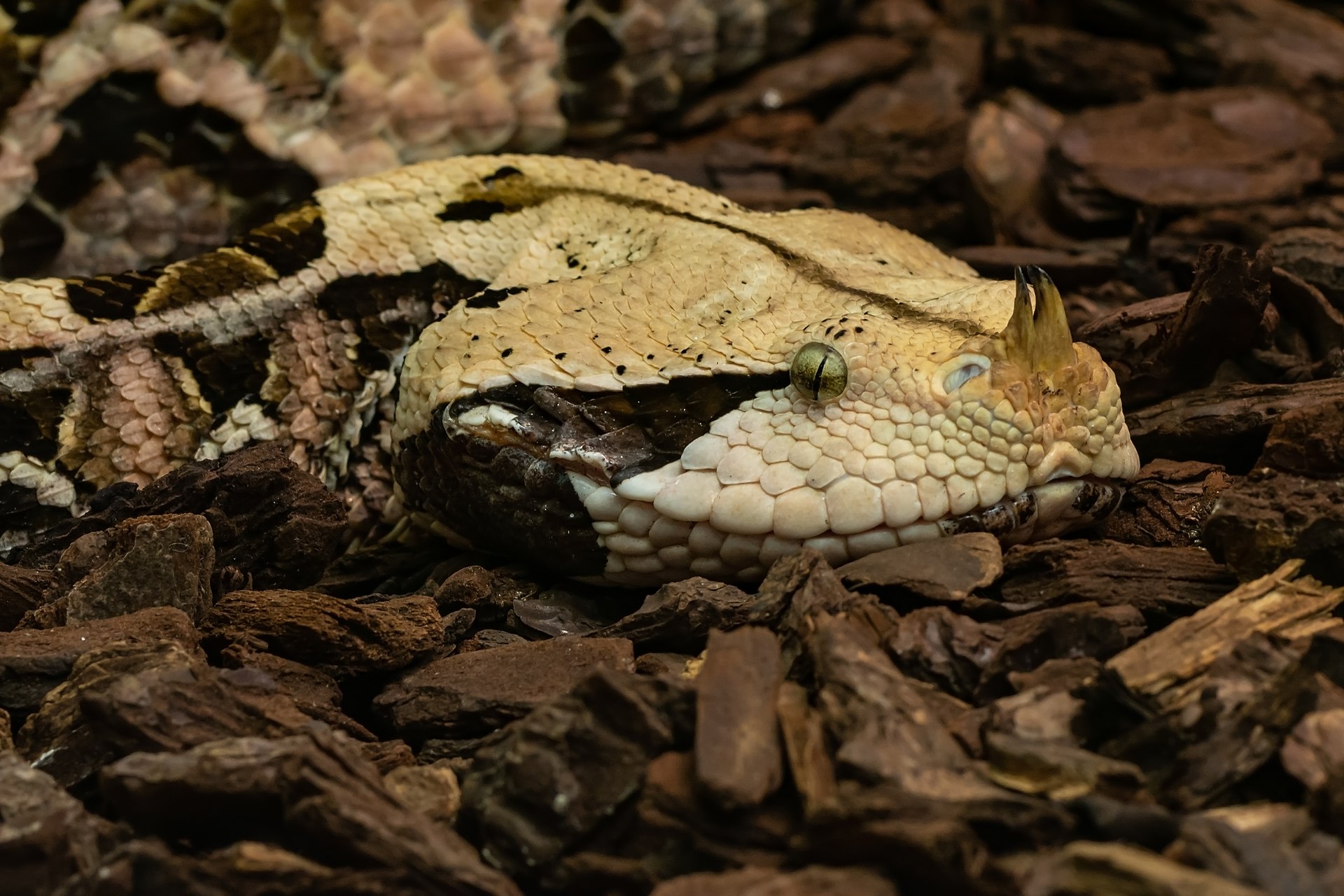
Gaboon Viper
Bitis gabonica
Characteristics
Temperament
Solitary, mostly nocturnal, terrestrial. AMBUSH PREDATOR with PERFECT MIMICRY among dry leaves (can stay still for WEEKS!). 3 WORLD RECORDS: longest fangs (5 cm!), highest venom dose (450-600 mg!), widest head in proportion among vipers. Slow 4 km/h but explosive strike 2.4 m/s. Ovoviviparous with huge litters 5-60 cubs. Heaviest viper in the world (record 11 kg).
Diet
Obligate carnivorous ambush predator. Rodents 50-60% diet, birds 15-20%, frogs/toads 10-15%, young hares 5-10%, palm civets, small mongoose, occasional small antelopes, small pythons (cannibalism). Hunting: total stillness + mimicry + 2.4 m/s explosive strike + 5 cm fangs + 450-600 mg venom + olfactory tracking + whole swallowing. 1 large meal every 1-3 months.
The Gaboon Viper (Bitis gabonica) is one of the most impressive snakes in the world, holding 3 world records among living snakes:
- LONGEST VENOM FANGS IN THE WORLD: up to 5 cm — absolute record among snakes (King Cobra 1.5 cm, Russell's Viper 1.5 cm, Black Mamba 6 mm)
- HIGHEST VENOM DOSE PER BITE: 450-600 mg dry venom per bite (record 2,400 mg). King Cobra 200 mg, Russell's Viper 130 mg, Black Mamba 100-120 mg
- WIDEST HEAD IN PROPORTION: 8-10% of total length, triangular with perfect leaf pattern
Also the heaviest African viper (up to 8 kg, record 11 kg!) and one of the longest (1.2-1.8 m avg, record 2.05 m). Famous for perfect mimicry: leaf-pattern coat allows complete stillness for weeks on tropical forest floor, indistinguishable from fallen leaves. Ambush predator. Distribution: Sub-Saharan Africa from Sierra Leone to Tanzania, mainly primary tropical forests. IUCN Least Concern globally, declining regionally.
Classification and category
Order Squamata, suborder Serpentes, family Viperidae, subfamily Viperinae, genus Bitis. Genus contains 17 living species of "African vipers". Most known: B. gabonica (this entry), B. arietans (Puff Adder), B. nasicornis (Rhinoceros Viper), B. parviocula, B. atropos, B. caudalis.
Recent split into 2 species (Lenk et al., 1999): Bitis gabonica (Eastern, Central-East Africa) and Bitis rhinoceros (Western, Sierra Leone to Nigeria, with 2 nasal horns).
Etymology: "Bitis" Late Latin "morsus" (bite). "Gabonica" from Gabon. Described by Duméril et al. 1854. Parameters: Weight 3-8 kg average (record 11 kg!). Length 1.2-1.8 m average (record 2.05 m). Head width 8-10 cm. Fangs 3-5 cm (record). Longevity 10-15 years natural, 20-25 captive. Sexual maturity 3-4 years. Ovoviviparous: live births. Litter 5-60 cubs (avg 20-40), 30-35 cm at birth with functional venom system.
Habitat and distribution
Endemic to sub-Saharan Africa, mainly primary tropical forests. West Africa: B. rhinoceros (Sierra Leone, Liberia, Côte d'Ivoire, Ghana, Togo, Benin, Nigeria, Cameroon). Central Africa: B. gabonica (Cameroon east, Gabon, CAR, Congo, DRC). East Africa: Uganda, Rwanda, Burundi, Tanzania, Kenya. Southern Africa: Zimbabwe, Mozambique, NE South Africa. Habitats: primary tropical forests (main), secondary humid forests, forest edges, riparian forests, seasonal floodplains. Avoids dry forests, completely open areas, deserts, montane areas above 1,500 m, intensive urban areas. IUCN: Least Concern globally, declining in West Africa. Threats: deforestation (main), hunting (skin, venom, trophy), kill-for-fear, illegal pet trade ($500-2,000 USD), road accidents, predation (Secretary Bird, eagles, mongoose, monitor lizards, leopards, warthogs). CITES: NOT included.
Diet
Exclusively carnivorous ambush predator. Diet: rodents 50-60% (rats, mice, gerbils, Gambian giant rats), birds 15-20% (understorey, francolins, quails), frogs/toads 10-15%, rabbits/leverets 5-10%, palm civets, mongoose, squirrels, occasional small antelopes (dik-dik, duiker calves), small pythons (cannibalism), warthog piglets (record). Hunting technique: complete stillness + mimicry + 2.4 m/s explosive strike + 5 cm fangs deliver 450-600 mg venom + grip and track via olfaction + whole-prey swallow.
Venom: hemotoxic + neurotoxic + cytotoxic. LD50 mouse 5 mg/kg subcut (vs King Cobra 0.5 mg/kg, Black Mamba 0.3 mg/kg) — less potent per mg but huge dose. Human mortality: 30% without antivenin, 5% with. Antivenoms: SAIMR Polyvalent (S. Africa), SAVP Polyvalent (UK NHS). Feeds 1 large meal every 1-3 months.
Physical features
Unmistakable silhouette: huge triangular head, stocky body, short tail. Coat: complex geometric pattern (triangles, rhombuses, banners) of brown-chestnut, yellow-ochre, purple-lilac, black, white. Mimics dry leaves + dappled light through canopy. PERFECT mimicry for tropical forest understorey. Head: ENORMOUS triangular (8-10 cm wide, widest in proportion among vipers), supraocular scales slightly raised ("rudimentary horns", emphasized in B. rhinoceros), golden eyes with vertical pupils, thermal pits between eye and nostril (infrared detection of warm prey at 1-2 m), extensible jaws for large prey, FANGS 3-5 cm (longest in world!), foldable (solenoglyphous). Body: heavy, robust, up to 11 kg, keeled scales, short tail. Speed: slow 4 km/h locomotion, 2.4 m/s strike (fastest documented in heavy snakes).
Behaviour and curiosities
Solitary, mostly nocturnal, terrestrial (not arboreal). Small territory (1-5 ha). Polygamous breeding. Dry-season mating, ritualised male combat (no venom). 12-month gestation. Ovoviviparous live birth. 5-60 cubs. No parental care.
Famous: 3 world records simultaneously (fangs, dose, head). Perfect mimicry studies: experts can walk within 30 cm without seeing them. Snake remains still for WEEKS. Species split 1999 (Lenk et al.): B. rhinoceros (Western) separated from B. gabonica (Eastern), 4-6 Mya divergence. African cultural beliefs: Bantu "nyoka mama" (mother of snakes), Pygmies as forest spirit, Yoruba death deity association, Kikuyu initiation ritual. Explosive strike: 2.4 m/s (60 ms vs human blink 200 ms). Huge meals: 5 kg viper ate 2.5 kg warthog piglet (Tanzania 1987). Ovovivipary for thermal/predator protection of embryos. Bitistatin peptide explored for anti-thrombosis medicine. Secretary Bird antagonist: Sagittarius serpentarius is its main natural predator. Longevity: 20 years San Diego Zoo (1985-2005).
Pros
- 3 record mondiali tra serpenti (zanne, dose veleno, testa)
- Mimetismo perfetto tra foglie secche (esempio paradigma)
- IUCN Least Concern, popolazione stabile complessivamente
- Veleno usato per ricerca farmacologica (Bitistatin)
Cons
- Mortalità 30% senza antiveleno (morsi rari ma gravi)
- Distruzione foreste tropicali primarie (causa declino regionale)
- Cattura illegale per pet trade ($500-2000)
- Vulnerabile a investimenti stradali per lentezza