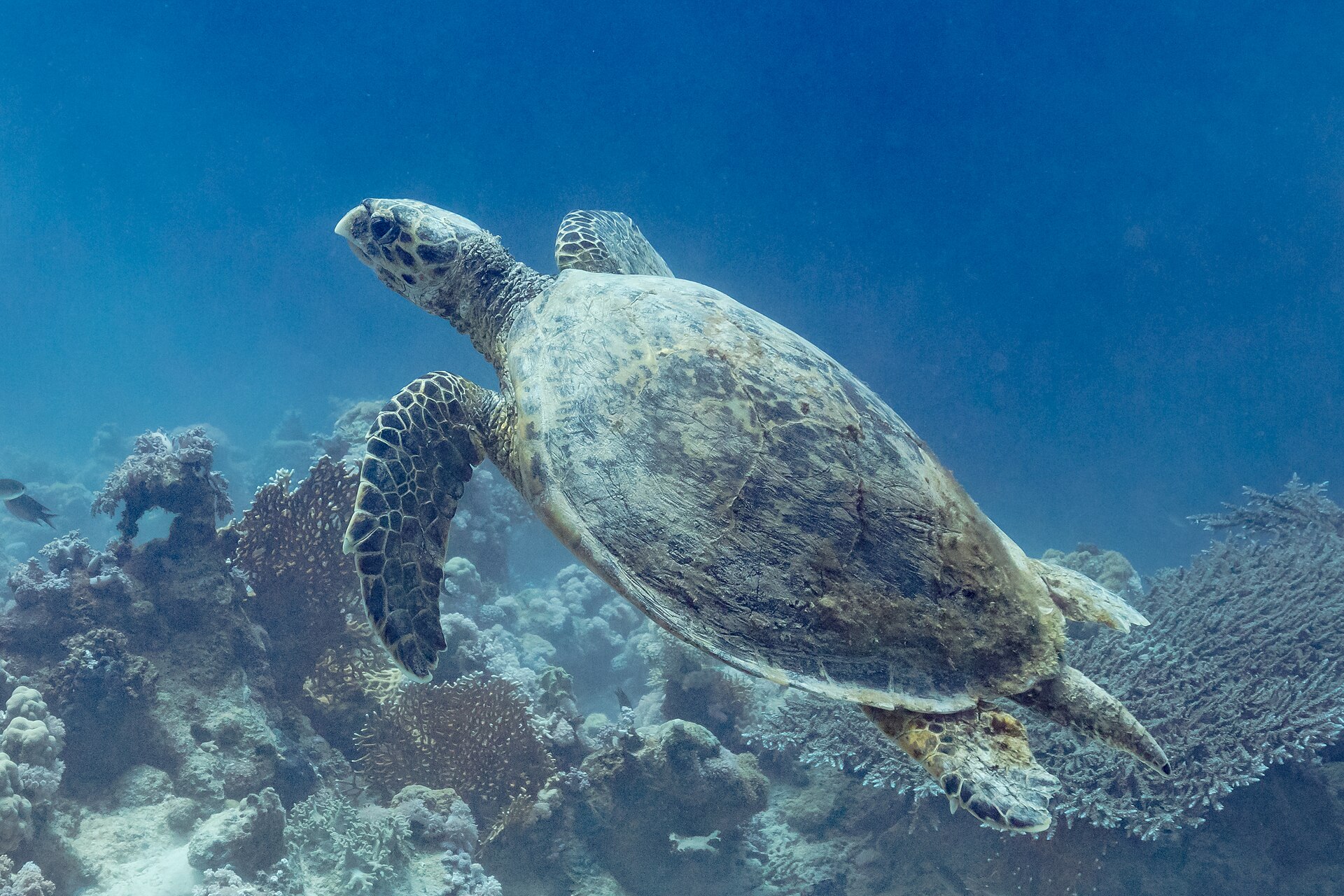
Hawksbill Sea Turtle
Eretmochelys imbricata
Characteristics
Temperament
A wild, solitary sea turtle, NOT a pet: it spends almost its whole life at sea, among tropical coral reefs, and only females return periodically to land to nest. It is calm but agile, able to slip among the crevices of the corals thanks to its narrow, pointed beak. Highly specialized in its feeding (it eats mainly sponges), it plays a fundamental ecological role for reef health. It is a Critically Endangered species, gravely threatened above all by the historical "tortoiseshell" trade and by the destruction of coral reefs. It is a symbol of marine conservation and must be protected, never exploited or kept in captivity.
Diet
An extremely specialized diet: it is essentially spongivorous, that is, it feeds mainly on marine sponges, an almost unique niche in the animal world. It supplements with sea anemones, other invertebrates, jellyfish, gelatinous organisms and algae. The narrow, pointed, hooked beak is the perfect tool for reaching prey hidden in the crevices of the corals. It can feed on sponges rich in defensive substances, which accumulate in its tissues, sometimes making its flesh toxic to humans. By feeding on sponges (which compete with corals for space) it plays a precious role in keeping coral reefs healthy.
The Hawksbill Sea Turtle (Eretmochelys imbricata) is one of the most beautiful, recognizable and gravely threatened sea turtles on the planet. A splendid inhabitant of coral reefs, it is famous for:
- The hawk-like beak: narrow and pointed like a raptor's, hence the name "hawksbill"
- The imbricate scutes: the carapace scutes overlap like roof tiles, hence the name "imbricata"
- The "tortoiseshell": of magnificent amber, marbled hues, historically coveted and the cause of its decline
- The sponge-based diet: it is one of the very few creatures that feed on marine sponges
- The bond with corals: it lives in tropical coral reefs, of which it is a guardian
- The critical status: it is a Critically Endangered species
IUCN status: Critically Endangered (CR). It enters the portal among the sea turtles, alongside the green sea turtle and the loggerhead: with them it completes the portal's trio of great ocean turtles, representing the three best-known sea turtle species in the world.
Classification and category
The Hawksbill belongs to the order Testudines, family Cheloniidae (the hard-shelled sea turtles), genus Eretmochelys, of which it is the only living species: Eretmochelys imbricata. In the portal it is placed among the sea turtles. It is useful to tell it apart from the portal's other two sea turtles: the green turtle (Chelonia mydas) — larger, with a rounded head and a non-hooked beak, herbivorous as an adult; the carapace scutes do not overlap; the loggerhead (Caretta caretta) — larger, with a very big, massive head and powerful "shell-crushing" jaws; the hawksbill is recognized by its narrow, pointed, hooked beak, its overlapping (imbricate) scutes and the serrated rear margin of the carapace; it is also the most tied to coral reefs. The combination of hawk beak + imbricate (overlapping) scutes + amber serrated carapace + reef habitat is the hawksbill's "identity card". Etymology: the species name imbricata comes from the Latin "imbrex" (roof tile) and refers precisely to the carapace scutes that overlap like the tiles of a roof; the English name "hawksbill" recalls the hooked beak similar to a hawk's. Parameters: Carapace length usually about 60-90 cm. Weight on average about 45-80 kg, smaller than the green and loggerhead. Appearance a medium-sized sea turtle, with a hydrodynamic body and a very colourful shell. Longevity: a long-lived species, living several decades and reaching sexual maturity after many years. Reproduction: females lay eggs in holes dug in the sand of tropical beaches; the hatchlings' sex depends on the incubation temperature.
Habitat and distribution
The Hawksbill is a tropical species, closely tied to coral reefs: its range covers tropical seas and oceans worldwide, both in the Atlantic and the Indo-Pacific. Preferred habitats — above all coral and coastal environments: coral reefs, its preferred environment, where it seeks food among the crevices; lagoons, rocky coasts and shallow coastal waters; and tropical sandy beaches, essential for egg-laying. It is a marine, solitary animal that spends its life at sea, of which only females return periodically to land to nest. Thanks to its narrow, pointed beak, it can slip into the crevices of the coral reef to reach its prey, above all sponges. Although it does make movements, it is generally more tied than other turtles to the reef areas where it finds food. IUCN status: Critically Endangered (CR). The hawksbill is one of the most threatened sea turtles. The main historical cause of its collapse is exploitation for "tortoiseshell", the precious material obtained from its scutes, used for centuries for ornaments, combs, glasses and luxury objects. To this are added the destruction of coral reefs, accidental capture in nets, plastic ingestion, egg collection and pollution. It is internationally protected and listed in CITES (Appendix I), which bans its trade.
Diet
The Hawksbill has an extremely specialized diet: it is essentially spongivorous, that is, it feeds on marine sponges, an almost unique food niche in the animal world. Its diet includes: marine sponges (the main component, including species that for other animals would be toxic or inedible); sea anemones and other invertebrates; jellyfish and other gelatinous organisms; and algae and occasionally other material. Features of its feeding behaviour: the "reef tool" beak (the narrow, hooked shape of the beak is perfect for reaching sponges and invertebrates hidden in the crevices of the corals); an eater of toxic sponges (it can feed on sponges containing harmful substances, which accumulate in its tissues, sometimes making its flesh toxic to humans); and a guardian of corals (by feeding on sponges, it helps keep them under control, leaving space for corals and contributing to reef health). Crucially, this dietary specialization makes the hawksbill an ecologically precious species, whose role in keeping coral reefs in balance goes well beyond its mere survival.
Physical features
The Hawksbill is perhaps the most elegant and colourful of the sea turtles. The head and beak — the distinguishing trait: a tapered head with a narrow, pointed, hooked beak, similar to a raptor's; suited to probing the crevices of the coral reef. The carapace: imbricate scutes (the scutes partly overlap like tiles, a unique trait among adult sea turtles); a magnificent colouration (amber, brown and marbled, with radiating patterns, the famous "tortoiseshell"); a serrated, saw-like rear margin. The body and limbs: a medium size, smaller than the green and loggerhead; limbs transformed into flippers, with two pairs of claws on the front flippers; a hydrodynamic body, perfect for moving nimbly among the corals.
Curiosities and conservation
The Hawksbill is a true jewel of tropical oceans, whose extraordinary beauty has paradoxically also been its curse. Its story is a warning about the price nature can pay for human vanity.
The "tortoiseshell": the beautiful shell of the hawksbill is the source of so-called "tortoiseshell" (Japanese "bekko"), a material of warm amber hues used for centuries to make combs, glasses frames, jewellery and art objects; this trade decimated the species' populations worldwide; today genuine tortoiseshell is banned by CITES, and the objects on the market are fortunately almost always plastic imitations. The hawk's beak: the name "hawksbill" perfectly describes its most obvious feature: a narrow, pointed, curved beak, similar to a raptor's; far from being merely aesthetic, this beak is a perfect tool for reaching sponges and other invertebrates hidden in the narrowest crevices of the coral reef. The sponge eater: the hawksbill is one of the very few creatures in the world to feed mainly on marine sponges, organisms most animals avoid because they are rich in silica and defensive chemicals; this extraordinary diet can make its flesh toxic to humans, and helps maintain the balance of coral reefs. The reef guardian: by feeding on sponges, which compete with corals for space, the hawksbill plays a fundamental ecological role: it helps control the growth of sponges and keep coral reefs healthy and diverse; its disappearance would therefore have consequences on entire marine ecosystems, well beyond the species itself. The tiled shell: unlike the other adult sea turtles, in which the carapace scutes are side by side, in the hawksbill the scutes partly overlap like the tiles of a roof; it is precisely this feature, the "imbrication", that gives it its scientific name, imbricata, and makes it recognizable at a glance. Conservation: the hawksbill is classified as Critically Endangered by the IUCN, one of the highest threat levels; besides the historical tortoiseshell trade, today it is threatened by the destruction of coral reefs (itself linked to climate change), accidental capture, plastic pollution and egg collection; its protection depends on safeguarding coral reefs, respecting nesting beaches, fighting illegal trade and reducing marine pollution; saving this splendid turtle also means protecting the extraordinary coral ecosystems of which it is a symbol and guardian.
Pros
- Tartaruga marina splendida e inconfondibile, simbolo delle barriere coralline
- Ruolo ecologico prezioso: mangiando spugne aiuta la salute dei reef
- Dieta unica nel mondo animale (una delle poche spongivore)
- Completa nel portale il trio delle tartarughe marine (con Verde e Caretta)
Cons
- In Pericolo Critico (IUCN): una delle tartarughe marine più minacciate
- Vittima storica del commercio del 'tartarugato' (oggi vietato dalla CITES)
- Minacciata da distruzione dei coralli, reti, plastica e prelievo delle uova
- È una specie selvatica e protetta, NON un animale da compagnia