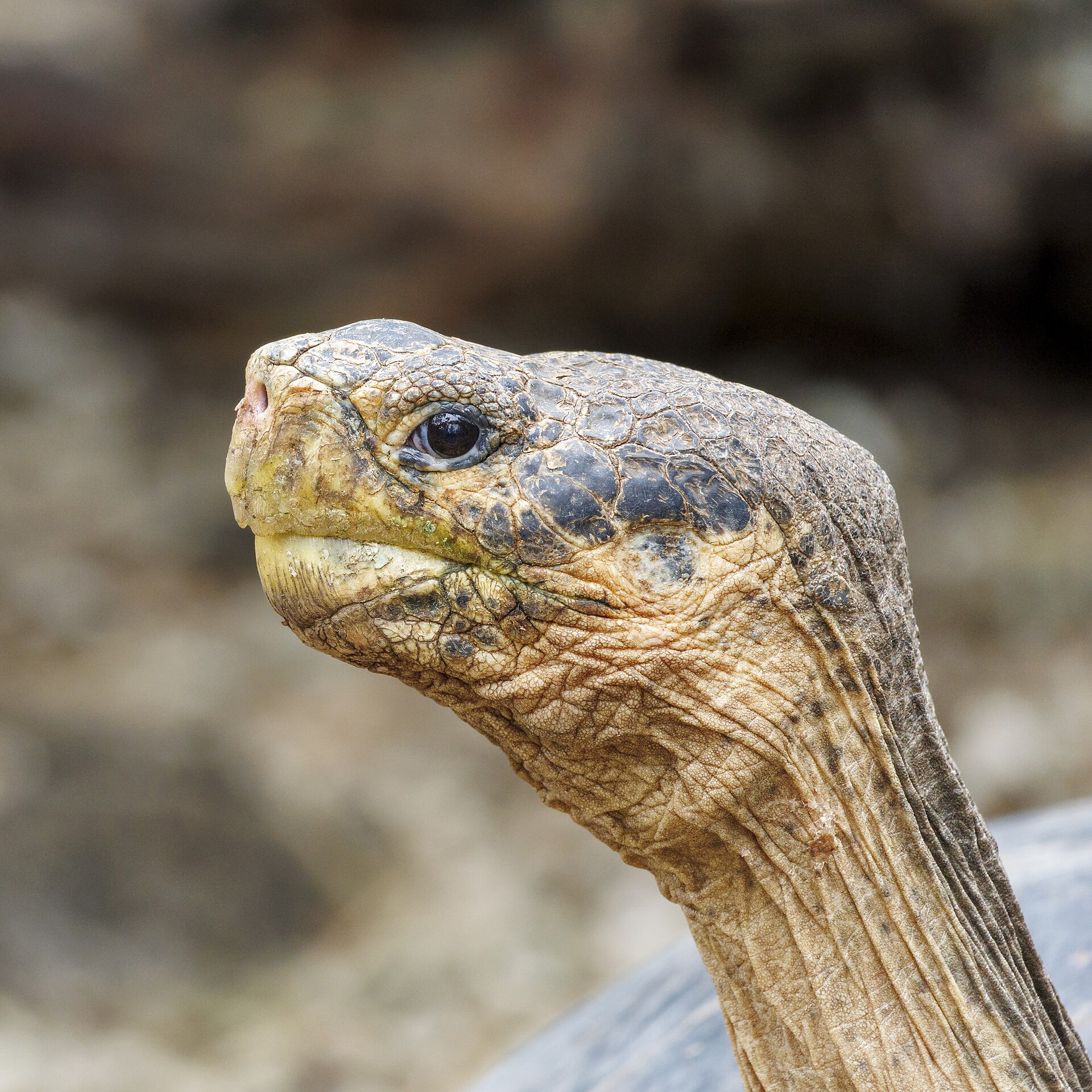
Galápagos Tortoise
Chelonoidis nigra
Characteristics
Temperament
Solitary, diurnal, gentle. Speed 0.3 km/h. Ritual combats between males without physical contact. Inspired Darwin's theory of evolution. Survives 1 year without drinking water.
Diet
Strict herbivore: leaves, grasses, flowers, fruits, prickly pear cactus, lichens. Very slow metabolism. Drinks up to 15 L/day but survives 1 year without water. Endemic to Galápagos.
The Galápagos Tortoise (Chelonoidis nigra), also known as the Galápagos Giant Tortoise, is the largest living terrestrial reptile. Endemic to the Galápagos Islands in the Pacific Ocean (Ecuador), it is one of the most iconic animals in natural history: its morphological variants between different islands inspired Charles Darwin during the Beagle voyage in 1835, contributing to the formulation of the theory of evolution by natural selection (1859). With a longevity that can exceed 150 years and a weight reaching 400 kg, it is one of the longest-lived vertebrates on the planet and a true living fossil that tells the evolutionary story of millions of years.
Classification and category
The Galápagos Tortoise belongs to the order Testudines, family Testudinidae, genus Chelonoidis. The species complex of the genus has undergone profound taxonomic revisions in the last 30 years thanks to DNA studies: today 15 distinct species of Chelonoidis are recognised in the Galápagos (previously considered subspecies of C. nigra), of which 12-13 surviving and 2-3 extinct in historical times (C. abingdonii, C. niger, C. wallacei). Each species is generally confined to a single island of the archipelago. They are huge reptiles: carapace length is 1.2-1.8 m, average adult weight 150-300 kg, with documented record specimens of 417 kg. Males are significantly larger than females (up to double the weight).
Habitat and distribution
The habitat is limited exclusively to the Galápagos Islands, a volcanic archipelago of recent origin (5 million years) located on the equator, 1,000 km off the coast of Ecuador. Tortoises live in two main ecological zones: arid lowlands (semi-desert coastal areas with prickly pear cactus, populated by "saddleback" species) and humid highlands (high-altitude rainforests above 200 m, where "domed" species live). The different shapes of the carapace are a classic example of adaptive radiation: saddlebacks have the front opening of the carapace raised to extend the neck upwards and reach high leaves, domed have round carapaces to roll on the ground and feed on low grass.
The historical total population was estimated at 200,000-300,000 individuals at the time of the discovery of the islands in the 16th century. Three centuries of fishing for meat (tortoises were "living provisions" on whaling and pirate ships), habitat loss and introduction of alien species (goats, rats, dogs) reduced the population to less than 3,000 specimens in the 1970s. Active conservation programmes of the Galápagos National Park and the Charles Darwin Foundation have allowed an exceptional recovery: today the population is about 20,000-25,000 wild tortoises. Conservation status varies by species: some are Critically Endangered (CR) with fewer than 100 individuals (e.g. C. donfaustoi, recently described), others Vulnerable (VU). The most famous species, "Lonesome George" (C. abingdonii, Pinta Island), died in 2012 definitively extinguishing its species.
Diet
The Galápagos Tortoise is a strict herbivore, capable of feeding on a great variety of plants with very slow metabolism. The diet includes: leaves, grasses, flowers, fruits, prickly pear cactus (Opuntia echios — plant endemic to the Galápagos), lichens and bromeliads. It is particularly suited to digesting fibrous plant material thanks to a long intestine and specialised bacterial flora. Tortoises consume large amounts of water (up to 15 litres per day) when available, but are famous for their extraordinary tolerance to water fasting: they can survive without drinking for over a year, exploiting the metabolic water obtained from the digestion of body fats.
This characteristic made them tragically valuable to whalers and pirates of the 17th-19th centuries: a live tortoise could be preserved in the hold for months without food or water, providing fresh meat to the crew on long voyages across the Pacific. It is estimated that over 200,000 tortoises were "harvested" in this way, contributing to the extinction of entire populations. Today the wild Galápagos tortoises are completely protected: feeding or disturbing them is illegal, and access to many areas of the archipelago is regulated by the National Park.
Physical features
The Galápagos Tortoise has a robust body with bony dorsal carapace covered by cornified scutes. The shape of the carapace is the most variable and distinctive morphological trait: the two main types are the "domed" (dome-shaped, typical of humid islands), rounded and low, and the "saddleback" (saddle-shaped, typical of arid islands), with raised front opening that allows the neck to extend upwards to reach high vegetation. There are also intermediate types. The colour of the carapace varies from dark grey to brown-black.
The neck is extremely long and flexible (can extend up to 80 cm), allowing it to reach distant water and leaves. The head is large, with well-developed black eyes, sharp horny beak (teeth absent). The legs are column-like, similar to those of elephants, with sturdy fingers and short nails; the front and back feet are equal to each other. The whole bone structure is imposing: the skeleton is an integral part of the carapace (the ribs are fused with the structure). The skin is dark, thick, covered with scales. The longevity is extraordinary: documented specimens of 152 years (Harriet, deceased in 2006, raised by the Beagle parents in 1830), 175 years (Adwaita of Calcutta, Aldabra giant tortoise), and an estimated average life of 100-150 years in nature. Sexual maturity is reached late: 20-40 years.
Behaviour and curiosities
The Galápagos Tortoise is a solitary, diurnal, mild animal. It spends most of its time (over 16 hours a day) motionless, alternating periods of feeding, baths in water pools (important for thermoregulation and hydration), and long periods of rest. The average speed when moving is about 0.3 km/h, but can briefly reach 0.5 km/h. The term "turtle" as a synonym for slowness is not exaggerated: the iconic "sinusoidal walk" swaying gait is iconic.
Reproduction takes place between January and May. Males compete through ritual combats: they rise on their forelegs, extend their necks upwards, and the opponent with the longer neck (detected by the height reached) wins without physical contact. Females migrate up to 15 km towards arid zones to lay eggs in holes dug in sand (clutches of 2-16 eggs each, up to 4 clutches per season). The sex of the young is determined by incubation temperature (TSD): above 29.5°C females are born, below 28°C males are born. Incubation lasts 4-8 months depending on the island. Juvenile mortality is very high: only 1-2% of young survive the first year, mainly due to introduced predators (rats) and alien species (fire ants, feral cats).
Charles Darwin, during his stay in the Galápagos (September-October 1835), observed the tortoises and noted: "I can tell from the shape of the carapace which island a tortoise comes from". This observation, together with those on finches (the "Darwin's Finches"), was seminal for the theory of evolution. Today the tortoises represent an icon of Galápagos ecotourism: the Galápagos National Park welcomes ~270,000 visitors a year (2024 figures), generating fundamental resources for conservation. The "Galápagos Conservancy" finances ex-situ breeding programmes with subsequent release: over 7,000 juvenile tortoises have been reintroduced to the original islands, bringing some populations close to extinction (e.g. Española) back from the brink of recovery.
Pros
- Più grande rettile terrestre vivente al mondo
- Longevità eccezionale (100-150 anni, record 175)
- Ispirò Darwin per la teoria dell'evoluzione
- Successo di conservazione (da 3.000 a 25.000 esemplari)
Cons
- Specie protetta CITES I, detenzione vietata fuori da zoo accreditati
- Mortalità giovanile 99% (predatori introdotti)
- Maturità sessuale lentissima (20-40 anni)
- La specie di Solitary George si è estinta nel 2012