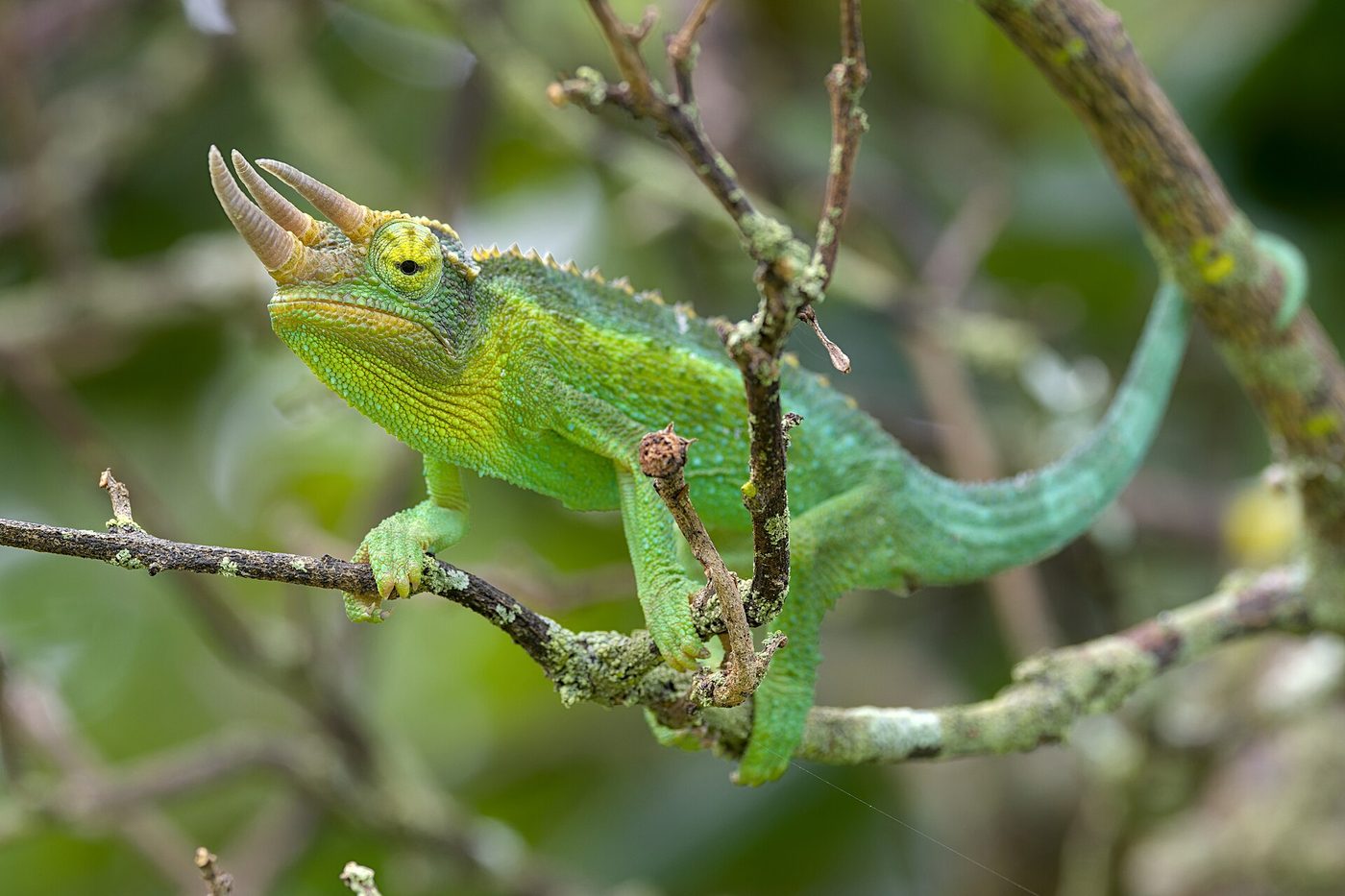
Jackson's chameleon
Trioceros jacksonii
Jackson's chameleon is an East African lizard that looks like a small dinosaur: the male bears three horns on its face, like a miniature triceratops.
Characteristics
Temperament
Arboreal, slow and diurnal; males with horns for duels.
Diet
Insectivorous: insects and small invertebrates caught with the tongue.
The three-horned chameleon
Jackson's chameleon (Trioceros jacksonii), also called the three-horned chameleon, is a lizard of the family Chamaeleonidae famous for its almost prehistoric look. The male has three pointed horns — one on the snout and two above the eyes — reminiscent of a miniature triceratops, used in duels between rivals. The female usually lacks them or has them much reduced. Its colour is typically bright green, with the ability, common to chameleons, to change shades.
Habitat and range
It is native to the cool mountain forests of East Africa — Kenya, Tanzania and Uganda — up to around 2,000 metres, in often very humid, rainy habitats. It has also been introduced by humans to Hawaii, Florida and California, where it has formed stable populations.
Behaviour and diet
It is arboreal and diurnal: it moves slowly among branches, catching insects and other small invertebrates with the lightning projection of its long tongue. One peculiarity is its reproduction: unlike most chameleons, which lay eggs, Jackson's chameleon is ovoviviparous — that is, it gives birth to fully formed young.
Did you know?
It is one of the most widely kept chameleons in the terrarium hobby, prized precisely for its horns and relative hardiness. It prefers cooler, humid climates than many tropical species.
Conservation
The IUCN lists it as Least Concern. It is still widespread, but collection for the exotic pet trade and loss of montane forest are pressures to watch; captive-bred animals are the better choice.
Pros
- Unique miniature-triceratops look (male)
- Ovoviviparous: gives birth to live young
- One of the hardier chameleons in terrariums
Cons
- Prefers cool, humid climates
- Collected for the trade: choose captive-bred animals
- Delicate, needs specific care