Photo: Uoaei1 · CC BY-SA 4.0
European green lizard
Lacerta viridis
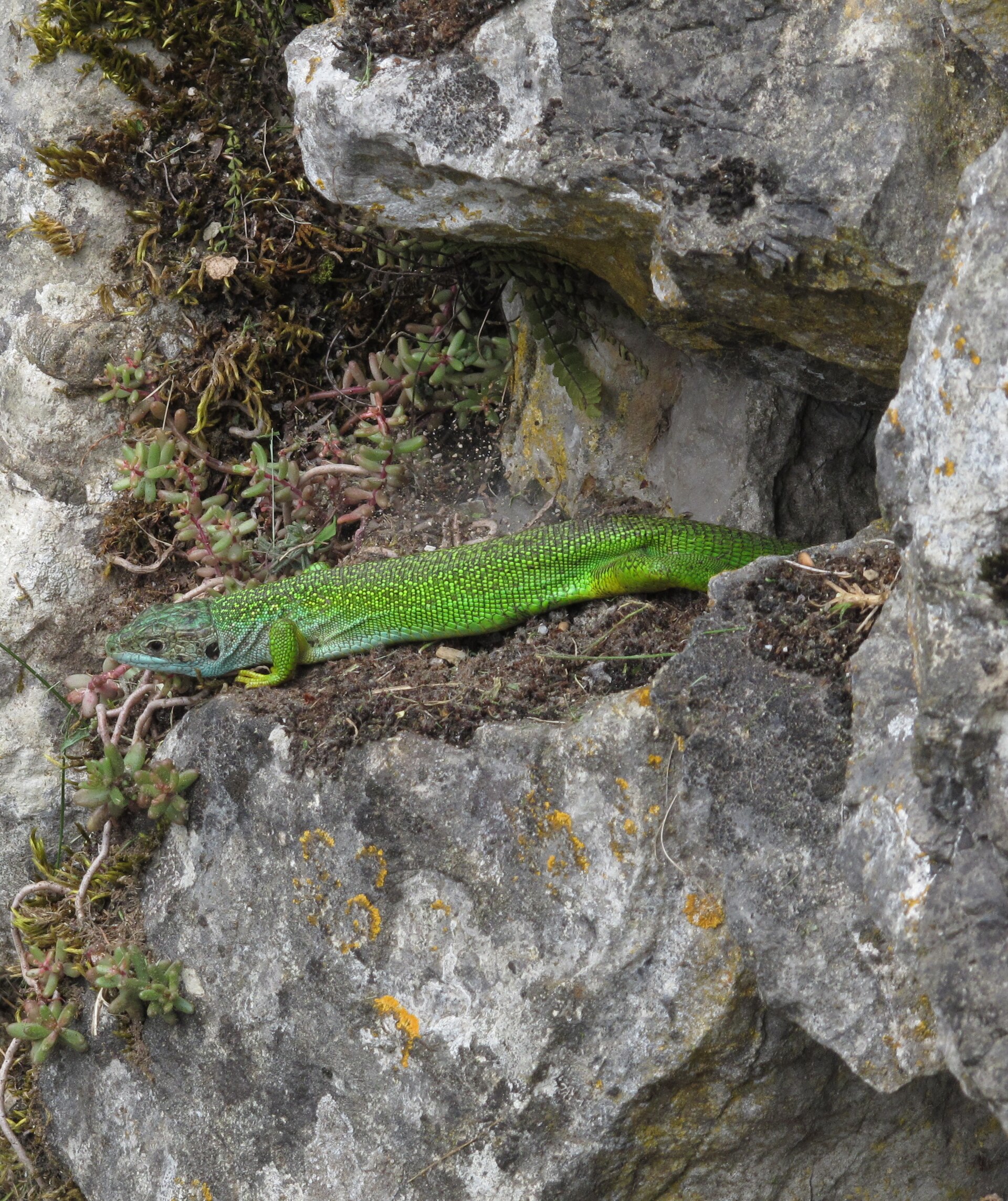
Emerald green and darting, the green lizard is the most striking of Europe's lizards: a flash of colour racing through the grass of sunny meadows.
Characteristics
Temperament
Diurnal, agile and wary, dependent on the sun to become active. Males are territorial; at the slightest threat it flees swiftly into dense vegetation.
Diet
Insectivore with a broad diet: insects, spiders, snails and earthworms, occasionally small vertebrates, eggs and fruit.
A lizard of dazzling green
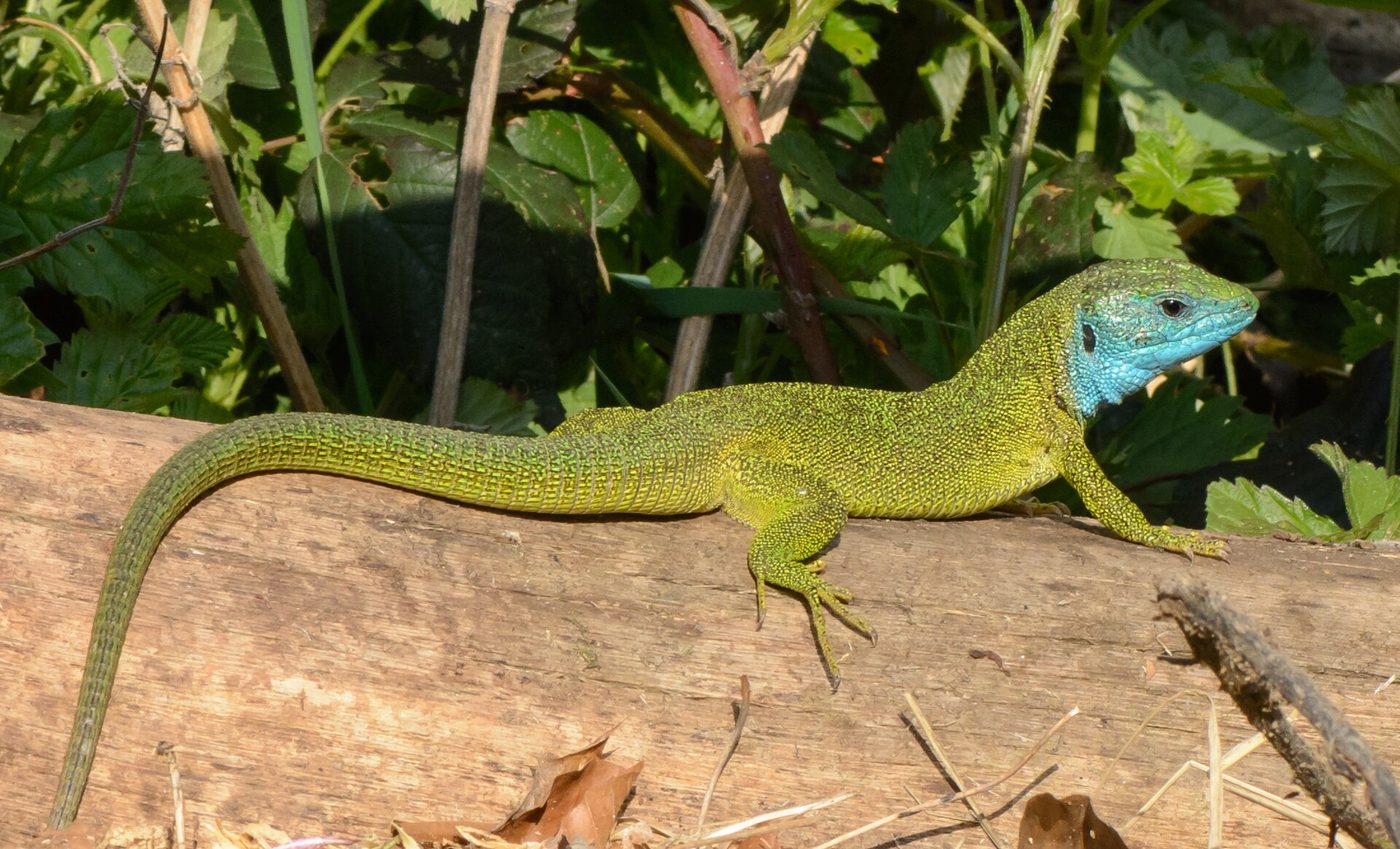
The European green lizard is one of the largest and most striking lizards in Europe. The male in particular sports a brilliant green livery that in spring flares into an intense blue on the throat, while the female tends towards a more uniform green, sometimes with pale streaks. The tail, very long, can exceed twice the length of the body and, as in many lizards, can be shed in an instant to escape a predator, later regrowing in a shorter form.
With a total length that can approach forty centimetres, it is impossible to confuse with the common wall lizards.
Where it lives
The green lizard favours warm, sunny settings with dense vegetation: woodland edges, hedgerows, rough meadows, grassy banks and vineyards. It likes to alternate areas of tall grass, in which to hide, with open spaces where it can warm itself in the sun. It is a typical inhabitant of the hill and lowland belt of central and southern Europe.
What it eats and how it lives
It is a diurnal predator feeding mainly on insects and other invertebrates such as spiders, snails and earthworms, but it does not spurn small vertebrates, eggs and, occasionally, ripe fruit. Like all reptiles it is ectothermic: it depends on external heat to regulate its body temperature, and so spends many hours basking in the sun before setting off to hunt.
Behaviour
The green lizard is agile, fast and rather wary: at the slightest danger it flees swiftly into the thick of the vegetation. Males are territorial and in spring may engage in lively clashes for control of the area and of females. With the arrival of cold the animal enters a phase of winter rest, taking refuge in burrows or crevices until the following spring.
Conservation
The European green lizard is listed as least concern, but its survival depends on the presence of open, sunlit environments with varied vegetation. Agricultural intensification, the loss of hedgerows and the spread of concrete reduce its habitat. In many countries it is a protected species.