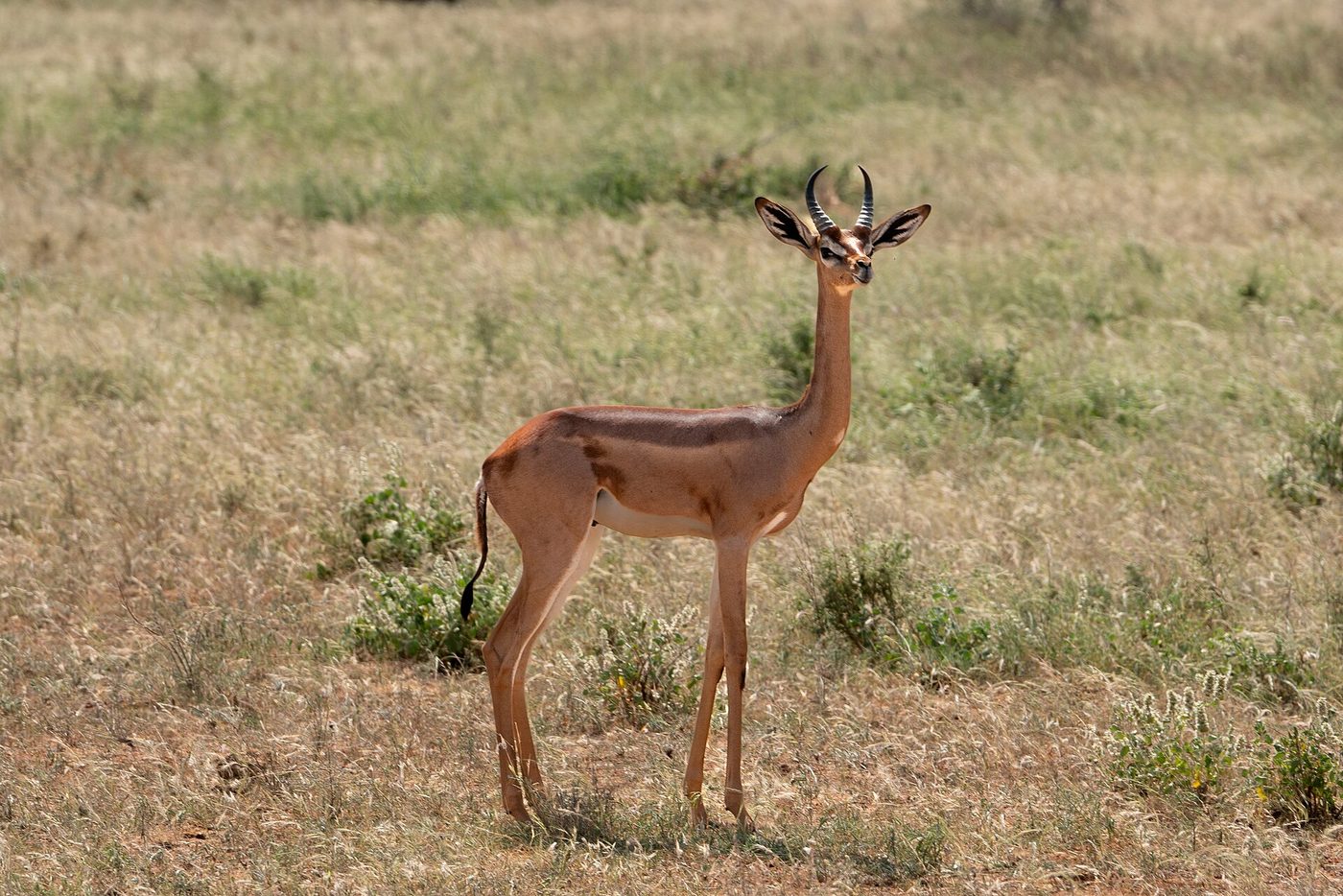
Photo: Payamfarahani · CC BY-SA 4.0
Gerenuk
Litocranius walleri
With its very long neck and slender legs, the gerenuk is an elegant African antelope able to stand up on its hind legs to browse the highest leaves.
Characteristics
Temperament
Shy, elegant, adapted to drought
Diet
Herbivore: high leaves and shoots of shrubs
The gazelle with a giraffe's neck
The gerenuk is an African antelope of unmistakable, slender appearance, nicknamed the 'giraffe gazelle' because of its exceptionally long, thin neck, supported by equally slim and elegant legs. Its body is compact, with a tawny coat on the back and paler on the belly. Its head is small, with large eyes and broad ears; only the males bear sturdy, curved horns. The combination of these features gives it a graceful and recognisable silhouette.
Habitat and distribution
It lives in the arid and semi-arid regions of East Africa, across Somalia, Ethiopia, Kenya and Tanzania, in dry savanna, scrubland and thorny areas. It is perfectly adapted to a habitat poor in water and low vegetation, where it knows how to make the most of the available resources in a way that is unique compared with other herbivores.
An unusual way of feeding
The gerenuk's most extraordinary feature is the way it feeds. Thanks to its very long neck and its ability to balance on its hind legs alone, it stands up, resting its front legs on the branches, thus reaching the highest leaves and shoots, out of reach of many other herbivores. This strategy allows it to exploit an exclusive feeding niche. Even more remarkable is its independence from water: the gerenuk gets almost all the moisture it needs from the plants it eats, and can live a long time without drinking.
Curiosities
The name 'gerenuk' comes from the Somali language and means 'giraffe neck', a clear reference to its most obvious feature. Its elegance and unique behaviour make it one of the most fascinating antelopes of the African savanna.
Conservation
The gerenuk is classified as a near-threatened species. The main threats are habitat loss and degradation, due to the expansion of human activities, and hunting. Conserving the dry savannas and scrublands where it lives is important to ensure the survival of this singular and graceful antelope.
Pros
- Very long neck, stands up to browse
- Extraordinary independence from water
- Exploits an exclusive feeding niche
- Elegant and unmistakable
Cons
- Near-threatened species
- Threatened by habitat loss and hunting
- Tied to specific arid environments