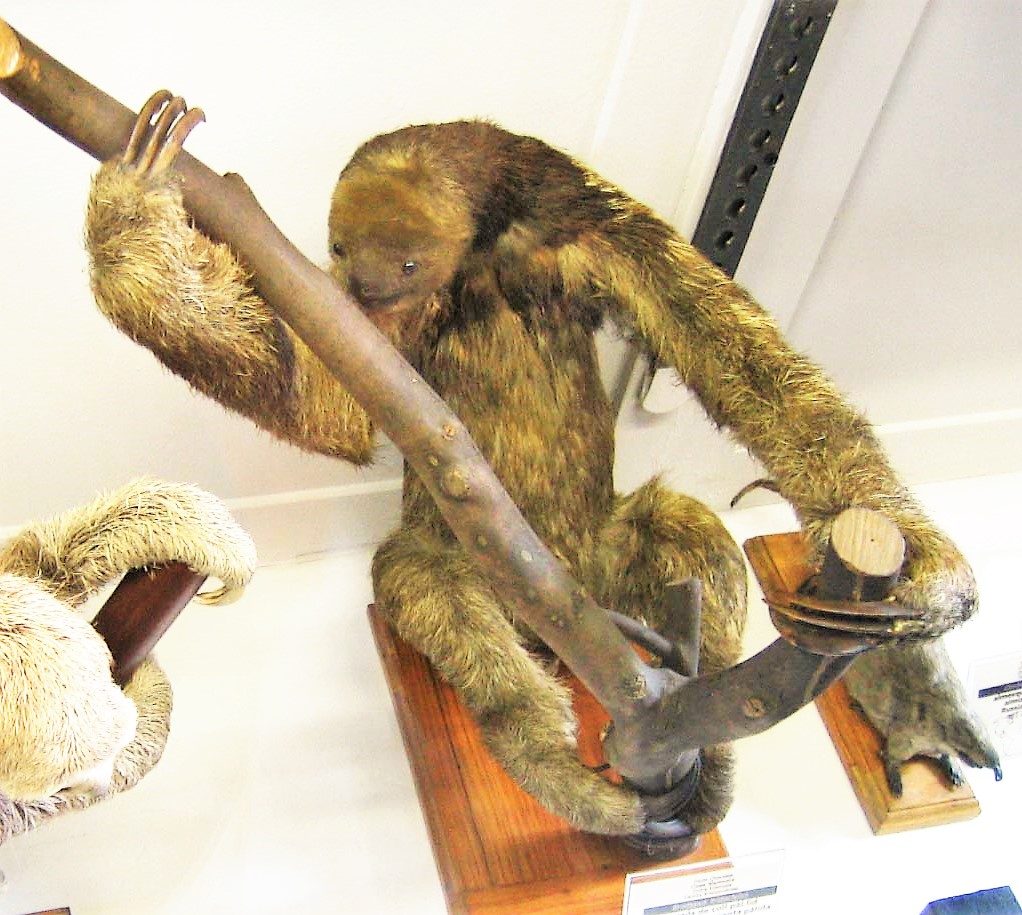
Photo: Esv - Eduard Solà Vázquez · CC BY-SA 3.0
Maned sloth
Bradypus torquatus
Very slow and with a characteristic mane of dark hair on its neck, the maned sloth is a rare arboreal mammal of the Brazilian Atlantic Forest.
Characteristics
Temperament
Very slow, solitary, placid, arboreal
Diet
Herbivore: almost exclusively leaves
A sloth with a mane
The maned sloth is one of the rarest and most fascinating sloths in the world. Like all sloths, it has a stocky body, long limbs ending in sturdy curved claws and a sleepy, placid appearance. Its most distinctive feature is a characteristic 'mane' of long dark hairs surrounding the neck and shoulders, particularly evident in the males, from which its name derives. Its fur, of a greyish-brown colour, often hosts microscopic algae that give it a greenish tint, a perfect camouflage among the leaves.
Habitat and distribution
This sloth is endemic to Brazil, where it lives exclusively in the Atlantic Forest, one of the richest and at the same time most threatened tropical forests on the planet. It is a strictly arboreal animal: it spends almost all its life suspended among the branches of the trees, moving with extreme slowness and only rarely descending to the ground.
Behaviour and diet
The sloth is famous for its proverbial slowness, which is not laziness but a refined adaptation. Its diet, composed almost exclusively of leaves, is poor in energy and difficult to digest: for this reason the animal has developed a very slow metabolism and economical movement that allows it to survive on few resources. Slowness also helps it go unnoticed by predators, which rely on movement to detect prey.
Curiosities
The relationship between the sloth and the algae living in its fur is a small ecosystem in miniature: the algae camouflage it and, according to some studies, may even contribute to its nutrition. Various small invertebrates also live on its body, making it a true living microcosm.
Conservation
The maned sloth is classified as an endangered species. The main threat is the dramatic destruction of the Atlantic Forest, of which only a small fraction survives today. Habitat fragmentation isolates the populations and reduces their survival. Protecting the remnants of this unique forest is essential to save this sloth and the immense biodiversity that surrounds it.
Pros
- Unique appearance with its characteristic mane
- Extraordinary example of adaptation to slowness
- A small living ecosystem with algae and invertebrates
- Symbol of the Atlantic Forest
Cons
- Endangered species
- Endemic: lives only in Brazil's Atlantic Forest
- Threatened by habitat destruction