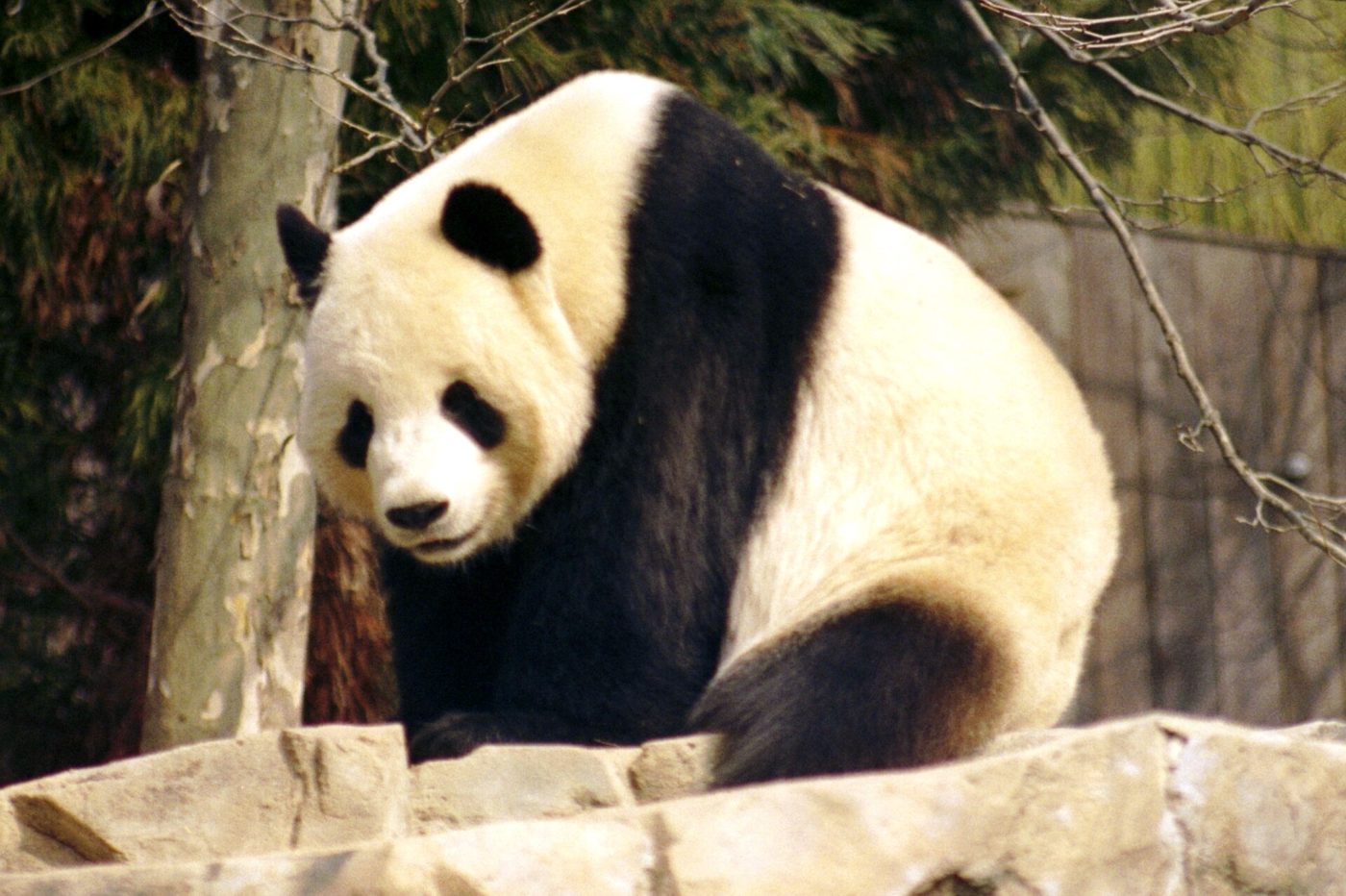
Photo: Jeff Kubina · Public domain
Giant panda
Ailuropoda melanoleuca
A worldwide symbol of conservation, the giant panda is a peaceful, solitary bear that has made bamboo its one extraordinary reason for living.
Characteristics
Temperament
Peaceful, solitary and calm, active at dawn and dusk. It spends much of the day feeding on bamboo; it meets its own kind almost only in the breeding season.
Diet
Almost exclusively bamboo, in enormous quantities; occasionally other plants and small animals.
An unmistakable bear
The giant panda is one of the most recognisable animals in the world, with its characteristic black-and-white coat: a pale body, and deep-black legs, ears and the famous patches around the eyes. It is to all intents a bear, belonging to the family of ursids, though its appearance and habits make it a case more unique than rare. It has a sturdy, stocky build and a fascinating anatomical peculiarity: an elongated wrist bone that works as a 'sixth finger', an opposable thumb that lets it grasp bamboo stems with dexterity.
A life of bamboo
The panda's diet is extraordinarily specialised: although a carnivore by anatomy and descent, it feeds almost exclusively on bamboo. Because this plant is low in nutrients, the panda must eat enormous quantities of it, up to dozens of kilograms a day, and spends much of its days chewing, seated among the bushes. Occasionally it supplements its diet with other plants or small animals, but bamboo remains the absolute focus of its existence.
Where it lives
The giant panda lives only in certain mountainous regions of central China, in damp, cool forests rich in bamboo, between a thousand and three thousand metres of elevation. It is a solitary and territorial animal, active mainly at dawn and dusk. It communicates with its kind through vocalisations and scent marks, meeting other pandas almost only in the mating season.
A tiny cub
One of the most surprising curiosities concerns the young: at birth a panda cub weighs barely a hundred grams, pink and helpless, incredibly tiny compared with its mother. Growth is slow and maternal care lasts a long time, one of the reasons why the species' reproduction is delicate.
Conservation
The giant panda is classified as a vulnerable species. Long threatened by the destruction of bamboo forests and the fragmentation of its habitat, it has become the very symbol of nature conservation. Thanks to massive protection efforts, the creation of reserves and breeding programmes, the situation has slowly improved, but its survival remains tied to the protection of China's mountain forests.