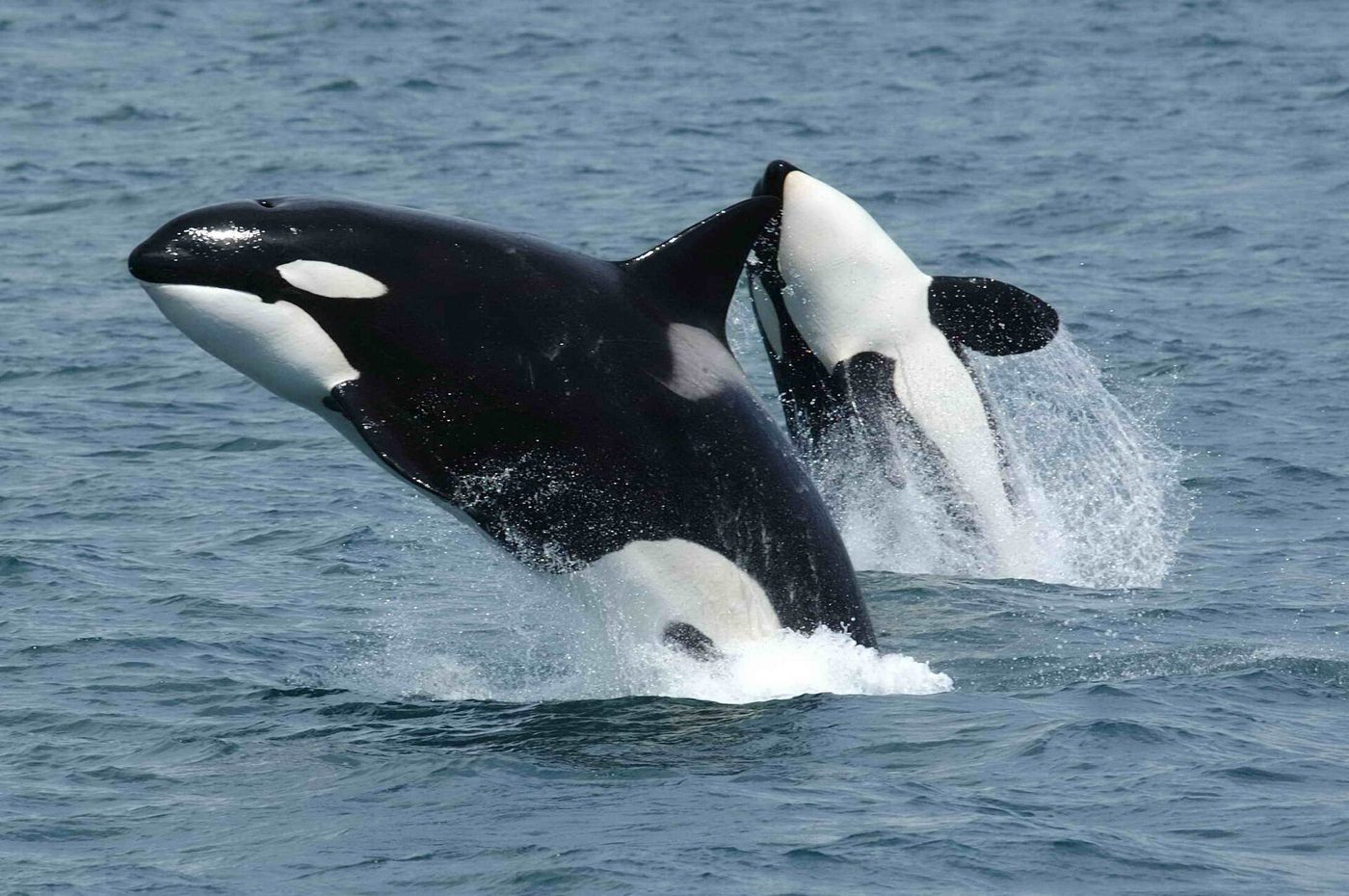
Photo: Robert Pittman · Public domain
Killer whale
Orcinus orca
Supreme predator of the oceans and in fact the largest of the dolphins, the orca lives in close-knit families and passes on hunting strategies like a true culture.
Characteristics
Temperament
Intelligent, social and cooperative. It lives in stable family groups led by the older females; it hunts as a team with learned, inherited strategies.
Diet
Apex carnivore: fish, squid, seals, penguins and, in some populations, great whales and sharks.
The largest of the dolphins
Despite the name 'killer whale' and its imposing size, the orca is not a whale but the largest member of the dolphin family. It is unmistakable for its sharply contrasting black-and-white livery, with a white patch behind the eye, and for its large dorsal fin, which in adult males can be very tall and straight. The body is sturdy and streamlined, built for speed and power. It is an apex predator, with no natural enemies in the sea.
Team hunting
The orca is one of the most intelligent and sophisticated hunters on the planet. It hunts in groups with coordinated strategies that vary from population to population: some pursue fish and squid, others hunt seals, penguins or even great whales and sharks. Some orcas create waves to slide seals off ice floes, others deliberately beach themselves to catch prey on the shore. These techniques are learned and passed on from generation to generation.
A family life
Orcas live in very stable family groups, often led by the oldest females. In many populations the offspring stay with their mother for life. Communication takes place through a rich repertoire of sounds, and each group has its own 'dialect' of calls, handed down among its members. This transmission of knowledge and habits is regarded as a form of animal culture.
Where it lives
The orca is found in all the world's oceans, from polar waters to tropical seas, and is among the most widely distributed of mammals. Different populations are specialised in different prey and environments, so much so that scientists are studying whether it is a single species or several distinct forms.
Conservation
Globally the orca is classified as data deficient, because its populations are so diverse and scattered that a single assessment is difficult. Some local populations, however, are in serious danger from pollution, the decline of prey and human disturbance. Its conservation calls for the study and protection of individual populations.