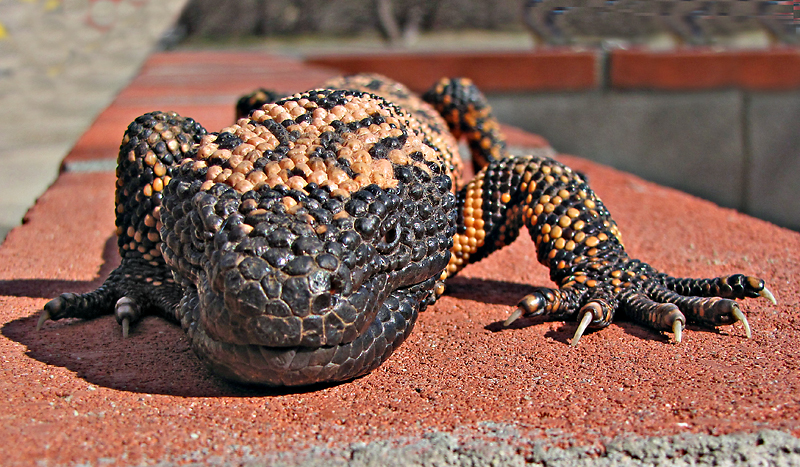
Gila Monster
Heloderma suspectum
Characteristics
Temperament
Solitary, 95% subterranean, crepuscular-nocturnal summer. ONE of ONLY 2 VENOMOUS LIZARDS in the world. Hemotoxic+neurotoxic venom via GROOVED TEETH (not fangs!). Venom glands in LOWER jaw (unique among reptiles). TENACIOUS bite 8-10 minutes. Max speed 2.4 km/h (slowness record!). Only 5-10 meals/year. Tail fat reserve. Living fossil (70 Mya).
Diet
Specialised carnivore. Eggs (30-50%), small mammals (cottontail cubs, rabbits, ground squirrels, desert rats), small reptiles, amphibians, carrion. Hunts by smell (forked tongue) and burrow digging. TENACIOUS bite 8-10 min with grooved teeth. Only 5-10 large meals/year. Eats 33-50% of body weight in single meal. Lives off tail fat between meals.
The Gila Monster (Heloderma suspectum), is one of ONLY 2 venomous lizards in the world (with its Mexican cousin Heloderma horridum) — the only living species of the family Helodermatidae. Endemic to the deserts of the southwestern United States and northwestern Mexico (Sonoran, Mojave, Chihuahuan deserts), this 350-700 g, 30-50 cm long lizard is famous for:
- Aposematic (warning) coloration: reticulated pattern of bright black-orange or black-pink
- Potent venom: hemotoxic and neurotoxic, delivered via grooved teeth (NOT fangs as in snakes)
- "Tenacious" bite: once it grasps a prey or aggressor, holds the grip for 8-10 minutes while chewing to inject more venom
- Very slow: maximum speed 2.4 km/h — much slower than a human
- Long life: 20-30 years in nature, up to 40+ in captivity
- 95% subterranean: spends most of its life in burrows and rocky shelters
- Fat reserve in the tail: can survive months without eating
- Revolutionary pharmacology: its venom led to Exenatide (Byetta), a multi-billion-dollar Type 2 diabetes drug
IUCN status: Near Threatened (NT) — threatened by habitat loss, illegal collection for pet trade, road accidents. Estimated global population: 50,000-100,000 individuals.
Classification and category
The Gila Monster belongs to order Squamata, suborder Anguimorpha, infraorder Platynota, family Helodermatidae, genus Heloderma. The family Helodermatidae is one of the oldest among living lizards — dating back to the Late Cretaceous (~65-70 Mya), survived the K-Pg mass extinction event!
The genus Heloderma comprises 5 species: H. suspectum (Gila Monster, two subspecies: H. s. suspectum "reticulated" and H. s. cinctum "banded"); H. horridum (Mexican Beaded Lizard); H. exasperatum, H. alvarezi, H. charlesbogerti (Critically Endangered, ~150 individuals).
Closest relatives: the monitor lizards (Varanidae). The Komodo Dragon is the largest relative. Studies from 2005-2009 (Bryan Fry et al.) discovered that monitors ALSO produce similar venom, suggesting venom in reptiles is older than thought.
Etymology: "Heloderma" from Greek "hēlos" (stud) + "derma" (skin) — reference to the osteodermic scales, similar to beads or studs. "Suspectum" from Latin "suspect" (the first describer Edward Drinker Cope was not certain of the venom in 1869). The species was described scientifically in 1869.
The morphological parameters: Weight 350-700 g. Total length 30-50 cm (M record 56 cm). Snout-vent length 20-35 cm. Tail 30-40% total length, thick "sausage". Longevity: 20-30 years in nature, up to 40+ in captivity (record 42 years). Sexual maturity: 4-5 years. Reproduction: very slow — females lay 2-12 eggs every 1-3 years. Incubation: 130-160 days.
Habitat and distribution
The Gila Monster is endemic to the southwestern USA and northwestern Mexico: Arizona (main USA population), New Mexico, southern Nevada, southern Utah, California, Sonora (~60% of world population), Sinaloa. Habitats: Sonoran Desert, Mojave Desert, Chihuahuan Desert, semi-arid grasslands, rocky slopes, arid alluvial valleys. Altitude: 0-1,500 m. Total population estimated 50,000-100,000 individuals. IUCN status: Near Threatened (NT) since 2007. Threats: habitat loss, illegal pet trade, road accidents, persecution, climate change. CITES: Appendix II.
Diet
The Gila Monster is a specialised carnivore. Diet: eggs (30-50% of diet), small mammals (cottontails, ground squirrels), small reptiles, amphibians, occasional carrion, occasional insects. Hunting technique: slow patrol (max 2 km/h), olfactory search using Jacobson's organ, digs into other animals' burrows, bites and CHEWS for 8-10 minutes injecting venom via grooved teeth. Only 5-10 large meals/year! Can eat 33-50% of own body weight in single meal. Lives off tail fat between meals.
Physical features
The Gila Monster has a stocky and robust body. Coat: black/dark purple base with bright orange/pink/yellow aposematic pattern (reticulated in H. s. suspectum, banded in H. s. cinctum). Skin covered with osteodermic "bead-like" scales. Head: large, flat, powerful jaws, dark eyes, forked purple-blue tongue, 8 grooved teeth per jaw, venom glands in LOWER jaw (unique among reptiles — opposite of snakes). Tail: thick "sausage" — fat reserve. Speed: 2.4 km/h max. Bite grip: ~25 psi (force is not the key — TENACITY is).
Behaviour and curiosities
The Gila Monster is solitary, mostly crepuscular-nocturnal in summer. Lives 95% of time underground. Territory 0.5-2 ha. Mating April-June with male-male wrestling competitions. Mating itself lasts 40 minutes - 8 hours (males bite female to anchor — but DON'T inject venom!). 2-12 eggs laid, incubation 130-160 days. Young born fully independent with functional venom.
Famous curiosity: "drug from venom". John Eng (1980s-90s) identified Exendin-4 in Gila Monster saliva — a GLP-1 analogue. Synthesised as Exenatide, launched antidiabetes drugs Byetta (2005) and Bydureon. Market: $1+ billion/year. Subsequent peptides (Semaglutide = Ozempic/Wegovy) derived from same mechanism. Gila Monster has literally saved millions of diabetics worldwide.
"Tenacious bite": once bitten, won't let go for 8-10 minutes while chewing. Old West stories describe people having to drown bites in water or use levers. "Living fossil": Helodermatidae date back ~70 Mya, survived K-Pg extinction. Cultural significance: Apache, Navajo, Hopi, Pima, Yaqui all have shamanic/spiritual relations with the Gila Monster. Bite to humans: ~10-15 documented/year USA, NO recorded deaths since 1939. Pain is severe (lava-burning sensation) but rarely fatal. Lowest metabolism: only 5-10 meals/year, 33-50% body weight in single meal.
Pros
- Solo 2 lucertole velenose al mondo — fascino unico
- Veleno ha originato Exenatide (farmaco diabete miliardi $)
- Fossile vivente: 70 milioni di anni di evoluzione
- Icona del Sud-Ovest americano e culture indigene
Cons
- IUCN Near Threatened, popolazione in declino
- Raccolta illegale per pet trade ($1.000-3.000)
- Lento (2,4 km/h) — alta mortalità da investimenti
- Morso estremamente doloroso (anche se non fatale)