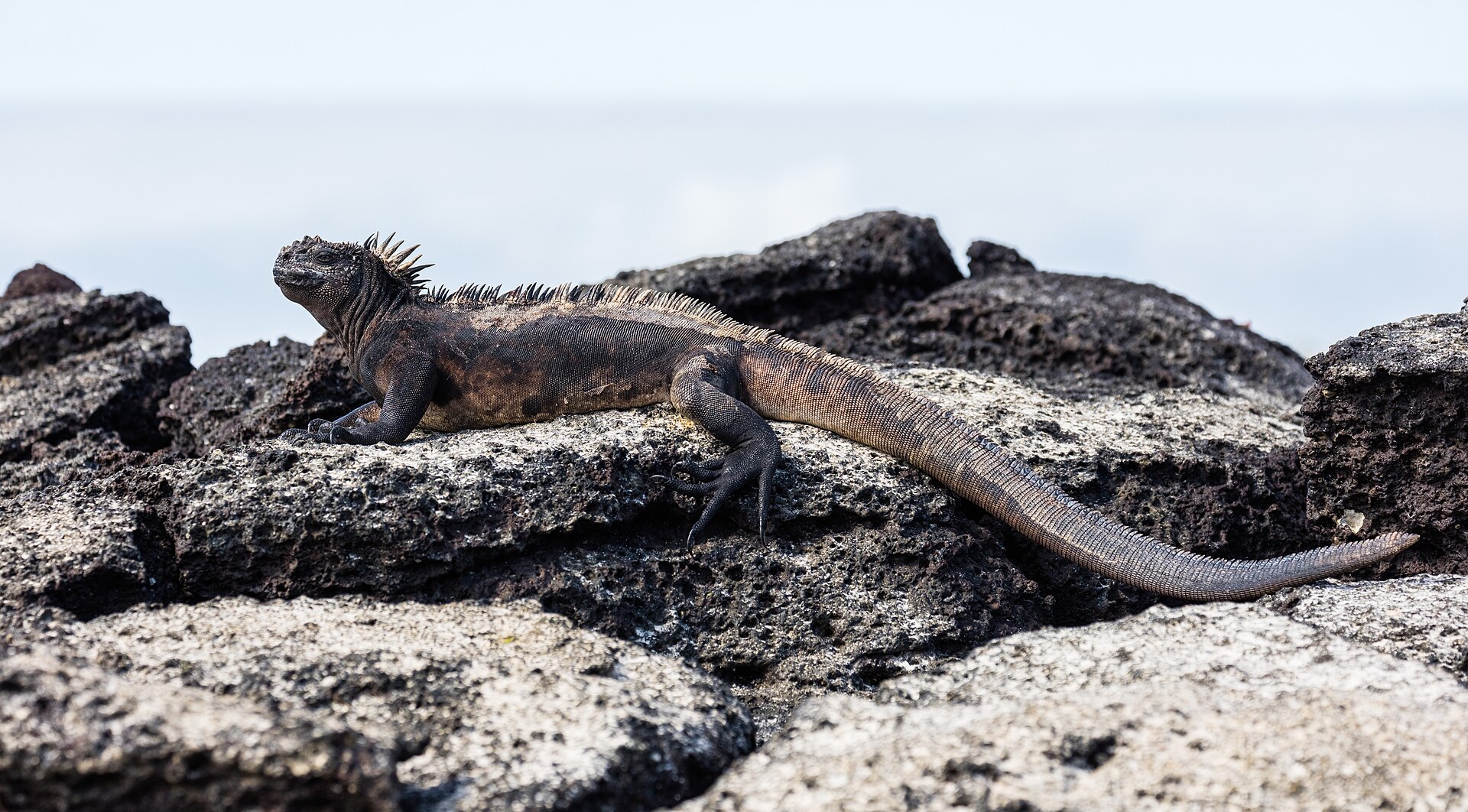
Marine Iguana
Amblyrhynchus cristatus
Characteristics
Temperament
Only marine lizard in the world. Social, diurnal, territorial during breeding. Capable of 15-45 min apnea (record 1h 45min). Heart: 4-5 bpm during immersion. "Shrinks" 20% during famine (El Niño). Expels salt by sneezing from nostrils.
Diet
Strict herbivore on marine algae (red and green). Adult males dive up to 30 m depth. Females and juveniles graze in intertidal zone. Only marine herbivorous lizard in the world.
The Galápagos Marine Iguana (Amblyrhynchus cristatus) is one of the most extraordinary and unique animals in the world: the only lizard on the planet that has completely adapted to marine life. Endemic to the Galápagos Islands (Ecuador), it has evolved in 4-5 million years a series of exceptional physiological and morphological adaptations to hunt in the cold waters of the Pacific Ocean: prolonged apnea capacity (up to 45 minutes), salt tolerance (expelled by nasal glands), thermoregulation through social aggregations. Charles Darwin, who observed it during the Beagle voyage in 1835, was disgusted, writing: "Imps of darkness, with black skin, stupid and slow"; however, his observations were fundamental for the theory of evolution. Today it is classified as Vulnerable by IUCN and protected by the Galápagos National Park.
Classification and category
The Marine Iguana belongs to the order Squamata, suborder Lacertilia, family Iguanidae, genus Amblyrhynchus. It is the only species of the genus, distinct from other Iguanidae for total marine specialisation. Recent genetic studies have identified 11 geographic subspecies, each confined to a single island of the archipelago, with distinctive morphological and chromatic characteristics (some populations are uniform black, others present vivid red-green-blue colouration during the breeding season, nicknamed "Christmas iguanas" for the festive colours). The size varies considerably between subspecies: length 60-150 cm (maximum in populations of Isabela and Fernandina), weight 1-12 kg (record 12 kg in large males from Fernandina). Males are significantly larger than females (up to double the weight). The evolution of A. cristatus separated from the Galápagos land iguana (Conolophus subcristatus) about 4.5-5 million years ago, from a common South American ancestor transported to the islands on floating vegetation rafts.
Habitat and distribution
The habitat of the Marine Iguana is limited exclusively to the Galápagos Islands, volcanic archipelago of 13 main islands and over 100 islets, located on the equator 1,000 km from the coast of Ecuador. It lives in littoral zones: volcanic rocky coasts, lava cliffs, black sand beaches, coastal mangroves. It never moves further than 100 metres from the shore, and depends totally on the sea for food.
The environment is extreme: the oceanic waters around the Galápagos are cold (even 11-23 °C) due to the presence of the Humboldt Current (cold current from Patagonia) and the Equatorial Upwelling (cold deep waters that rise). For an ectothermic (cold-blooded) reptile, swimming in these waters is an enormous physiological challenge: body temperature can drop from 35-37 °C (on rocks in the sun) to 25 °C (in water) in a few minutes, drastically reducing muscle efficiency. The total population is estimated at 200,000-300,000 specimens, with large variations between islands. Conservation status is listed as Vulnerable (VU) by IUCN. The main threats are: introduced predators (cats, dogs, rats that prey on eggs and young), El Niño (climatic events that drastically reduce algal biomass, causing mortality of even 90% in isolated populations), excessive tourism (disturbance during thermoregulation), hydrocarbon pollution (local oil incidents, e.g. Jessica shipwreck 2001). The species is completely protected by the Galápagos National Park and listed in CITES Appendix II.
Diet
The Marine Iguana is a strict herbivore specialised in marine algae, the only lizard in the world with this diet. It feeds almost exclusively on red algae (Rhodophyta) and green algae (Chlorophyta) that grow on the rocky bottoms of the intertidal and subtidal zone. The main species consumed are: Centroceras clavulatum, Hypnea pannosa, Ulva spp., Cladophora spp.
The feeding technique differs by sex and size: females and juveniles graze algae in the intertidal zone during low tide, without diving. Large adult males actively dive into the sea up to 25-30 metres deep, remaining in apnea 15-45 minutes (absolute record for a non-marine reptile) and feeding on nutrient-rich underwater algae. During immersion, heart rate drops from 100 to 4-5 bpm to conserve oxygen (dive reflex). The longest dives last over 1 hour with a record apnea of 1 hour and 45 minutes. Breathing is completely nasal (not buccal like terrestrial iguanids), to prevent the ingestion of salt water. The Marine Iguana is also famous for its "saline tears": it has two large nasal glands that concentrate the salt ingested with food and periodically expel it through vigorous sneezing — observable behaviour on rocks in the sun and that creates spectacular saline encrustations on the head.
Physical features
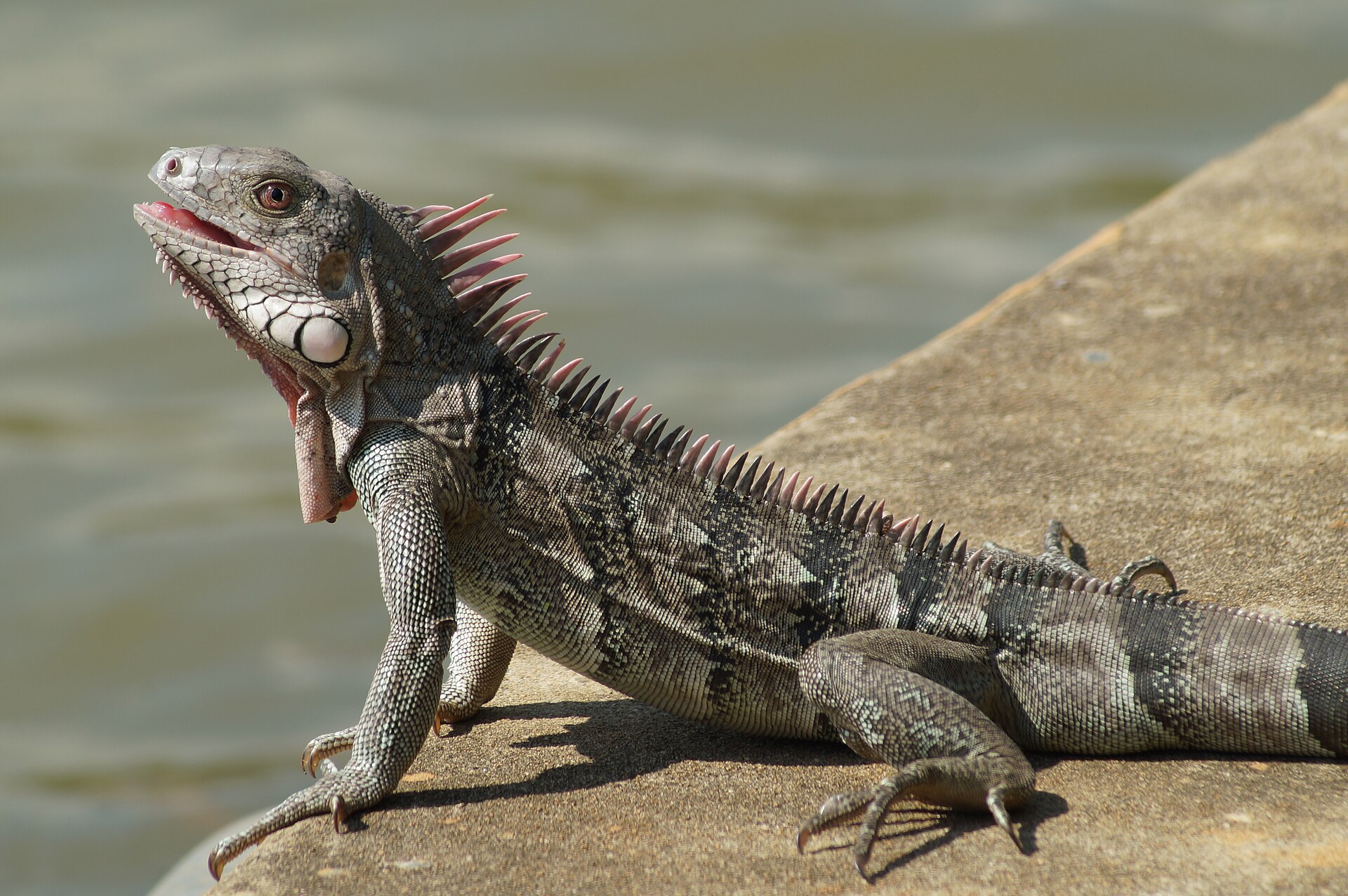
The Marine Iguana has a massive, stocky body, perfectly adapted to amphibious life. The colour varies by population and season: predominantly slate black (to absorb solar heat after cold dives), but some populations show spectacular red-green colouration during the breeding season (subspecies A. c. venustissimus from Española, nicknamed "Christmas Iguanas"). Juveniles are darker.
The muzzle is characteristically "truncated and flattened" (hence the scientific name Amblyrhynchus = "flat muzzle"), an adaptation to graze algae directly on rocks. The teeth are multi-lobed, perfect for tearing algae (75 teeth per jaw, continuously replaced). The tail is laterally compressed, almost twice as long as the body, and works as a powerful propeller during swimming (sinusoidal undulatory movement, similar to that of crocodiles). The legs are short but muscular, equipped with long and sturdy claws to cling to rocks battered by waves. The skin is covered with bone-like scales (osteoderms) that protect from impact with rocks during storms. Along the back runs a characteristic dorsal crest of horny spines, taller in adult males (can reach 7-10 cm). The thermoregulatory physiology is extraordinary: the iguana alternates long periods in the sun on black rocks (to warm up to 35-37 °C) with brief immersions in the cold sea. At night, individuals huddle (groups of 50-200 specimens) to reduce heat dispersion. The ability to enter extreme brachycardia (4 bpm) during apnea, and to suspend blood flow to the extremities to concentrate heat in vital organs, are unique among reptiles.
Behaviour and curiosities
The Marine Iguana is a social, diurnal, territorial during reproduction animal. It lives in coastal colonies of hundreds of individuals that share thermoregulation sites. Communication includes head shakes (dominance signal), salt "sneezes" (physiological status signal), body postures. Reproduction takes place between December and March: dominant males establish reproductive territories (1-2 m²) through ritual fights (frontal headbutts, similar to those of deer). The female lays 1-6 eggs in sand or gravel holes 40-80 cm deep, where they are incubated for 95-110 days. The young at birth measure 25 cm and are already autonomous.
A unique characteristic discovered only in 2000 (Wikelski et al., Nature) is the ability to physically shrink during famine events (such as El Niño years). During these periods, when algal biomass collapses, marine iguanas lose up to 20% of body length by reabsorbing bone matter. This "body shrinking" is reversible: when food conditions improve, iguanas resume their original length. It is the only documented case of an adult vertebrate that actively reduces for survival, suggesting new hypotheses on bone plasticity. Longevity is 12-30 years: females live on average 12 years, males 20-30 years due to larger size and lower reproductive stress (reproduction is energetically expensive for females).
Historical and cultural curiosities: Charles Darwin during the Beagle voyage (September 1835) described the Marine Iguanas as "imps of darkness", remaining aesthetically disgusted but fascinated from an evolutionary point of view. His observations were fundamental for the theory of evolution (Marine Iguanas are a classic example of adaptive radiation). Today they represent an ecotourism icon of the Galápagos: the National Park welcomes ~270,000 visitors/year (2024), generating resources for conservation. Marine Iguanas appear in David Attenborough's documentary films ("Planet Earth II", 2016: famous scene of the young escaping from the Galápagos racer snake) and in the logo of the Galápagos National Park. Scientifically, they are a fundamental model for studies on: adaptation to marine environment, apnea physiology, climate change (El Niño sensitivity), phenotypic plasticity (body shrinking).
Pros
- Unica lucertola marina del mondo, endemica Galápagos
- Ispirò Darwin per la teoria dell'evoluzione
- Apnea record per un rettile non marino (45 min)
- Capacità di 'restringersi' fisicamente in carestia (unica nei vertebrati)
Cons
- Specie protetta CITES II, detenzione vietata fuori da zoo accreditati
- Mortalità 90% durante eventi El Niño in popolazioni isolate
- Minacciato da predatori introdotti (gatti, cani, ratti)
- Non è specie da terrariofilia in nessun caso