Common Chameleon
Chamaeleo chamaeleon
Characteristics
Temperament
An arboreal wild reptile, diurnal, solitary and very slow, of a shy, calm nature. It moves with great caution among the branches, swaying its body, and relies on camouflage and stillness rather than flight. It is territorial: males, facing rivals or threats, change colour, inflate themselves and open their mouths to intimidate. It is NOT an animal to handle for fun: stress harms it, and it is a protected wild species. In a terrarium it requires very specific care (heat, UVB, plants, live prey); it is best observed and respected, preferably in the wild.
Diet
An insectivorous predator with spectacular hunting. It feeds on insects of all kinds — grasshoppers, locusts, flies, beetles, butterflies, bees and wasps — and occasionally other small invertebrates. It spots prey by moving its eyes independently through nearly 360°, then points both eyes at the prey to judge the distance precisely in three-dimensional vision, and finally projects in a fraction of a second its sticky tongue, longer than its body, which catches the insect and brings it back to the mouth. It is a very slow hunter that compensates with patience, camouflage and a lightning "ballistic" weapon.
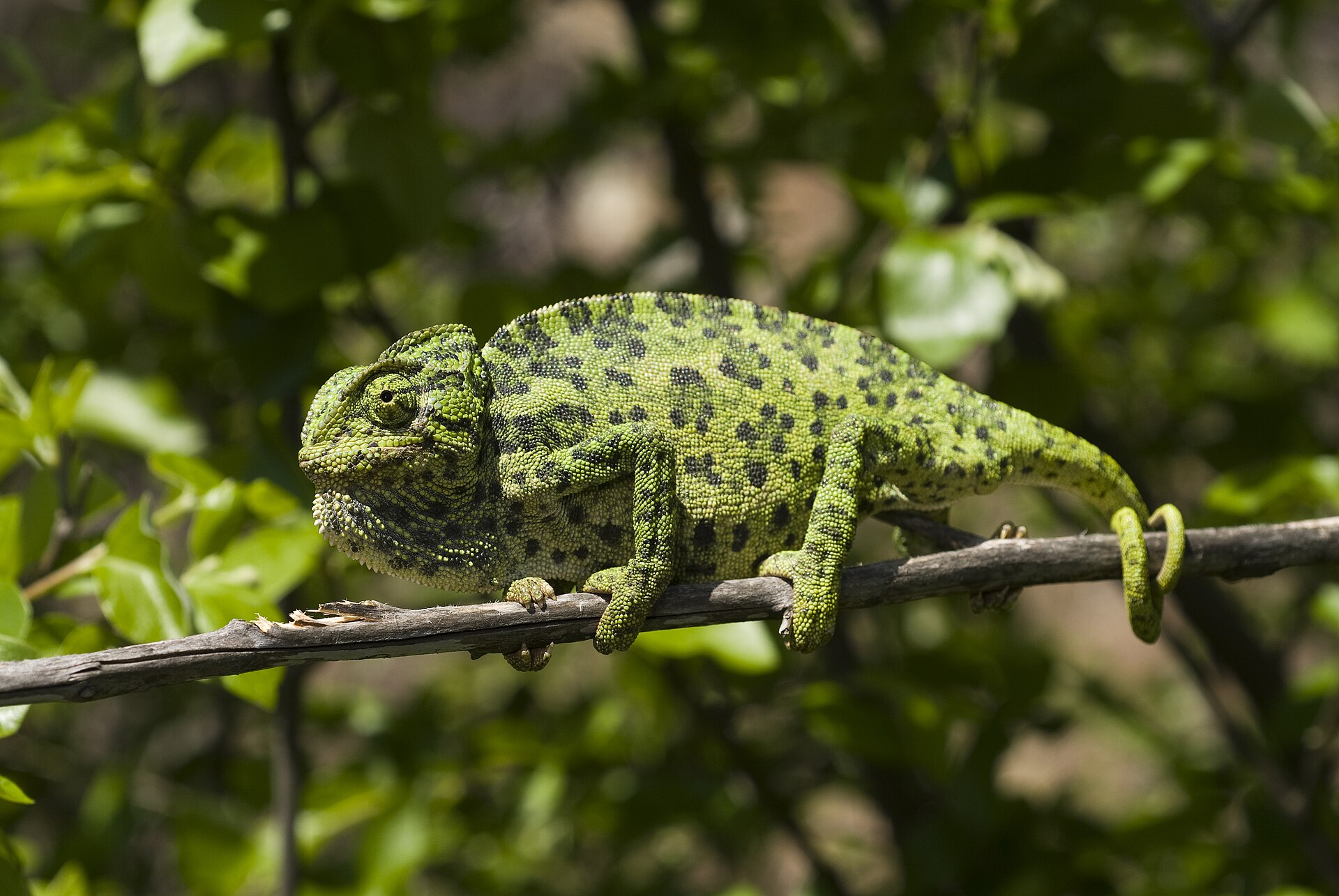
The Common Chameleon (Chamaeleo chamaeleon), also called the Mediterranean chameleon, is an extraordinary reptile and, above all, the only chameleon native to Europe. Famous for:
- The independent eyes: the two eyes rotate separately, covering nearly 360°, then aim together at the prey
- The ballistic tongue: a sticky tongue longer than its body, projected in a fraction of a second
- Colour change: it changes hue mainly to communicate and thermoregulate, not to "vanish" against any background
- Pincer feet: toes fused into two opposed groups, like tongs, to grip branches
- The prehensile tail: used as a "fifth limb" to climb
- Being "European": it lives in the Mediterranean, the sole representative of a mostly African and Malagasy family
IUCN status: Least Concern (LC), but locally threatened and protected. It enters the portal in the Chameleons group, alongside the Veiled Chameleon (a terrarium species from Yemen): together they represent the chameleon family, from the large veiled one with its showy casque to the more sober but equally fascinating chameleon of the Mediterranean.
Classification and category
Order Squamata (the scaled reptiles), family Chamaeleonidae (the chameleons), genus Chamaeleo. In the portal it is placed among the Chameleons. Its importance lies in being the only chameleon naturally present in Europe: all other chameleons live in Africa, Madagascar, the Middle East and southern Asia. It is useful to tell it apart from other well-known chameleons: the Veiled Chameleon (Chamaeleo calyptratus), from Yemen, is larger and has a showy "casque" on the head; it is a popular terrarium species; the panther chameleon (Furcifer pardalis) of Madagascar is famous for its gaudy colours; the Common Chameleon is smaller and of sober colours (greens, yellows, browns), but has all the typical family traits and is our Mediterranean species. Etymology: the word "chameleon" comes from the Greek chamai-léon, "ground lion" or "dwarf lion". The scientific name Chamaeleo chamaeleon simply repeats this term, emphasizing that it is the chameleon par excellence of the classical and Mediterranean world. Parameters: Length about 20-30 cm including the tail (females often larger). Body laterally compressed, tall and narrow. Appearance typically chameleon, with a small casque on the head. Longevity: in the wild often quite short (many individuals die after breeding), but it can reach several years. Reproduction: it is oviparous; the female descends to the ground, digs a hole and lays numerous eggs (even several dozen), which have a long incubation of many months.
Habitat and distribution
The Common Chameleon is a circum-Mediterranean species: its range covers the coasts and regions of the Mediterranean — the Iberian Peninsula, North Africa (the Maghreb), parts of the Middle East, islands and areas of Greece, Malta, and some areas of southern and insular Italy (partly native, partly of ancient introduction). Preferred habitats — warm, bushy environments: Mediterranean scrub, garrigue and woodland; coastal pinewoods, olive groves, vineyards and gardens; and anywhere with shrubs and trees to climb, in sunny areas. It is an arboreal, thermophilic animal: it spends its life among branches and bushes, moving extremely slowly and often swaying back and forth, perhaps to mimic a leaf moved by the wind. It is diurnal and solitary, and in cooler climates spends winter in dormancy. Its dependence on natural Mediterranean environments makes it sensitive to the destruction of scrub, to fires and to coastal urbanization. IUCN: Least Concern overall, but in many European areas the populations are localized and in decline, threatened by habitat loss, road collisions (when it descends to the ground to lay eggs) and illegal collection. It is a protected species in Europe.
Diet
The Common Chameleon is an insectivorous predator with a spectacular hunting technique. It eats: insects of all kinds (grasshoppers, locusts, flies, beetles, butterflies, bees and wasps); and occasionally other small invertebrates. The hunting technique is one of the most extraordinary in the animal kingdom: spotting (moving its eyes independently, it scans the environment through nearly 360° without moving its body); focusing (having located the prey, it points both eyes at it, gaining three-dimensional vision that precisely measures the distance); and the tongue strike (in a fraction of a second it projects its sticky tongue, longer than its body, which hits and catches the insect and brings it back to the mouth). Crucially, the chameleon's tongue is a prodigious "ballistic" weapon. Thanks to an elastic mechanism, it shoots forward at very high speed and with remarkable precision, allowing this very slow hunter to catch agile, fast prey without chasing it. It is the perfect example of a predator that replaces speed with patience and a lightning weapon.
Physical features
The Common Chameleon brings together all the famous adaptations of its family in a modestly sized reptile. Eyes and head: bulging, "turret" eyes, covered in skin except for a small pupil, able to rotate independently of each other; a small casque (crest) on the head. The body: a laterally compressed body, tall and narrow, making it resemble a leaf; granular skin, able to change colour (greens, yellows, browns, to almost black). The limbs and tail: "pincer" (zygodactyl) feet, the toes fused into two opposed groups, forming tongs that firmly grip branches; a long, prehensile tail, which can be coiled, used as a fifth limb to anchor itself. Performance: a ballistic tongue longer than the body, the hunting weapon; panoramic and stereoscopic vision; and extreme slowness of movement, compensated by camouflage and patience.
Behaviour and curiosities
The Common Chameleon is a solitary, diurnal, arboreal and very slow animal. It moves cautiously among the branches, often rocking its body back and forth with each step. It is very territorial: males, facing a rival or a threat, change colour, inflate themselves and open their mouths to appear larger and more intimidating.
The colour-change myth: contrary to the most widespread belief, the chameleon does not change colour to blend in with any background, turning red on a red cloth or chequered on a chessboard; in reality the colour change serves mainly to communicate (moods, dominance, readiness to mate) and to regulate temperature (darkening to absorb more heat, lightening to reflect it); its "base" colour, greenish or brown, nonetheless gives it good camouflage among the vegetation. The independent eyes: the chameleon's eyes are among the most extraordinary in the animal world; they can move and focus completely independently of each other, letting the animal watch in two different directions at once and keep almost everything around it under control without moving its head; when it spots prey, however, the chameleon points both eyes at it, switching to three-dimensional vision that it uses to calculate the distance precisely for the tongue strike. The "slingshot" tongue: the Common Chameleon's tongue is a prodigious hunting weapon; at rest it is folded in the mouth, but when it strikes it is projected forward at impressive speed, extending to more than the length of the animal's body; the sticky, suction-cup-shaped tip adheres to the prey, which is then brought back to the mouth; all this happens in a fraction of a second: the chameleon, very slow in its movements, thus possesses one of the fastest "strikes" in the animal world. The "ground lion": the word chameleon comes from the Greek and curiously means "dwarf lion" or "ground lion" (chamai = on the ground, léon = lion); despite its anything-but-leonine appearance, the name perhaps reflects the small casque or crest on the head of some species, vaguely compared to a mane, or simply the "regal", bizarre charm of this reptile, which has struck the imagination since antiquity. The only chameleon in Europe: the chameleon family is typically African and Malagasy, with a great centre of diversity in Madagascar; the Common Chameleon is the only species to have stably colonized Europe, living along the Mediterranean coasts; this is why, in Italy and the other Mediterranean countries, it is a small naturalistic "treasure": to meet it among the scrub or olive groves is to observe the only European chameleon in its environment. The digging mother: unlike many reptiles that simply abandon their eggs, the female Common Chameleon performs a small "ritual": she leaves the safety of the trees and descends to the ground, where she carefully digs a hole in the soil to lay her eggs, before closing it again; it is a delicate, risky moment of her life — precisely when she is on the ground, slow and vulnerable, she is most exposed to predators and road collisions.
Pros
- Affascinante e unico: l'unico camaleonte nativo d'Europa
- Un concentrato di adattamenti straordinari (occhi indipendenti, lingua balistica)
- Utile insettivoro della macchia mediterranea
- IUCN Least Concern a livello globale; piccolo "tesoro" della fauna mediterranea
Cons
- NON è un animale da compagnia "facile": è selvatico, fragile e protetto
- In cattività richiede cure molto specifiche e si stressa con facilità
- Localmente minacciato da perdita di habitat, incendi e cattura illegale
- Vulnerabile quando scende a terra per deporre le uova (predatori, investimenti)