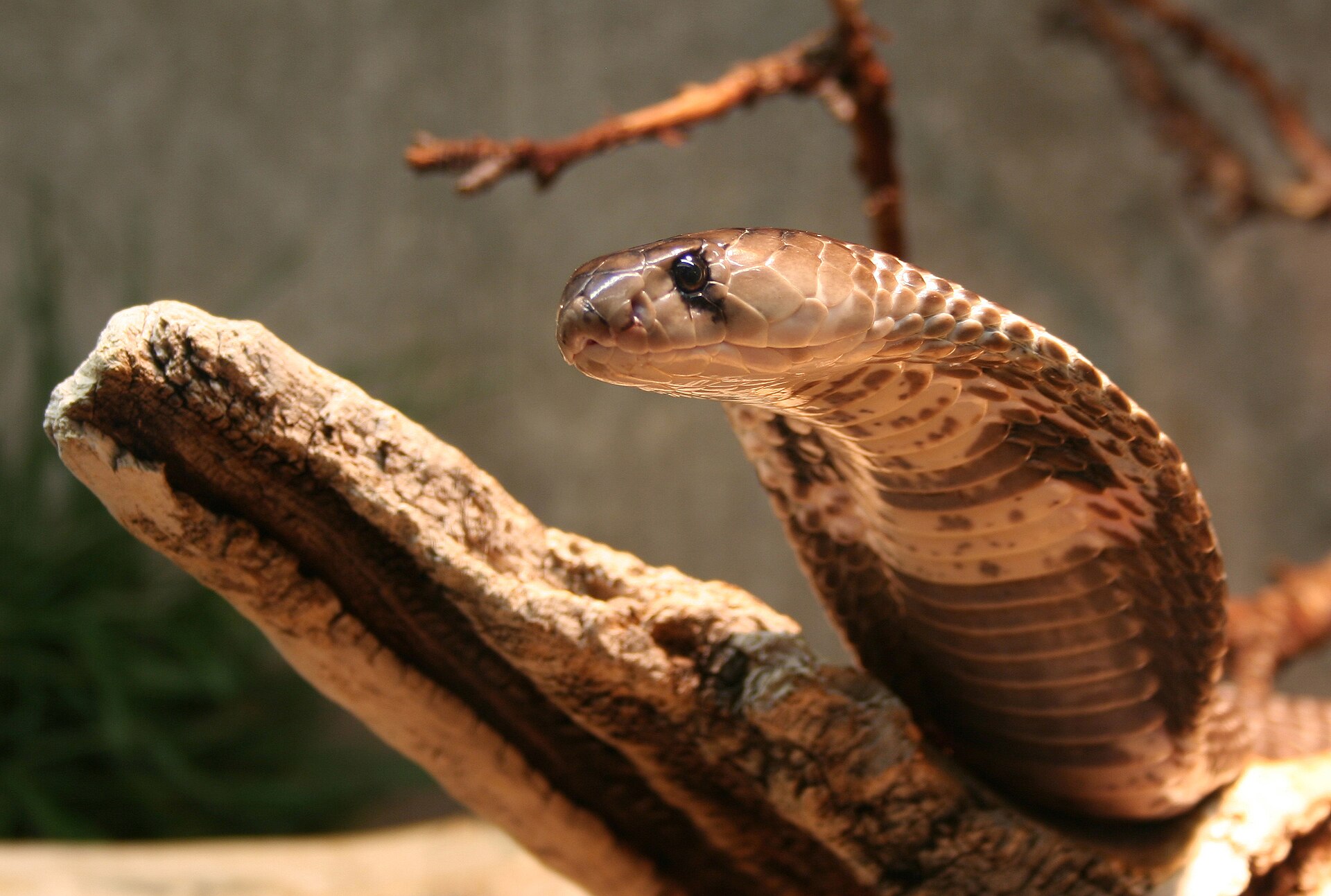
Indian Cobra
Naja naja
Characteristics
Temperament
Solitary, ectothermic, nocturnal-crepuscular. Iconic expandable hood with "spectacle pattern". Powerful neurotoxic venom. "Big Four" snake (50,000 deaths/year in India). Sacred in Hinduism as "Naga". One of the few snakes that cares for eggs (50-60 days).
Diet
Strict carnivore. Active hunting: rodents (50-70% diet), other snakes, lizards, amphibians, birds. Important biological controller of rodents in agricultural areas. 1-2 prey/month. Injection of 100-300 mg of neurotoxin per bite.
The Indian Cobra (Naja naja), also known as the Spectacled Cobra due to the characteristic mark on the back of the hood, is one of the most iconic and sacred snakes in the world. Distributed throughout the Indian subcontinent (India, Pakistan, Bangladesh, Sri Lanka, Nepal, Bhutan), it is celebrated in Hinduism as the incarnation of "Naga" — sacred serpent deity. 1-1.5 m long (record 2.2 m) and weighing 1-1.5 kg, it is a venomous elapid snake: its venom is a powerful neurotoxin capable of causing respiratory paralysis. It is one of the "Big Four": the 4 venomous snakes responsible for the majority of the 50,000 annual deaths from snake bites in India (along with Russell's viper, saw-scaled viper, krait). Its most iconic feature is the expandable hood: when threatened, it raises the first third of its body vertically in an "S" position and extends the hood, showing the famous "spectacle" pattern — an intimidating warning. Global IUCN conservation status: Least Concern (LC) but locally declining.
Classification and category
The Indian Cobra belongs to the order Squamata, suborder Serpentes, family Elapidae (cobras, mambas, sea snakes, coral snakes — all venomous), genus Naja. The genus Naja ("true cobras") comprises 38 species distributed in Africa and Asia. Naja naja is the "type" cobra of the genus, hence the scientific name.
The species was scientifically described by Linnaeus in 1758. There are 2 main subspecies:
- N. naja naja — Spectacled Cobra (central-southern India, Sri Lanka)
- N. naja oxiana — Oxus or Caspian Cobra (today distinct species: Naja oxiana; Iran, Afghanistan, Central Asia)
Important distinction: the "King Cobra" (Ophiophagus hannah) is a different species: larger (3-5 m), distinct monotypic genus, eats other snakes, lives in Southeast Asia. The "Spectacled Cobra" described here (Naja naja) is smaller, lives in India, has the spectacle pattern. Adult dimensions are: average length 1-1.5 m, record 2.2 m (Sri Lanka, 1937), weight 1-1.5 kg. Females are slightly larger than males. Longevity is 20-25 years in nature, up to 30 years in captivity.
Habitat and distribution
The Indian Cobra's habitat is extraordinarily varied: rainforests, savannas, agricultural land, rice paddies, cultivated lands, urban outskirts, village surroundings. It prefers areas with abundant rodents and hiding places: rodent burrows, stone piles, wood piles, leaves, under buildings. It is very adaptable to human presence: the cobra often enters rural houses, granaries, rice warehouses — cause of many dangerous encounters. The distribution includes: India (most of the territory excluding north Kashmir and high Himalaya), Pakistan, Bangladesh, Sri Lanka, Nepal, Bhutan. It is found from 0 to 2,000 m of altitude.
The global population is estimated at several million specimens. The global IUCN conservation status is Least Concern (LC) since 2007. However, local populations are declining in India due to: direct killings (fear, 100,000+ cobras killed per year in India in retaliation), illegal skin trade (for leather goods), capture for snake charmer shows (banned by the Wildlife Protection Act 1972 but still practised), habitat loss (deforestation, agricultural conversion), road accidents. CITES: Appendix II. Trade in venom for antivenom production is instead legal and regulated (necessary to save thousands of lives a year). Important: India is the country with the highest number of snake bite deaths in the world: 50,000 deaths a year (out of a global total of 138,000), of which the cobra is responsible for 25-30%. Active programmes: India Snakebite Initiative, WHO Snakebite Envenoming Strategic Plan (2019-2030).
Diet
The Indian Cobra is a strict carnivore, opportunistic predator. The diet is composed mainly of:
- Rodents (rats, mice — preferred prey): 50-70% of diet. Important ecological function: rodent control in agricultural areas, indirectly increasing rice and wheat yields
- Other snakes (including young of its own species — opportunistic cannibalism)
- Lizards, geckos
- Amphibians (frogs, toads)
- Birds and bird eggs (occasionally)
- Fish (rarely, near ponds)
The hunting technique is active and mobile (unlike constrictor pythons that use ambush): the cobra actively searches rodent burrows, dens, leaf piles, looking for prey. It uses mainly smell (through forked tongue and Jacobson's organ) and touch (ground vibrations). Sight is moderate at short distances. When it locates prey, it attacks with a lightning bite: the grooved front teeth (proteroglyphs) inject venom directly into tissues.
The Indian Cobra's venom is a powerful post-synaptic neurotoxin: it blocks acetylcholine receptors at neuro-muscular junctions, causing muscle paralysis. An average lethal dose for an adult human is 15-20 mg; the cobra injects 100-300 mg per bite (10-20× the lethal dose). Symptoms in humans: immediate local pain, swelling, progressive paralysis (eyes → respiratory muscles → heart), death by asphyxia in 6-12 hours without antivenom. With antivenom, mortality drops from 30% to 3-5%. Venom action speed: paralysis begins in 15-30 minutes. The cobra eats 1-2 prey per month; slow metabolism allows weeks of survival without food.
Physical features
The Indian Cobra has a cylindrical, slender, muscular body, of "elapid" snake type (elongated body without great variation in width). The average length is 1-1.5 m, record 2.2 m. The weight is 1-1.5 kg. The base colour varies from light brown-grey to almost black; some regional variants are completely black (south India, Sri Lanka), others brown-yellowish (north India), others striped. Notable feature: no genetically distinct subspecies in colours — it is local polymorphism.
The most iconic feature is the hood: a skin fold on the neck, distensible, that widens into a "gangster hat" shape when the cobra stands menacingly. The hood is formed by elongated cervical ribs (8-10 pairs), which the cobra can voluntarily extend/contract through muscles. When fully extended, it reaches a width of 15-20 cm. On the back of the hood appears the characteristic "spectacle pattern": 2 dark spots surrounded by light rings, with a line connecting them — it looks like a stylised pair of glasses. This is the "binocular pattern" diagnostic of the Indian Cobra. Function: aposematism (visual warning to predators) and defensive mimicry (the "eyes" look like a large threatening face of a raptor, deterring avian predators).
The teeth are fixed, anterior, grooved (proteroglyphs) — not retractable like those of vipers. The fangs are 6-8 mm long, located in a fixed frontal position in the upper jaw. The bite force is 50 psi (relatively low, but sufficient to inject venom). The eyes are medium, brown-red in colour, with round pupils (diagnostic feature: vipers have elliptical pupils!). Vision is moderate at short distances. The scales are smooth, shiny, arranged in 21-23 dorsal rows. The belly is cream-white in colour, with typical dark transverse bands. The tail is short (8-15% of length), ends in a sharp point. Anatomical feature: unlike vipers, the cobra has asymmetric lungs: functional and very elongated right lung (60% of body length), reduced left lung.
Behaviour and curiosities
The Indian Cobra is a solitary, ectothermic, predominantly nocturnal-crepuscular animal. During the day it hides in burrows, stone piles, under rocks; it goes out at dusk to hunt. It is active all year in tropical zones; in subtropical zones it enters brumation (the reptile analogue of hibernation) during the cold winter. The burrow is a hole dug by rodents or a dense bush; the cobra often kills the original rodent and occupies its burrow — a case of "home stealing".
The defensive behaviour is iconic:
- Postural warning: threatened, the cobra raises the first third of its body in a vertical "S" position (30-60 cm height); extends the hood; emits a deep hiss ("hissing"); stares at the opponent.
- Spitting (not in this species!): the Indian Cobra is NOT a "spitting cobra" (venom spit) — only some African subspecies are spitting (e.g. N. nigricollis). The Indian cobra bites, does not spit.
- Attack: if the opponent does not retreat, the cobra strikes with a lightning bite (speed 1-2 m/s). The bite is brief; venom is injected in 1 second.
Reproduction: the breeding season is March-June. The female lays 10-30 eggs in nests hidden in rodent burrows, rotten leaves, or stone piles. It is one of the few snakes that cares for its eggs: the female actively protects the nest for the 50-60 days of incubation, attacking any predator that approaches — a unique behaviour in snakes. The cubs are born already fully developed and venomous (20-30 cm in length). They are autonomous from birth.
Famous curiosities: the Cobra is sacred in Hinduism. In mythology, it is called "Naga" (divine serpent, symbol of kundalini energy, of death and rebirth, of eternity). Vishnu rests on the cobra Shesha (the infinite); Shiva wears a cobra around his neck (Vasuki); Krishna dances on the cobra Kaliya. The annual "Naga Panchami" festival (July-August) celebrates the cobra: live snakes are honoured with offerings of milk, rice, flowers in temples and villages. Traditionally, Hindus do NOT kill cobras that enter their homes — they believe they are reincarnated ancestors. Snake charmers curiosity: the famous Indian "snake charmers" use cobras (usually with teeth removed or venom glands blocked to prevent bites). The "fluttering" of the cobra following the flute is actually a visual response: cobras are deaf (lack external ear and eardrum), so they follow the movement of the flute (they see vibrations) and not the music. The practice is banned in India since 1972 but survives in rural areas. Historical curiosity: Cleopatra VII (Queen of Egypt) committed suicide in 30 BC through the bite of an "asp" that many scholars identify as the Egyptian cobra (Naja haje, close relative of ours). Medical curiosity: cobra venom is studied for modern medicine: the compound "cobratide" is in phase 3 of clinical studies as a powerful analgesic (10× stronger than morphine, without dependence). Scientific curiosity: the "spectacle pattern" is not invariable: some cobras have only 1 eye or complete absence of pattern — a phenomenon called "unspectacled morph". Ethological curiosity: cobras recognise their owners individually in captivity (studies at Madras zoos): they follow the keeper's gaze, distinguish family members from strangers, remember feeding routines. Size curiosity: the Indian cobra is NOT the largest cobra — the King Cobra (Ophiophagus hannah) can reach 5 m. However, the Indian Cobra is the most dangerous for humans (more bites than other snakes) due to its frequency in inhabited areas and the efficiency of its venom. "Dance" curiosity: two cobras (males) during the breeding season perform a "dancing fight": they both rise in position, intertwine their necks trying to bring down the rival to the ground. They do not bite each other. The winner mates with the female.
Pros
- Una delle serpenti più iconiche e culturalmente importanti al mondo (Naga)
- Controllore biologico essenziale dei roditori nelle aree agricole indiane
- Longevità eccellente (20-30 anni)
- Uno dei pochi serpenti che cura le uova (protezione attiva del nido)
Cons
- Tra i 'Big Four' responsabili di 50.000 morti/anno per morso in India
- Veleno neurotossico altamente mortale (mortalità 30% senza antiveleno)
- CITES Appendice II: commercio regolamentato
- Detenzione vietata/regolamentata in quasi tutto il mondo