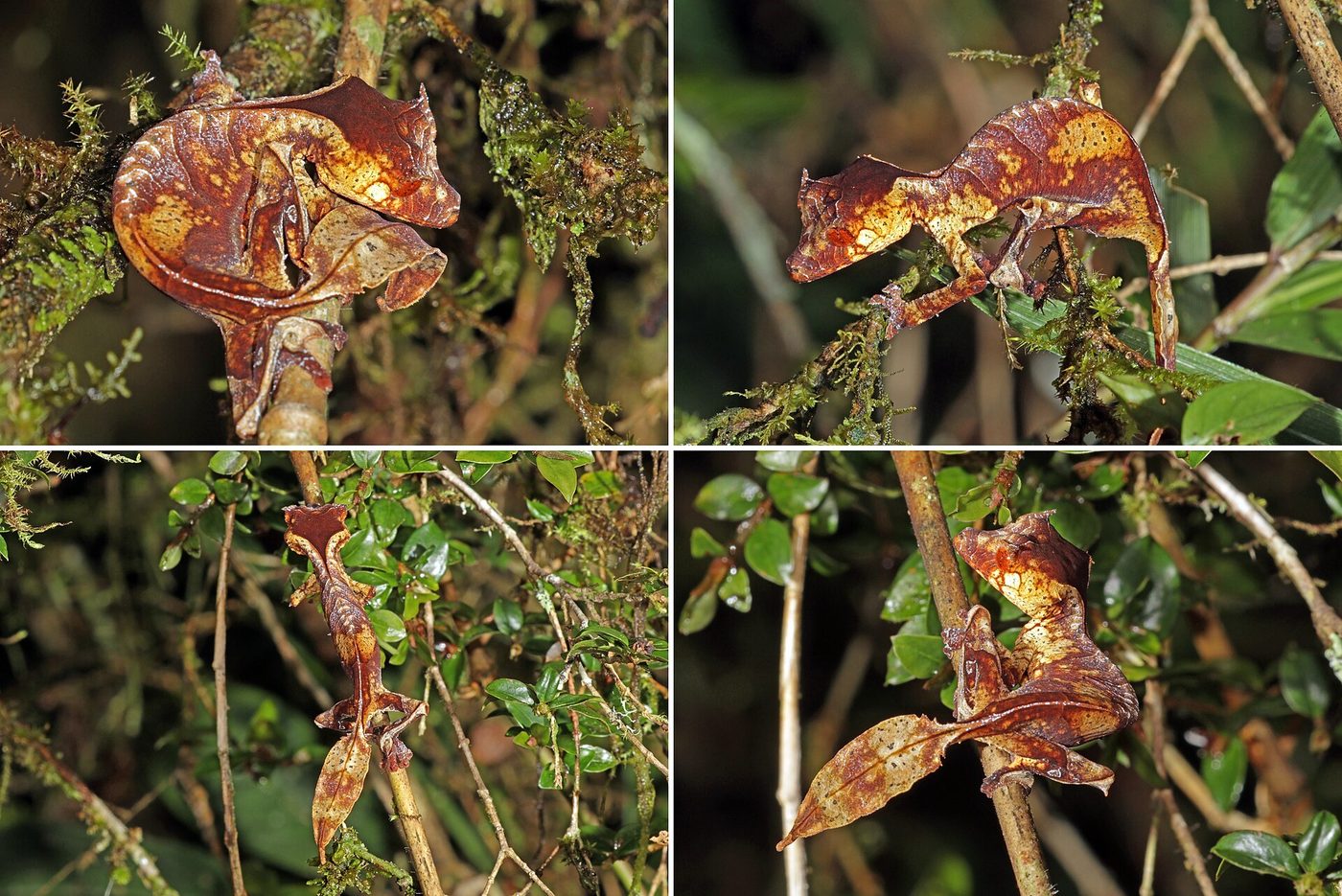
Photo: Charles J. Sharp · CC BY-SA 4.0
Satanic leaf-tailed gecko
Uroplatus phantasticus
The satanic leaf-tailed gecko is a tiny Madagascan reptile that perfectly mimics a dead leaf, one of nature's most extraordinary masters of camouflage.
Characteristics
Temperament
Nocturnal, motionless and cryptic; entirely harmless.
Diet
Insectivorous: small insects and nocturnal invertebrates.
A gecko disguised as a dead leaf
The satanic leaf-tailed gecko (Uroplatus phantasticus) is a small gecko endemic to Madagascar, the smallest-bodied of the genus Uroplatus. Its camouflage is among the most perfect in the animal kingdom: the brown body, veined and blotched to mimic the ribs and blemishes of a dead leaf, is completed by a flat, jagged tail that looks exactly like a dried, nibbled leaf. Above its eyes it bears small pointed projections resembling horns, hence the name "satanic".
Habitat and range
It lives in the rainforests of eastern Madagascar, among the undergrowth. It spends the day motionless, clinging to a twig or hanging among dead leaves, virtually invisible to predators and prey alike.
Behaviour and diet
It is nocturnal and insectivorous: at night it emerges from hiding to hunt small insects and other invertebrates. If discovered, it may gape its bright red mouth or sway like a leaf in the breeze to reinforce the illusion. By day it stays perfectly camouflaged.
Did you know?
Despite its eerie looks and name, it is entirely harmless. Its "horns" and leaf-like tail serve only to disguise it. The perfection of its camouflage makes it one of the most photographed and sought-after species among reptile enthusiasts.
Conservation
The IUCN lists it as Least Concern, but it depends entirely on Madagascar's forests. Deforestation and collection for the exotic pet trade are pressures to watch; captive-bred animals are the better choice.
Pros
- Among the most perfect camouflage in nature
- Entirely harmless despite its looks
- Small and fascinating to observe
Cons
- Depends entirely on Madagascar's forests
- Collected for the trade: choose captive-bred animals
- Delicate, needs humidity and specific care