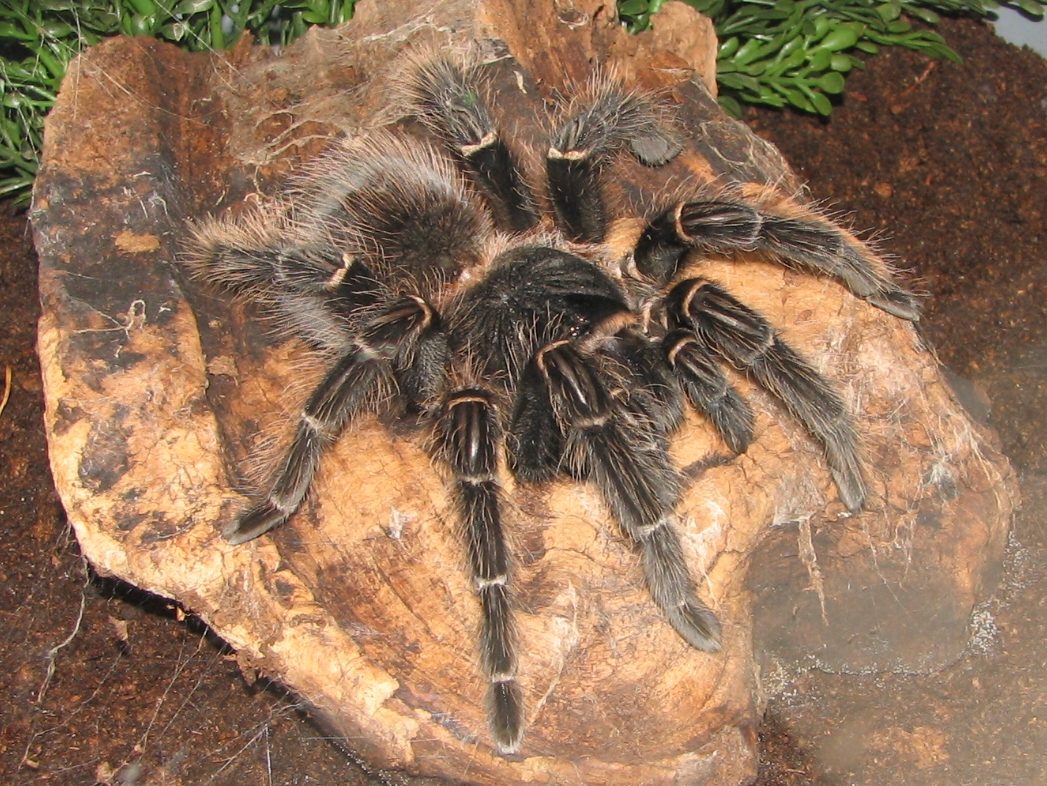
Photo: Ltshears · Public domain
Goliath birdeater
Theraphosa blondi
Gigantic and covered in hairs, the Goliath birdeater is the largest spider in the world by mass, a colossus of the rainforests of South America.
Characteristics
Temperament
Nocturnal, an ambush predator, defensive
Diet
Carnivore: insects, worms, small amphibians and vertebrates
The most massive spider in the world
The Goliath birdeater is famous for being the largest spider in the world in terms of mass and one of the largest of all. Its sturdy body and legs can reach an impressive span, comparable to a dinner plate. It is entirely covered with dense golden-brown hairs that give it a velvety appearance. Despite its imposing bulk and disturbing name, it is a less dangerous animal than one might think.
Habitat and distribution
It lives in the rainforests of northern South America, in particular in the humid, swampy regions of Guyana, Venezuela and Brazil. It is an animal tied to the forest floor: it digs and occupies underground burrows, often sheltered among roots and trunks, where it spends much of its time waiting for prey. It prefers the warm, humid environments typical of the tropical forest.
Behaviour and diet
Despite its name, the Goliath birdeater rarely catches birds: the name arose from an old illustration depicting a similar spider devouring one. In reality it feeds mainly on large insects, worms, amphibians and other small ground animals. It is an ambush predator: it waits near its burrow and catches prey with a rapid attack. To defend itself it has two strategies: urticating hairs, which it can release into the air to irritate attackers, and the ability to produce a hiss by rubbing its legs.
Curiosities
Like all spiders, the Goliath birdeater has no bony structure and to grow it must periodically shed its skin through moulting. Females are much longer-lived than males and can live for decades. Its venom, although its bite can be painful, is not considered dangerous to humans: the main defence remains its urticating hairs.
Conservation and care
The Goliath birdeater is sometimes kept by terrarium enthusiasts, in warm, humid environments that reproduce its natural habitat. In the wild, like all inhabitants of tropical forests, it depends on the health of these delicate ecosystems. Protecting the South American rainforests remains important for its survival and for the immense biodiversity that surrounds it.
Pros
- The largest spider in the world by mass
- A fascinating, imposing predator
- Females are very long-lived
- Not lethally dangerous to humans
Cons
- Urticating hairs can irritate skin and eyes
- The bite, though not lethal, can be painful
- Requires specific warm, humid environments