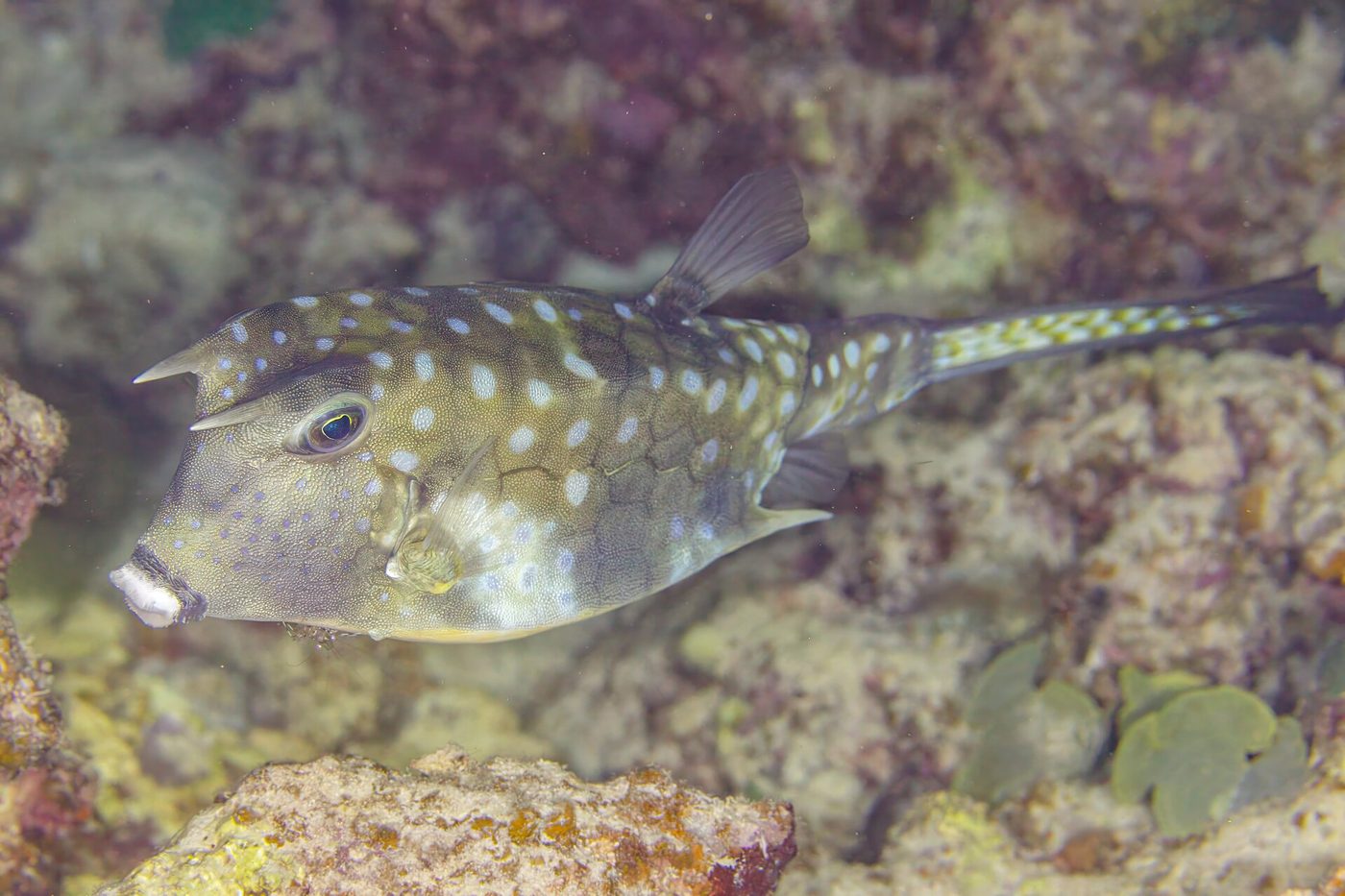
Photo: Diego Delso · CC BY-SA 4.0
Longhorn cowfish
Lactoria cornuta
The longhorn cowfish is a quirky box-shaped tropical fish, with two horns on its head and a rigid bony armour, that swims slowly around the reef.
Characteristics
Temperament
Slow and calm; a clumsy swimmer protected by its armour.
Diet
Omnivorous: small bottom invertebrates and algae.
A fish inside a box
The longhorn cowfish (Lactoria cornuta), also called the horned boxfish, belongs to the family Ostraciidae, the boxfishes. Its body, yellow speckled with pale blue spots, is enclosed in a rigid bony armour of fused plates and is almost square in section: only the fins, eyes and mouth protrude and can move. Its most striking feature is the pair of long "horns" jutting from its forehead, like those of a cow or bull, plus another pair pointing backward beneath the belly. It can reach about 50 cm, but usually stays much smaller.
Habitat and range
It lives on coral reefs and sandy bottoms of the Indo-Pacific. It moves slowly, propelled by the beating of its small fins in a kind of hovering, almost helicopter-like flight, as it explores the seabed for food.
Behaviour and diet
It feeds by blowing jets of water at the sandy bottom to uncover small invertebrates — worms, crustaceans, molluscs — and algae, which it then sucks up. Its rigid armour limits its speed but offers excellent protection. As a further defence, when stressed it can release a toxin (ostracitoxin) into the water, capable of killing other fish nearby.
Did you know?
Its boxy shape and horns make it one of the most recognisable reef fish. In aquariums it is fascinating but delicate and problematic: the toxin it releases under stress can poison the whole tank, including itself.
Conservation
It is not considered a threatened species, but like all reef dwellers it depends on the health of these ecosystems, which are put at risk by pollution and warming waters.
Pros
- Unique boxy shape with horns
- Bony armour that protects it from predators
- A fascinating reef swimmer
Cons
- Releases a toxin when stressed
- Delicate and problematic in aquariums
- A slow, poorly manoeuvrable swimmer