Photo: Mike Baird · CC BY 2.0
Emperor scorpion
Pandinus imperator
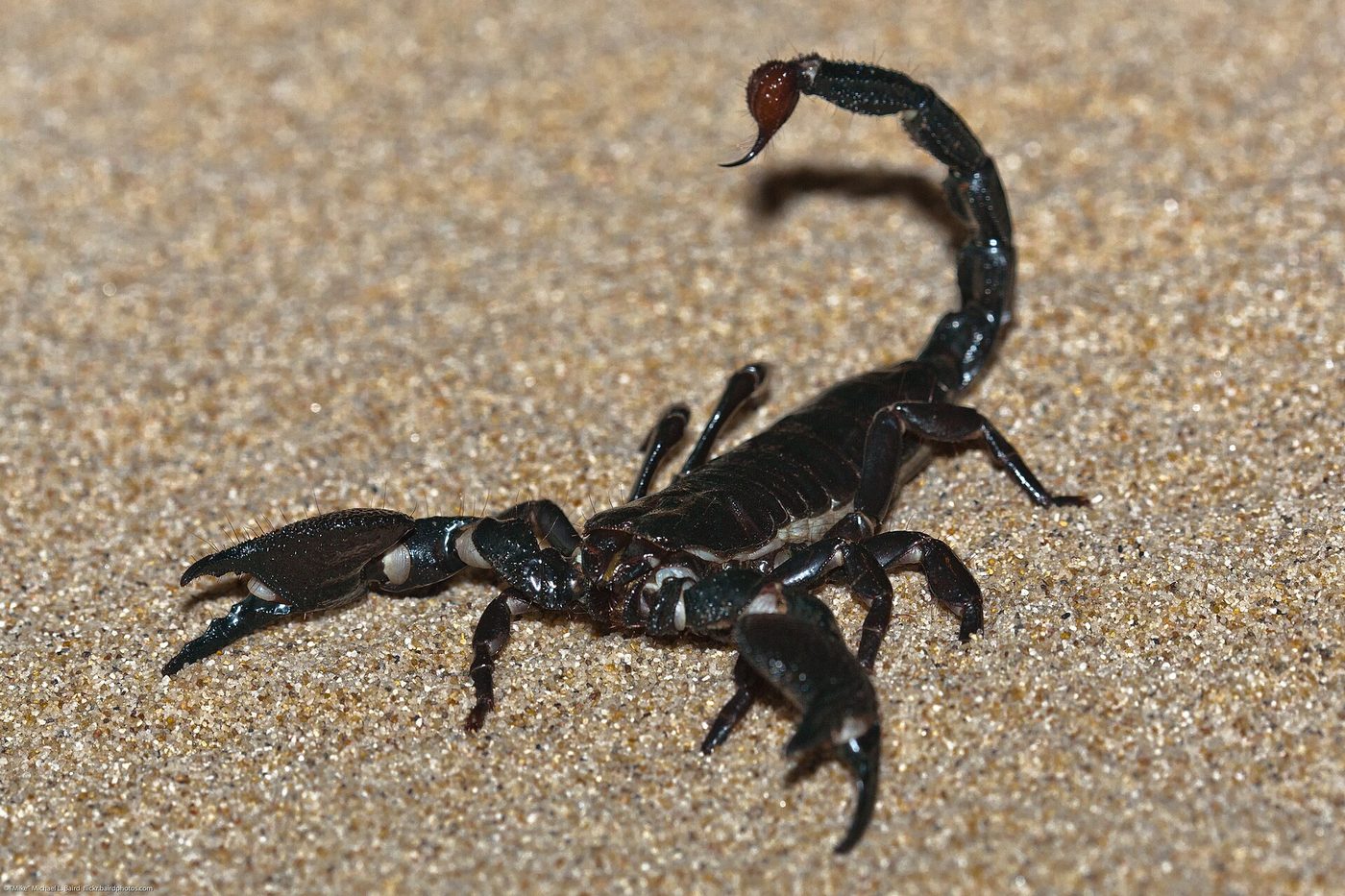
Large, black and glossy, the emperor scorpion looks fearsome but is among the most docile: its pincers are scarier than its sting, whose venom is surprisingly weak.
Characteristics
Temperament
Nocturnal, calm and surprisingly docile despite its appearance. It relies on its large pincers more than on venom; it shows unusual parental care for its young.
Diet
Carnivore: insects, spiders and other small invertebrates, caught mainly with the large pincers; the largest individuals also small vertebrates.
A giant among scorpions
The emperor scorpion is one of the largest scorpions in the world, able to exceed twenty centimetres in length. Its body is an intense, glossy black, which under ultraviolet light glows with a characteristic green-blue sheen, as with all scorpions. It has two large, sturdy pincers, a curved tail ending in the sting and, on the abdomen, tiny comb-shaped sensory organs that let it 'taste' the ground as it walks.
More bark than bite
Despite its threatening appearance and imposing size, the emperor scorpion is surprisingly docile and its venom is weak, to humans little more bothersome than a bee sting. Its real weapon is its large pincers, with which it grabs and crushes its prey: a scorpion this big relies more on the brute force of its claws than on venom. It is precisely this combination of spectacular appearance and calm nature that makes it one of the most popular scorpions as a terrarium animal.
Life in the forest
The emperor scorpion lives in the humid tropical forests of West Africa. It is a nocturnal animal, which by day takes refuge in burrows dug in the ground, under logs or among roots, and by night comes out to hunt. It feeds on insects, spiders and other small invertebrates, and the largest individuals can catch small vertebrates too.
Surprising parental care
Unlike many invertebrates, the emperor scorpion shows parental care. The female does not lay eggs but gives birth to live young, which climb straight onto her back. There they stay protected for weeks, until they are strong enough to fend for themselves. It is an unusual and fascinating maternal behaviour for an arachnid.
Conservation
The emperor scorpion is the object of intense trade for the terrarium market, which has raised concern for the wild populations. For this reason its capture and trade are regulated internationally. Choosing captive-bred specimens, when keeping one, helps reduce the pressure on natural populations.