Photo: Jürgen Otto · CC BY-SA 2.0
Peacock spider
Maratus volans
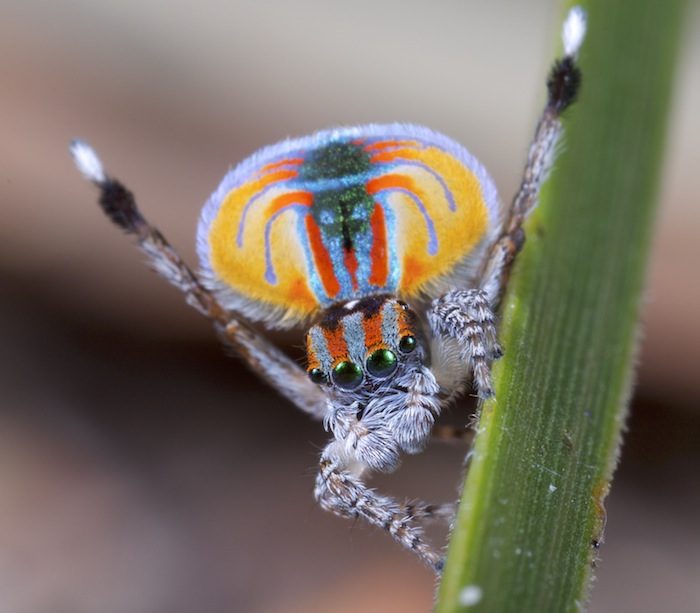
Tiny but brilliantly coloured, the peacock spider wins over females with a spectacular dance, raising its abdomen like a peacock's tail.
Characteristics
Temperament
Diurnal, active hunter, dancer
Diet
Carnivore: small insects and invertebrates
A jewel in miniature
The peacock spider is a tiny jumping spider, only a few millimetres long, but among the most spectacular in the animal kingdom. The male owes its fame to its abdomen, which carries on its back a richly coloured flap of skin, with iridescent patterns of blue, red, orange and green, that it can raise and open like a peacock's fan. The females, by contrast, are more subdued, of a brownish-grey, camouflaged colour. Like all jumping spiders, it has large front eyes that give it a curious, lively gaze.
Habitat and distribution
It is native to Australia, where it lives in a variety of environments, from woodlands to grassy areas. It is a ground-dwelling, diurnal spider, moving nimbly through the low vegetation and the soil, hunting actively during daylight hours.
The courtship dance
What makes the peacock spider famous is the male's courtship, a genuine display. When it meets a female, the male raises the coloured flap of its abdomen and waves it like a fan, lifts a pair of legs and performs a rhythmic dance of movements and vibrations. It is a risky performance: if the female is not convinced, she may react aggressively. Its extraordinary vision, able to perceive the full colour spectrum and even ultraviolet, is essential both for courtship and for hunting.
Behaviour and curiosities
It does not build webs to catch prey: like all jumping spiders, it is an active hunter, spotting small insects and catching them with a precise, lightning leap. Despite the species name ('volans', meaning flying) and its showy appearance, it does not fly: the name comes from an old interpretation that the coloured flaps served to glide. It is completely harmless to humans, both for its minute size and for its calm nature.
Pros
- Iridescent colours among the most spectacular
- Fascinating courtship dance
- Extraordinary vision, perceives ultraviolet
- Completely harmless to humans
Cons
- Minute size, hard to observe
- Only the males are colourful
- Risky courtship for the male