Great hornbill
Buceros bicornis
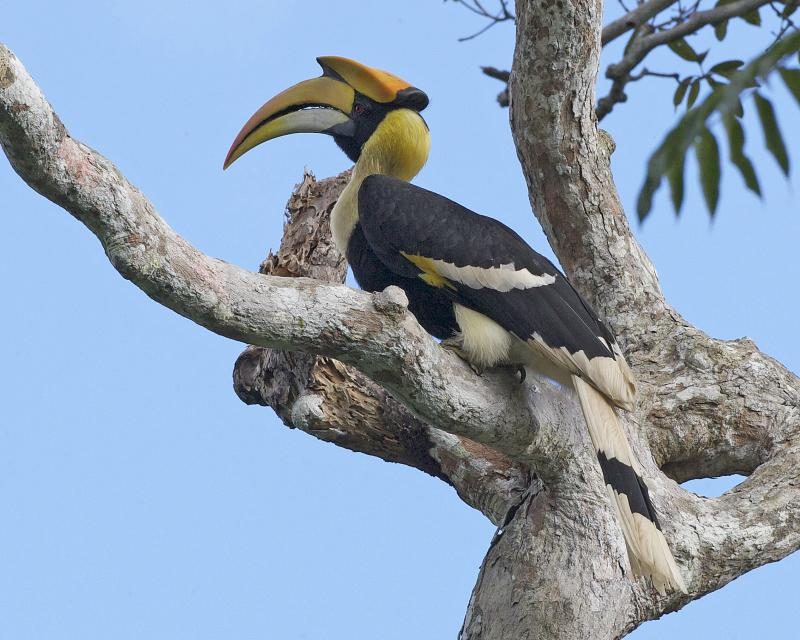
With its enormous bill topped by a yellow and black casque, the great hornbill is one of the most majestic and recognisable birds of the Asian forests.
Characteristics
Temperament
Social, tree-dwelling, with a noisy flight
Diet
Omnivore: mainly fruit, then small animals
A majestic, unmistakable bird
The great hornbill is one of the most imposing birds of the Asian tropical forests. Its most spectacular feature is its enormous yellow bill, topped by a hollow, curved structure called a casque, which gives it a truly unique profile. Its plumage is mainly black and white, with striking yellow tints on the neck and bill due to a special secretion with which the bird colours itself. Its very broad wings produce a dull, powerful sound in flight, audible even at a great distance.
Habitat and distribution
It lives in the humid, mature forests of South and Southeast Asia, from India through Indochina to part of Indonesia. It is closely tied to the great forests with ancient, majestic trees, indispensable both as a source of food and as a nesting site. Its presence is considered an indicator of healthy, well-preserved forests.
Behaviour and nesting
The great hornbill feeds mainly on fruit, in particular wild figs, but also on small animals. By moving among the trees and dispersing seeds in its droppings, it plays a valuable role as a 'gardener of the forest'. Its nesting is extraordinary: the female shuts herself in a cavity of a large tree, sealing the entrance almost completely with mud and debris, and remains walled inside for weeks to brood and tend the young, while the male feeds her through a slit.
Curiosities
The casque on the bill, though imposing, is internally hollow and light. It is thought that it may act as a resonating chamber to amplify calls and as a visual signal for recognising partners. The great hornbill is a long-lived animal and holds strong cultural value in many Asian regions.
Conservation
The great hornbill is classified as a vulnerable species. The main threats are the destruction of forests, the felling of large nesting trees and hunting. Protecting mature forests and their ancient trees is essential for the survival of this magnificent bird and for the ecosystems it helps to maintain.
Pros
- Majestic, unmistakable appearance with its casque
- Valuable seed disperser of the forest
- Long-lived, living many decades
- Indicator of healthy forests
Cons
- Vulnerable species
- Depends on large ancient trees for nesting
- Threatened by deforestation and hunting