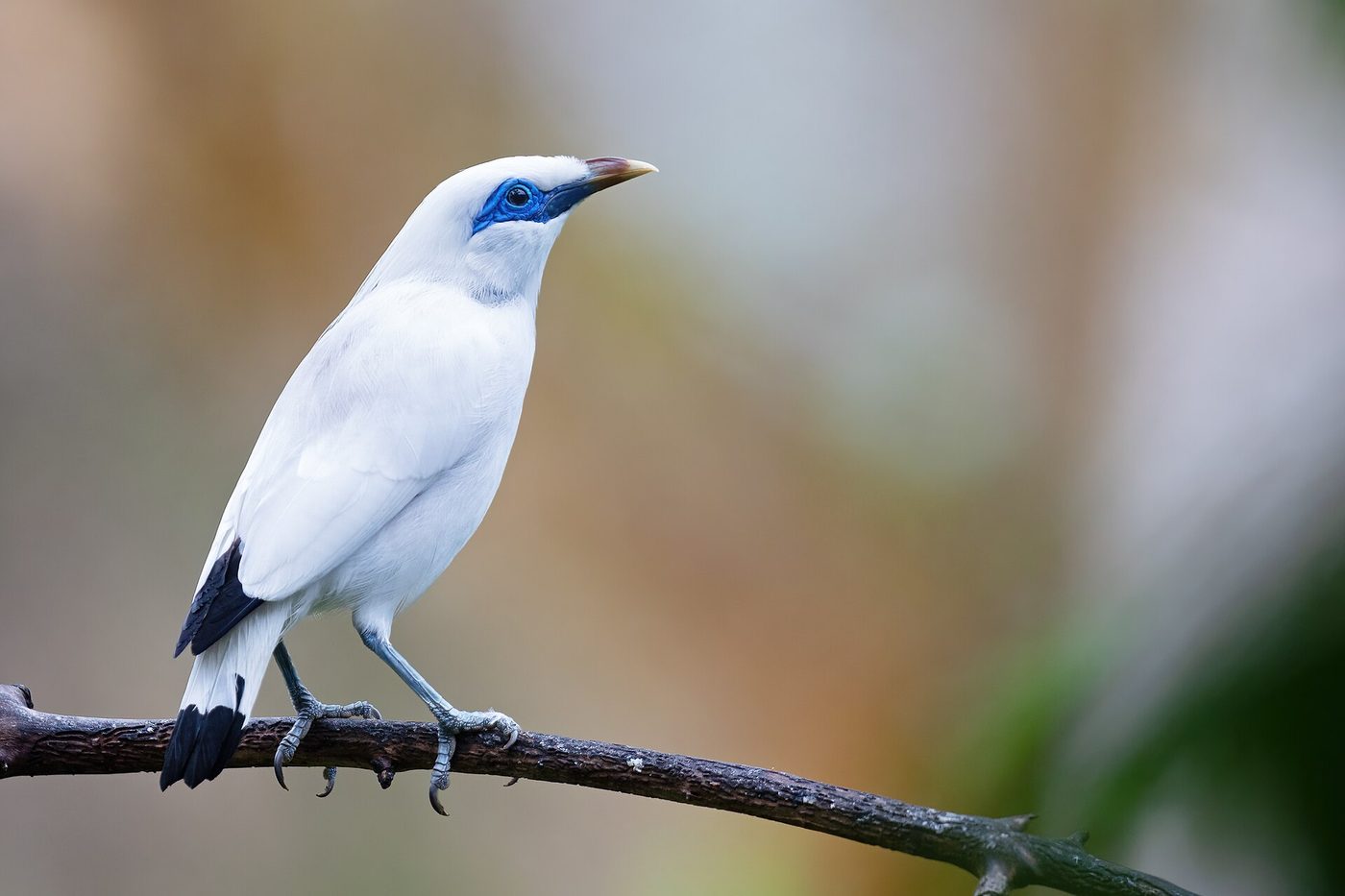
Photo: JJ Harrison · CC BY-SA 3.0
Bali myna
Leucopsar rothschildi
The Bali myna is an elegant, almost wholly white bird, endemic to the island of Bali and its emblem, today one of the rarest birds in the world.
Characteristics
Temperament
Social and lively; gathers in groups outside breeding.
Diet
Omnivorous: fruit, seeds, insects and small invertebrates.
A white jewel of Bali
The Bali myna (Leucopsar rothschildi), known locally as jalak Bali, is a medium-sized, strikingly elegant starling: its plumage is almost entirely pure white, with a long drooping crest and only the wingtips and tail-tip black. Around its eyes it has a conspicuous patch of bare blue skin; its legs are greyish and its bill brown and yellow. Male and female look much alike. It is the only species of its genus.
Habitat and range
It is endemic to the island of Bali, Indonesia, where in the wild it survives only in a small area of the northwest. It lives in wooded savannah and open scrub, nesting in tree cavities.
Behaviour and diet
It feeds on fruit, seeds, insects and other small invertebrates. It is a social bird that gathers in groups outside the breeding season. Its call and pure-white appearance make it an unmistakable presence in its habitat.
Did you know?
It was discovered in 1910 by Baron Walter Rothschild, banker and zoologist, honoured in its scientific name. It is a national symbol of Bali, depicted on coins and in local imagery. Its very beauty has made it a target of the illegal trade.
Conservation
The IUCN lists it as Critically Endangered: in 2020 fewer than 50 adults were thought to remain in the wild. Capture for the illegal cage-bird trade and habitat loss have driven it to the brink of extinction. Breeding and reintroduction programmes now aim to save it.
Pros
- Elegant, unmistakable white plumage
- A national symbol of Bali
- The focus of reintroduction programmes
Cons
- Critically endangered (fewer than 50 wild adults)
- A target of the illegal bird trade
- An extremely small wild range