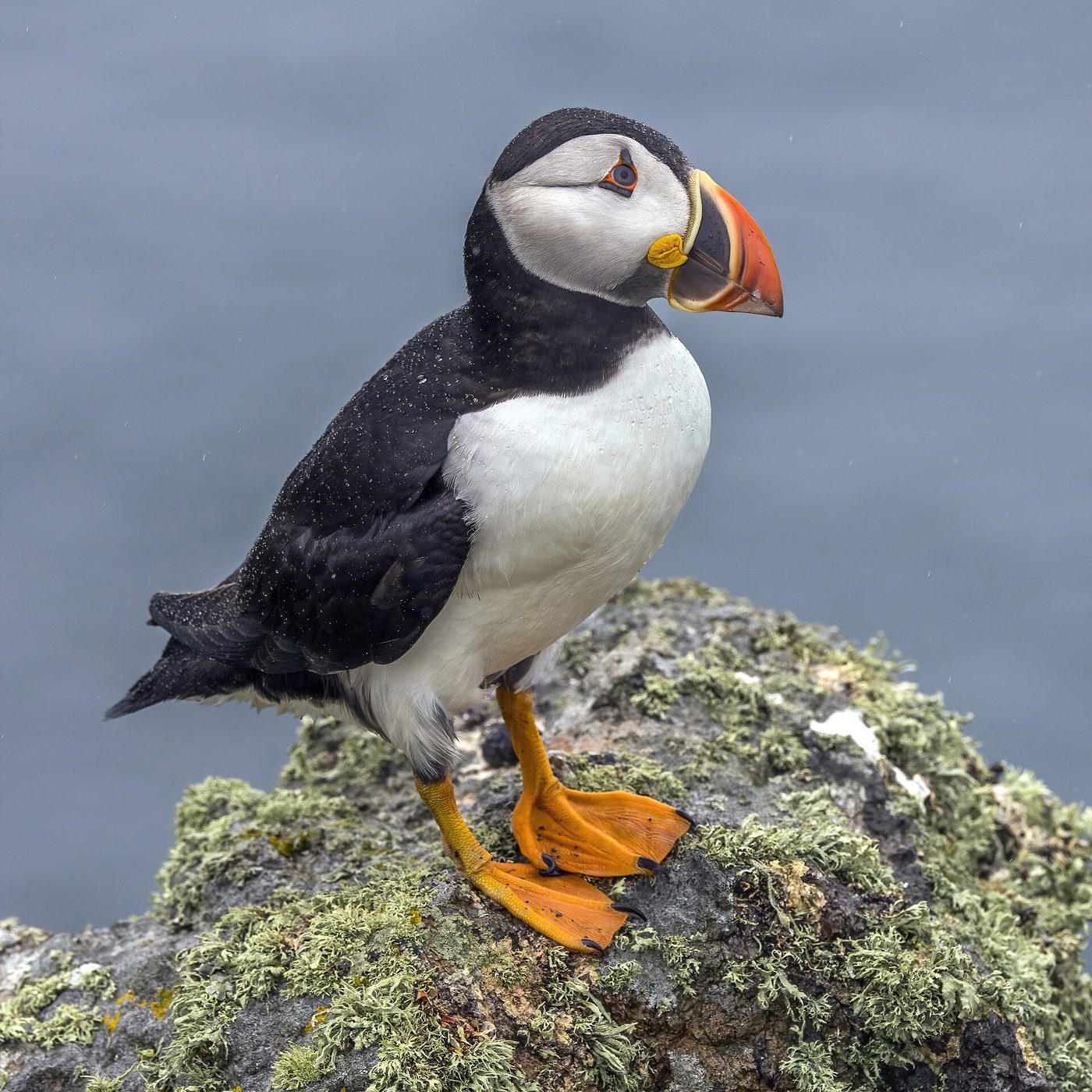
Photo: Charles J. Sharp · CC BY-SA 4.0
Atlantic puffin
Fratercula arctica
With its large colourful bill and comical air, the Atlantic puffin is among the most beloved seabirds: an expert swimmer dressed as a clown.
Characteristics
Temperament
Social and colonial, faithful to nest and partner. Clumsy on land but a highly skilled underwater swimmer; it spends much of the year on the open sea.
Diet
Piscivore: small fish such as sand eels and herring, caught by underwater dives.
The clown of the northern seas
The Atlantic puffin is one of the most recognisable and beloved seabirds of the North Atlantic. It has a compact black-and-white body and a stocky, clumsy look on land, which gives it a comical, endearing air. Its most famous feature is the large triangular bill, which during the breeding season lights up with vivid colours: orange, yellow and blue. Out of season, however, the colourful plates of the bill are shed and the colour fades, becoming more subdued.
An underwater fisher
Despite its awkward appearance, the puffin is a formidable swimmer. It uses its wings to 'fly' underwater, propelling itself with powerful strokes and steering with its webbed feet, and can dive to considerable depths to chase small fish. Its most extraordinary ability is seen in its bill: it can hold many prey all at once, neatly arranged, thanks to a rough tongue and backward-pointing spines inside the bill. It can thus return to the nest with many fish in a single trip.
Colonies above the sea
Puffins spend much of the year on the open sea, returning to land only to breed. They nest in large colonies on the cliffs and islands of the north, digging burrows in the ground or using cavities among the rocks. They are faithful birds: pairs tend to reunite each year at the same nest and to raise a single chick together.
Curiosities
The puffin's flight is fast but laborious: its small wings must beat very quickly, up to several hundred times a minute, to support its stocky body. This same shape, inefficient in the air, is instead perfect for underwater swimming.
Conservation
The Atlantic puffin is classified as a vulnerable species. Its populations are declining because of climate change, which alters the availability of the fish it feeds on, marine pollution and the introduction of predators on the nesting islands. Its conservation depends on the health of the northern seas and on the protection of the breeding colonies.