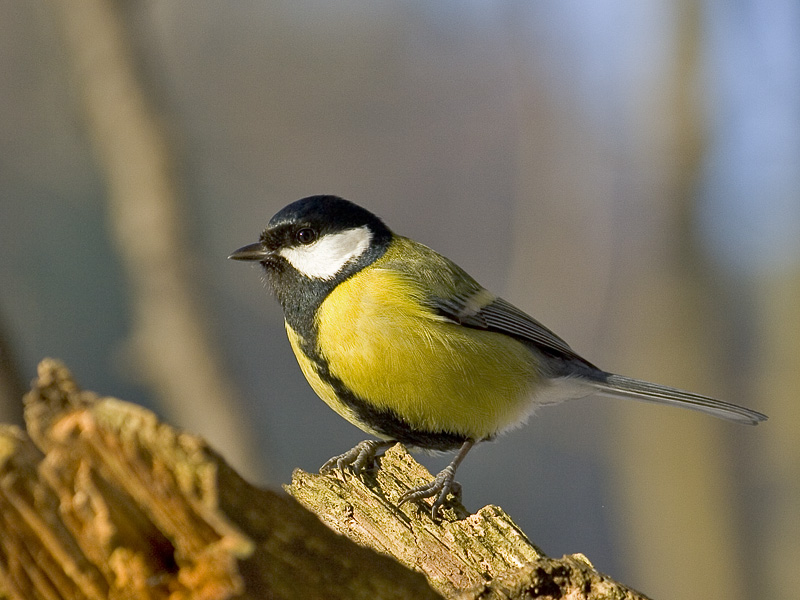
Great Tit
Parus major
Characteristics
Temperament
A small wild bird with a strong character: lively, curious, acrobatic and surprisingly intelligent. It is NOT a cage bird, but a free passerine that readily frequents gardens, parks and feeders. Confident toward humans, at winter feeders it is combative and dominant even toward smaller tits. It is famous for its ability to learn and solve small problems. Resident and active all year, outside the breeding season it is sociable and joins mixed flocks. Hosting it in the garden with winter food and nest boxes is easy and rewarding, and makes it an excellent ally against harmful insects.
Diet
Omnivorous and opportunistic, with a seasonal diet: in spring and summer it feeds mostly on insects, caterpillars, spiders and other invertebrates, essential for raising the chicks (a single family consumes thousands of caterpillars); in autumn and winter it switches to seeds, nuts and berries, and regularly visits feeders (sunflower seeds, peanuts, fats, fat balls). It is skilled and acrobatic at reaching food, even hanging upside down, and ingenious at opening the harder seeds by holding them between its feet. It is precisely this dietary flexibility that lets it stay all year in the same territory.
The Great Tit (Parus major) is the largest, most common and widespread of the European tits: a very lively, colourful little passerine full of character, among the best-loved guests of gardens and feeders. Unmistakable for:
- The black "tie": a vertical black band crossing the yellow belly, broader in males and thinner in females
- The black head and white cheeks: a glossy black head with two striking white cheek patches
- The bright colours: olive-green back, bluish wings with a white wing bar and a bright yellow breast
- The lively temperament: active, acrobatic, curious and combative at feeders
- The ringing song: the famous "tea-cher tea-cher", one of the first signs of spring
- The intelligence: famous for its ability to learn and solve small problems
IUCN status: Least Concern (LC), one of the most abundant species on the continent. It enters the portal among the passerines, alongside the Goldfinch, Blackbird and Robin: with them it enriches the group of small garden birds, the most familiar songbirds of our countryside and cities.
Classification and category
The Great Tit belongs to the order Passeriformes (the passerines, the "songbirds"), family Paridae (the tits). The species is Parus major. In the portal it is placed among the passerines, alongside the other small garden birds. It is the largest of the European tits, and it is useful to tell it apart from its smaller relatives, the other tits: the blue tit (Cyanistes caeruleus) — smaller, with a blue cap and without the black belly tie; the coal tit and the marsh tit — smaller, plainer in colour and lacking the bright yellow belly; the great tit is recognized by the combination of black head, white cheeks, yellow belly and above all the striking central black tie. The combination of black head + white cheeks + yellow belly with a black tie is the great tit's "identity card". Etymology: the scientific name major ("greater") indicates its size, the largest among the tits. Parameters: Length about 14 cm. Weight about 16-21 g. Appearance a small, compact passerine, brightly coloured and with an unmistakable pattern. Longevity: in the wild it lives on average 2-3 years, but can exceed 10 years in exceptional cases. Reproduction: it nests in cavities (holes in trees, but also nest boxes), laying large clutches, often of 8-12 eggs.
Habitat and distribution
The Great Tit is an extremely adaptable and widespread bird, present across much of Eurasia and North Africa: its range covers all of Europe, much of Asia and part of North Africa. Preferred habitats — wherever there are trees and food: broadleaf and mixed woods and forests, its preferred environment; parks, gardens and hedgerows, even in a full urban context; and orchards and wooded countryside. It is a largely resident bird: it does not undertake true migrations and stays all year in its territory, even in winter. It is precisely in winter that it becomes a regular guest of feeders, where it appears lively, acrobatic and dominant over the smaller tits. It is a diurnal bird, active and sociable outside the breeding season, when it often joins mixed flocks with other tits and small passerines. IUCN status: Least Concern (LC). The great tit is one of the most common and abundant bird species in Europe, and its populations are stable. Its great adaptability and willingness to frequent human environments and feeders make it one of the best-known and most-studied species on the continent.
Diet
The Great Tit is omnivorous and opportunistic, with a diet that changes with the seasons: insects and caterpillars (the main component above all in spring and summer, essential for feeding the chicks); spiders and other invertebrates; seeds, nuts and berries (important in autumn and winter); and feeder food (sunflower seeds, peanuts, fats and fat balls). Features of its feeding behaviour: skilled and acrobatic (it hangs upside down from branches and feeders to reach food); a caterpillar hunter (during nesting a single family can consume thousands of caterpillars, making it valuable for controlling harmful insects); and ingenious (it holds the harder seeds between its feet and opens them with blows of the beak, and can exploit new food sources). Crucially, its ability to feed on both insects and seeds lets it live all year in the same territory, alternating its diet according to the season. It is precisely this flexibility that makes it so common and successful.
Physical features
The Great Tit is a small but brightly coloured bird with an unmistakable pattern. The plumage pattern — the distinguishing trait: a glossy black head with two broad white cheek patches; a bright yellow belly, crossed by a vertical black band (the "tie"); an olive-green back and grey-bluish wings with a white wing bar. The sexual dimorphism: in the male the black tie is broader and more marked, a signal of its "quality"; in the female the band is narrower and less intense. The build: a small, compact body, with a short, sturdy beak suited to seeds and insects; strong legs, perfect for clinging and moving acrobatically among the branches; a lively appearance, always on the move.
Curiosities and behaviour
The Great Tit is a little bird with a strong character and surprising intelligence, so much so that it is one of the subjects most studied by ornithologists. Lively and curious, it is a familiar and welcome presence in gardens and parks.
The song of spring: the great tit's song, a loud, rhythmic "tea-cher tea-cher", is one of the first to ring out at the end of winter; for many it is the sign that spring is now near; its vocal repertoire is also very rich and varied, with dozens of different calls. The tie that talks: the black band crossing the belly is not just decorative; its width is a signal of the individual's "quality": males with a broader, more marked tie tend to be more dominant and sought-after as partners; it is a classic example of how a simple plumage detail can convey important information among animals. The genius bird: the great tit is famous for its intelligence and learning ability; the most famous example is the one, documented in Britain, of tits (great tits and blue tits) that learned to open with their beaks the foil tops of milk bottles left on doorsteps, to drink the cream risen to the top; this behaviour then spread among individuals, becoming a classic example of social learning in animals. The queen of feeders: at winter feeders the great tit is often the largest and most combative of the tits, and tends to dominate smaller species like the blue tit; acrobatic and tireless, it hangs in any position to reach the food, offering amusing spectacles to those who watch it. The nest-box nester: a lover of cavities, the great tit readily accepts artificial nest boxes, becoming one of the easiest species to host in the garden; for this reason it is also an excellent "ally" of the gardener: by feeding its chicks thousands of caterpillars, it helps keep insects harmful to plants under control. Behaviour and relationship with humans: lively, confident and adaptable, the great tit lives serenely alongside humans and frequents their gardens, parks and feeders; offering it food in winter and nest boxes in spring is a simple and rewarding way to get closer to nature and contribute to urban biodiversity; its cheerful presence and ringing song make it one of the most loved and familiar wild birds in Europe.
Pros
- Uccello da giardino comune, vivace e dai colori inconfondibili
- Facile da ospitare con mangiatoie e cassette nido
- Intelligente e di grande interesse per il birdwatching
- Utile alleato: divora migliaia di bruchi e insetti dannosi
Cons
- È un uccello selvatico e libero, NON un animale da gabbia
- Molto territoriale e combattiva nella stagione riproduttiva
- Alle mangiatoie può dominare e scacciare le cince più piccole
- Necessita di alberi e cavità (o cassette nido) per nidificare