Photo: Alexis Lours · CC BY 4.0
Eurasian coot
Fulica atra
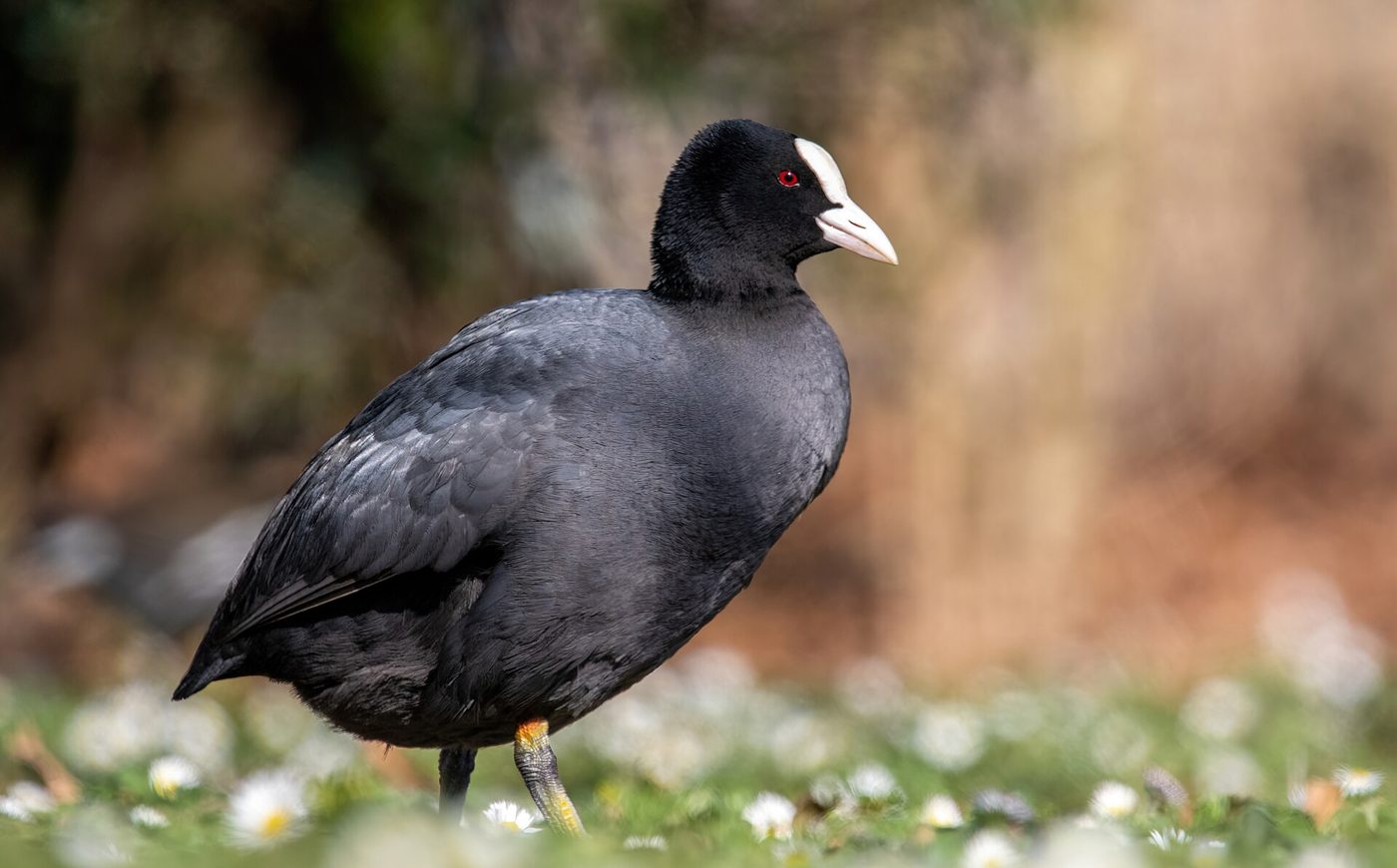
The coot is an all-black waterbird with an unmistakable white bill and frontal shield, very common on lakes and ponds.
Characteristics
Temperament
Aquatic, lively, territorial
Diet
Mainly aquatic plants, plus seeds and invertebrates
Description
The coot is a waterbird of the rail family, with a stocky, rounded body. Its plumage is a uniform slaty black, with a glossier black head. Its unmistakable feature is the white bill, extending into a broad white frontal shield on the forehead, standing out against the black of the head. Its legs are sturdy, with long lobed toes that aid swimming. The sexes look alike.
Habitat and distribution
It is found in Eurasia, North Africa and Oceania. It is one of the commonest waterbirds on lakes, ponds, slow rivers and nutrient-rich waters, even in city parks. In winter it often gathers in large flocks on open water.
Behaviour
It is an excellent swimmer and diver: it frequently dives to gather aquatic plants, its main food, supplemented with seeds, insects and small invertebrates. It is a lively and often quarrelsome bird, defending its territory with noisy chases across the water. To take off it has to run for some distance over the surface.
Did you know?
The white frontal shield, source of the expression 'bald as a coot', is more developed in dominant individuals. The chicks have heads coloured in vivid red and orange, very different from their parents.
Conservation
It is classed as least concern and is very common and abundant. It benefits from waters rich in vegetation, while it can suffer from pollution and the loss of wetlands.
(Note: the mass value given by Wikidata, 36.5 kg, is clearly wrong: the coot actually weighs about 0.6–0.9 kg.)
Pros
- Excellent swimmer and diver
- Very common and easy to observe
- Adaptable even to urban waters
Cons
- Territorial and often quarrelsome
- Affected by water pollution
- Depends on the presence of wetlands