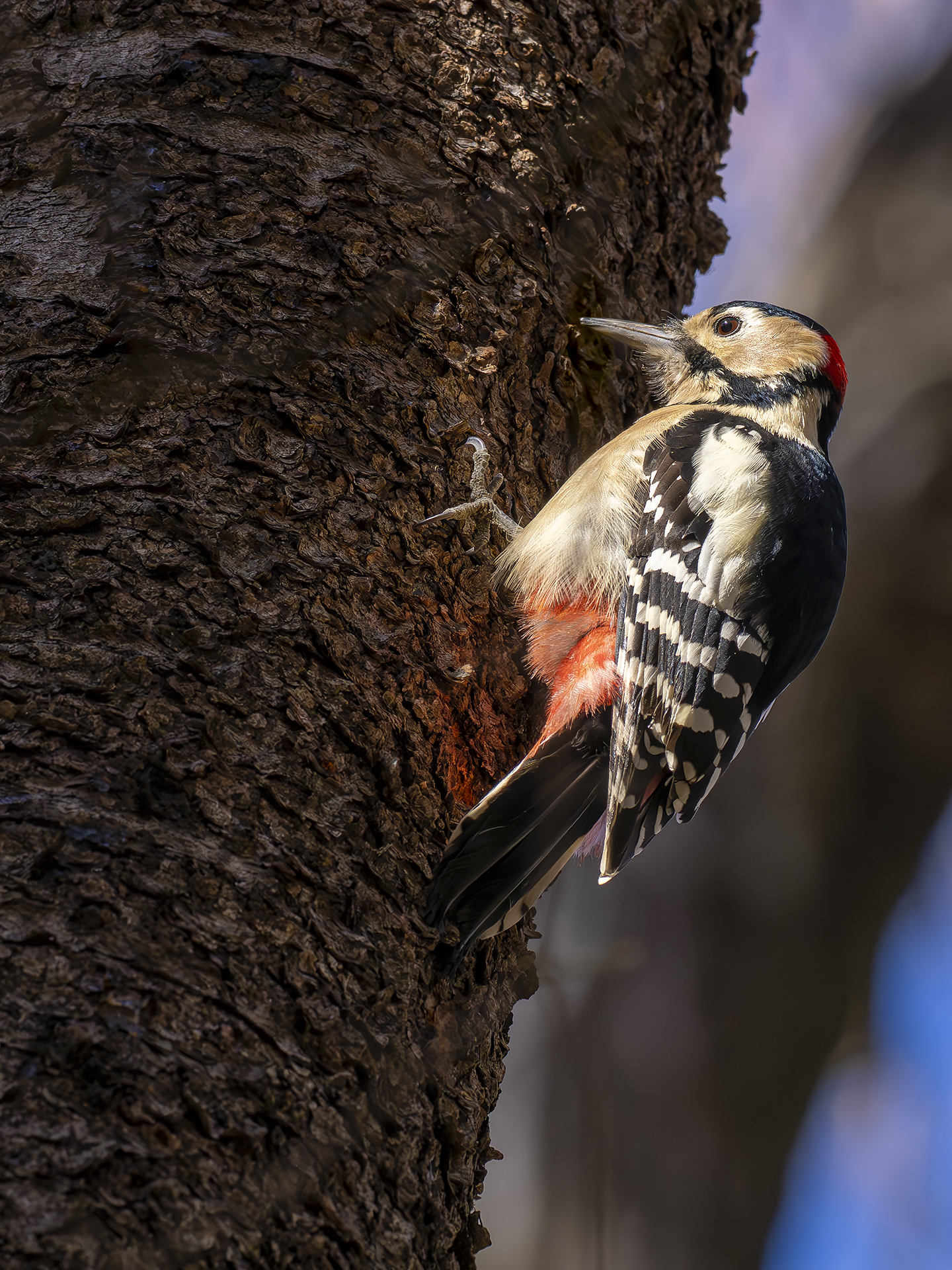
Great Spotted Woodpecker
Dendrocopos major
Characteristics
Temperament
A lively, energetic, territorial wild bird, mostly solitary outside the breeding season. It defends its territory all year and communicates above all by drumming, as well as with a sharp "kick" call. Active by day, it spends its time clinging to trunks in search of food. Wary but curious, it gets used to human presence and readily visits parks, gardens and feeders. It is NOT a cage bird: it is protected wildlife, to be observed in nature.
Diet
A varied, seasonal diet. In spring-summer it hunts insects and especially the larvae of wood-boring beetles, which it reaches by hammering the wood and extracts with its very long sticky tongue. In autumn-winter it switches to conifer seeds (extracted from cones), nuts, hazelnuts, acorns and berries; it uses an "anvil" (a crack in the bark) to hold and open cones and shells. Occasionally it preys on the eggs and nestlings of other birds. In winter it visits feeders looking for fats and seeds.
The Great Spotted Woodpecker (Dendrocopos major) is the most common and widespread woodpecker in Europe: the black-and-white bird, the size of a blackbird, whose unmistakable "drumming" resounds among the trees. Famous for:
- Drumming: very fast bursts of bill-blows on resonant wood, used not to feed but to "sing" and mark territory
- The chisel bill: strong and straight, a veritable pickaxe to bore through bark and wood
- An extraordinary tongue: very long, sticky and barbed, able to extend well beyond the bill tip to extract grubs
- A shock-absorbing skull: a structure that absorbs impacts and protects the brain from repeated blows
- The pied plumage: contrasting black and white, with the characteristic bright red under the tail
- The prop tail: stiff feathers that act as a third support while it climbs vertically
IUCN status: Least Concern (LC), common and increasing. It is the first woodpecker in this portal and joins, in the order Piciformes, the tropical Toco Toucan: two faces of the same kinship, the black-and-white climber of temperate woods and the giant with the colourful bill of the rainforest.
Classification and category
Order Piciformes, family Picidae (the woodpeckers), genus Dendrocopos. In the portal it is classified among the piciformes, the same group as the Toco Toucan: though very different in appearance, woodpeckers and toucans are in fact related and share some features, such as zygodactyl feet (with two toes pointing forward and two back), excellent for clinging. It is worth telling it apart from other woodpeckers and similar birds: the Great Spotted Woodpecker is black and white with a red vent, the size of a blackbird, and is by far the commonest; there are lesser spotted woodpeckers (smaller) and green woodpeckers (green and yellow, foraging for ants on the ground), as well as the large black woodpecker; unlike treecreepers and nuthatches, the true woodpecker actively "excavates" wood and drums. Etymology: the genus name Dendrocopos comes from Greek and means roughly "the one who strikes trees", a perfect description; the epithet "great" distinguishes it from the smaller lesser spotted woodpecker. Parameters: Length about 22-23 cm. Wingspan about 34-39 cm. Weight about 70-100 g (roughly blackbird-sized). Longevity in the wild a few years on average, but it can exceed 10 years. Reproduction: it excavates a new nest each year in a trunk cavity; it lays 4-7 white eggs, incubated and then fed by both parents. Male and female differ by the red nape patch, present only in the male (juveniles instead have a red crown).
Habitat and distribution
The Great Spotted Woodpecker is a species very widely distributed across the Palearctic: much of Europe (including Italy, where it is the commonest woodpecker), North Africa and much of Asia as far as Japan. Preferred habitats — wherever there are trees: woods of every kind (broadleaf, coniferous and mixed, both mature and young); parks, orchards, tree rows and large gardens, even in cities; and woodland edges and tree-lined hedges. It is a sedentary, adaptable bird that defends a territory all year. It favours the presence of dead wood and old trees, essential both for finding the grubs it feeds on and for excavating nest cavities. For this reason it is also a good "indicator" of the health and maturity of a wood. It is a familiar presence even for those who put out feeders in winter, where it readily comes to look for fats and seeds. IUCN: Least Concern. Its populations are numerous, stable and in many areas increasing, helped by its ability to adapt to parks and gardens.
Diet
The Great Spotted Woodpecker has a varied, seasonal diet, a skilful exploiter of trees. It eats: insects and their larvae (especially the larvae of wood-boring beetles, its favourite food); conifer seeds (in winter it extracts seeds from cones, a key resource in the cold season); nuts, hazelnuts, acorns and berries; and occasionally the eggs and nestlings of other birds, which it preys on by drilling into nests. Feeding strategies: excavating wood (it hammers bark and wood to reach the hidden grubs, which it then extracts with its tongue); the woodpecker's anvil (it wedges cones, nuts and hazelnuts into a crack in the bark — a fixed "workshop" — to crack them open with blows of the bill); and fishing for grubs (it inserts its very long, sticky tongue into the galleries dug by insects). Crucially, the woodpecker's tongue is a prodigious tool. So long that at rest it wraps right around the skull, it can extend well beyond the bill tip and has a barbed, sticky tip, perfect for harpooning grubs at the bottom of their tunnels.
Physical features
A robust bird, with contrasting black-and-white plumage and unique adaptations. Plumage and colours: black upperparts with large oval white shoulder patches and wing bars; cream-white underparts; bright red vent; the male also has a red nape patch, absent in the female. The woodpecker's tools: a chisel bill, straight, strong and pointed, to bore wood; a "shock-absorbing" skull (bones and tissues that cushion the blows and protect the brain); a stiff tail (strong feathers used as a prop to climb vertically); zygodactyl feet (two toes forward and two back, for a firm grip on bark); and a very long tongue, sticky and barbed, wrapped around the skull. Performance: drumming (more than a dozen blows in less than a second); climbing (it goes up trunks in jerks, always head-up); and undulating flight (typical, in short bursts alternating with closed wings).
Behaviour and curiosities
The Great Spotted Woodpecker is a lively, territorial and mostly solitary bird outside the breeding season. It is more often noticed by sound than by sight: its call is a sharp "kick!", but it is above all the drumming that betrays its presence. It is active by day and spends much of its time clinging to trunks, searching for food.
The drum that does no harm: the woodpecker's drumming is not for getting food, but for communicating — choosing a dead branch or a particularly resonant surface, the woodpecker produces very fast bursts of blows that work like a "song": they serve to mark territory and attract a mate; both male and female drum; the surprising thing is that the bird can strike thousands of blows a day without injuring itself, thanks to a series of skull adaptations. The natural helmet: how does the woodpecker hammer wood all its life without brain damage? Its skull is an extraordinary "anti-concussion" structure: spongy bones that absorb impacts, cushioning muscles, a slightly elastic bill and a hyoid bone (the tongue's) that wraps around the skull as a "safety belt"; these mechanisms are studied by engineers to design helmets and impact-absorbing materials. The tongue longer than the body: the woodpecker's tongue is so long it couldn't fit in the mouth: at rest it wraps backwards, passing around the skull up above the eyes; when needed it shoots forward well beyond the bill tip, and with its sticky, barbed end it harpoons grubs deep in the wood's galleries — one of the most curious anatomical adaptations in the whole bird world. The woodpecker's workshop: to open cones, nuts and hazelnuts, the Great Spotted Woodpecker uses a real "anvil" — it wedges the food into a crack in the bark or a purpose-made hole in a trunk to hold it fast, then hammers it with the bill until it opens; it often uses the same spots, under which a little heap of emptied cones accumulates: the unmistakable signs of its presence. The toucan's cousin: strange as it may seem, the little black-and-white woodpecker of our woods and the gaudy huge-billed toucan of the Amazon forest belong to the same order, the Piciformes; they share features such as zygodactyl feet (two toes forward and two back) and nesting in cavities; a fine example of how the same "extended family" of birds can have produced such different forms on distant continents and climates. Male, female and young: telling the sexes of the Great Spotted Woodpecker apart is easy if you look at the head — the male has a red nape patch; the female lacks it, with an all-black nape; the young, instead, have the whole crown red; all, however, share the bright red under the tail.
Pros
- Uccello affascinante e benèfico: controlla gli insetti xilofagi dannosi
- Indicatore della salute dei boschi; le sue cavità ospitano poi altri animali
- Comune, adattabile e in aumento: facile da osservare anche in parchi e giardini
- Un portento di adattamenti (lingua, cranio anti-urto) di grande interesse scientifico
Cons
- NON è un animale da compagnia: è fauna selvatica protetta
- Talora tamburella su grondaie e pali, o fora le facciate in legno delle case
- Può predare uova e nidiacei di piccoli uccelli
- Dipende da legno morto e alberi vecchi: soffre la rimozione eccessiva del legname