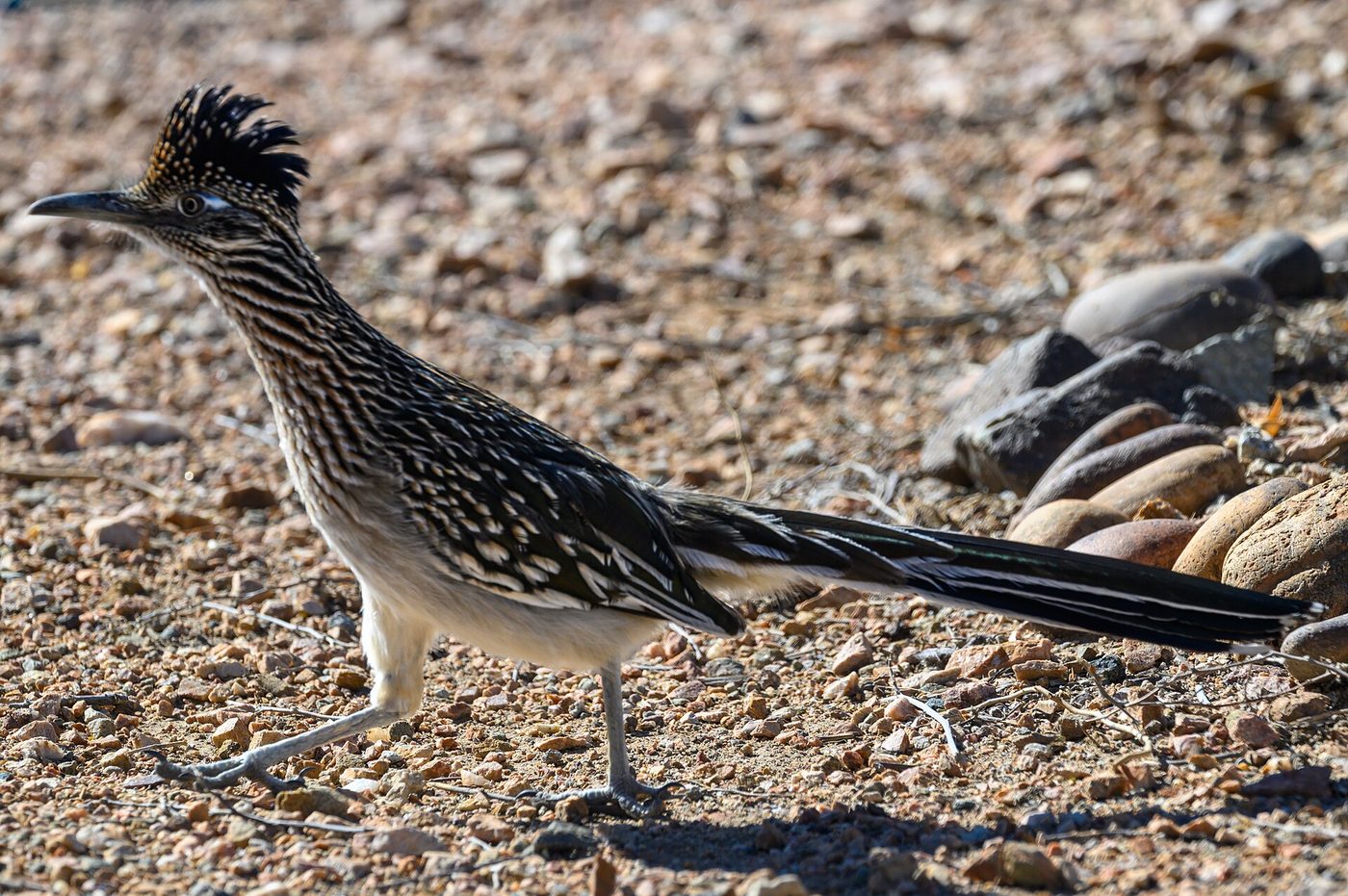
Photo: Gordon Leggett · CC BY 4.0
Greater roadrunner
Geococcyx californianus
The greater roadrunner is a long-legged, ground-dwelling cuckoo of the North American deserts, famous for sprinting across open ground and hunting snakes.
Characteristics
Temperament
Territorial, curious and quick; far more at home on the ground than in the air.
Diet
Omnivorous but mainly carnivorous: insects, reptiles, small mammals, birds, eggs, seeds and fruit.
A cuckoo that runs instead of flies
The greater roadrunner (Geococcyx californianus) belongs to the cuckoo family, Cuculidae, but has evolved a strikingly different lifestyle: rather than flying, it runs. On powerful legs it sprints at more than 30 km/h across open ground, using its long tail as a rudder and raising or lowering its shaggy crest with its mood. Its plumage is a streaked mix of brown, white and black, with a bare patch of blue and red skin behind the eye that brightens during courtship.
Habitat and range
It lives in the arid lands of Aridoamerica, from the southwestern United States down into central Mexico. It favours deserts, chaparral, grasslands and sagebrush flats, where open terrain lets it run and scattered shrubs offer cover and nest sites. It is a sedentary, territorial bird that defends a large home range all year round.
Behaviour and diet
The roadrunner is a bold, opportunistic predator. It seizes insects, spiders, scorpions, lizards, small rodents and snakes — including rattlesnakes — with lightning dashes and jabs of its heavy bill. It also takes eggs, small birds and, in winter, seeds and fruit. On cold mornings it fluffs the feathers of its back to expose dark skin to the sun and rewarm after the chilly desert night.
Breeding
Pairs are generally monogamous and build a cup nest of twigs in a shrub or cactus. Both parents incubate the eggs and feed the young. Its adaptability and broad diet keep it classified as Least Concern by the IUCN.
Did you know?
It is a cultural icon of the American Southwest and inspired the cartoon character Road Runner. It is also nicknamed the snake killer, chaparral cock and ground cuckoo.
Pros
- Superb desert-adapted runner
- Naturally controls insects and venomous snakes
- Widespread and not threatened
Cons
- A wild bird, unsuited to captivity
- Needs large arid territories to thrive