Superb fairywren
Malurus cyaneus
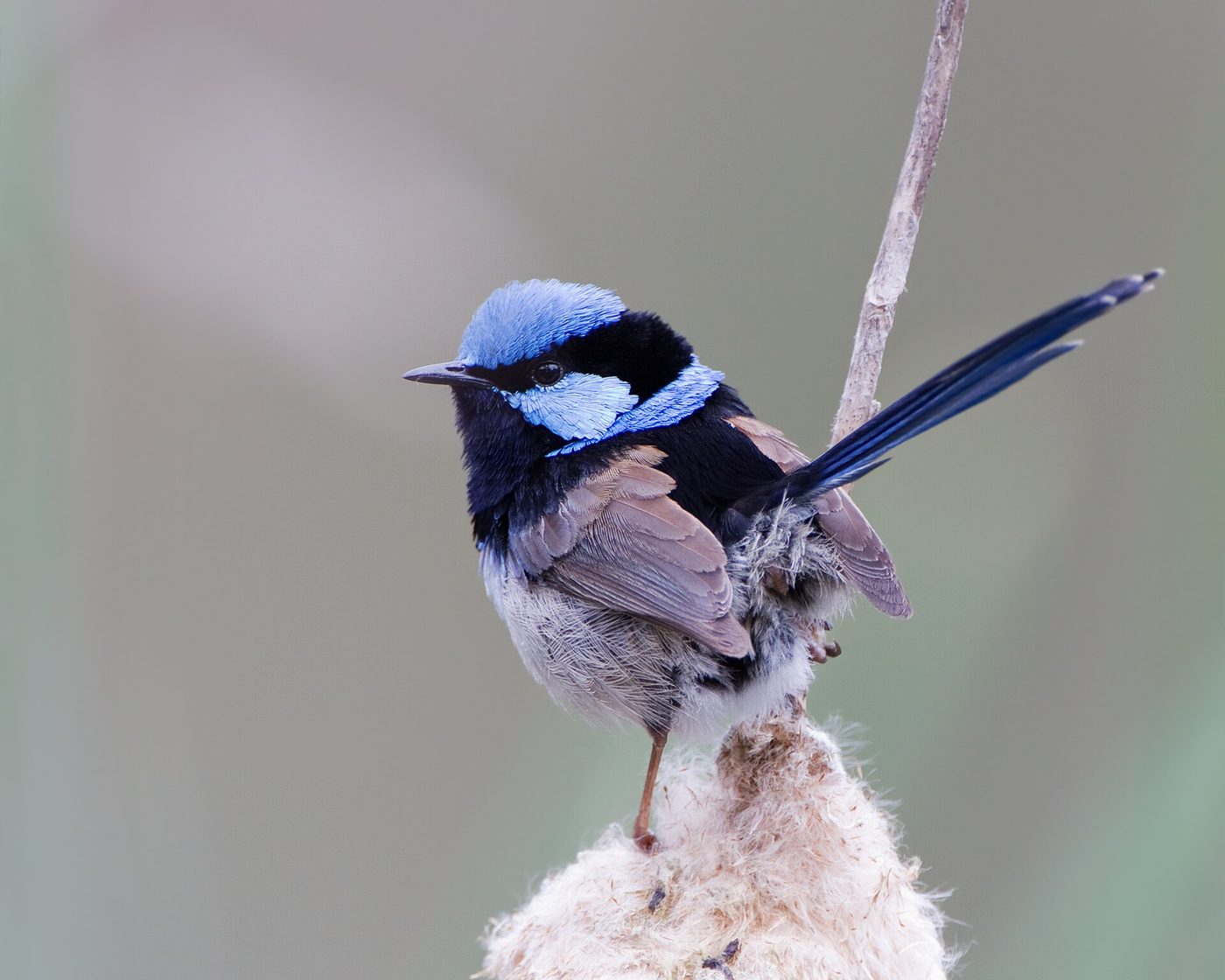
Tiny and lively, with the male in electric-blue colours and the long tail held upright, the superb fairywren is one of the most beloved birds of Australian gardens.
Characteristics
Temperament
Lively, social, territorial
Diet
Insectivore: insects, with seeds and fruit
A blue jewel
The superb fairywren is a small passerine bird, tiny and always on the move, with a long tail that it often holds upright. The species shows a marked difference between the sexes: the male, in breeding plumage, is spectacular, with its forehead, cheeks, back and tail of an almost electric bright blue, contrasting with a black mask and dark throat. The females, juveniles and out-of-season males, on the other hand, are a subdued grey-brown, with reddish tones around the eye. It was precisely this difference that, in the past, led to the mistaken belief that the few colourful males were polygamous.
Habitat and distribution
It is widespread in south-eastern Australia and Tasmania, where it is a common and familiar bird. It frequents a wide variety of environments with low, bushy vegetation, and has adapted very well to gardens, parks and suburban areas, where it is easy to watch it hopping about on the ground in search of food.
Behaviour and social life
It is a sedentary, territorial bird that lives in small family groups. A fascinating feature is cooperative breeding: besides the main pair, other members of the group, often offspring from previous broods, help to raise the young. Its social life is complex: although it forms stable pairs, the superb fairywren is famous among researchers for its high rates of infidelity, with frequent mating outside the pair.
Feeding and conservation
It feeds mainly on insects and other small invertebrates, which it catches by hopping nimbly through the low vegetation and on the ground, supplementing its diet with seeds and fruit. It is classified as a species of least concern, with abundant, stable populations, favoured by its ability to live alongside humans.
Pros
- Male in spectacular blue colours
- Lively and pleasant to watch
- Fascinating cooperative breeding
- Abundant, unthreatened populations
Cons
- Small and vulnerable to domestic cats
- Depends on low, bushy vegetation
- Only the breeding male is colourful