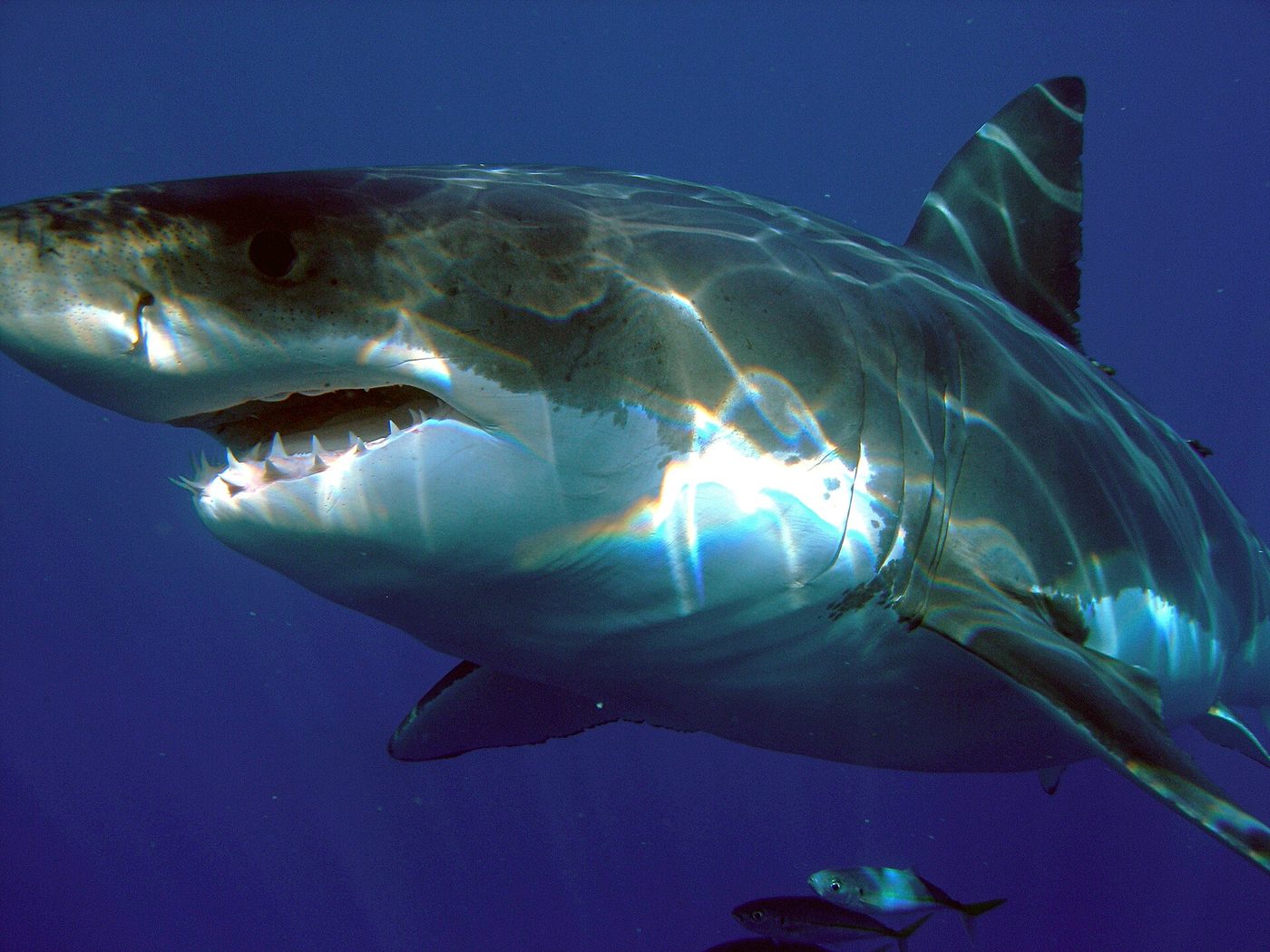
Photo: Sharkdiver.com · Public domain
Great white shark
Carcharodon carcharias
A legendary predator of the seas, the great white shark combines power, sharpened senses and an irreplaceable ecological role, far from the monster of the films.
Characteristics
Temperament
An apex predator, powerful and with exceptional senses. It often hunts by ambush from below; towards people it is not habitually aggressive and its fame is greatly exaggerated.
Diet
Carnivore: when young, fish; as an adult, mainly marine mammals such as seals and sea lions.
The great predator of the seas
The great white shark is one of the largest predatory fish on the planet. It has a tapered, powerful body, a grey-blue back and a white belly, a colouring that camouflages it whether seen from above or below. It can reach and exceed six metres in length and weigh over a tonne. Its mouth is armed with rows of serrated, triangular teeth, which are renewed continually throughout life: when one breaks, another moves forward to replace it.
A hunter's senses
The great white shark has an extraordinary sensory apparatus. Besides very sharp sight and smell, able to detect traces of blood at great distances, it has special organs called ampullae of Lorenzini, which sense the very weak electric fields generated by the muscles of its prey. With them it can locate an animal even hidden or in the dark. It often hunts by attacking from below with a lightning acceleration, catching its prey by surprise.
What it really eats
When young it feeds mainly on fish, but as an adult it prefers fat-rich marine mammals such as seals and sea lions, essential to sustain its great energy needs. Attacks on people, however feared, are rare and often the result of a mistaken identification: the shark does not regard humans as usual prey, and many bites are exploratory.
An irreplaceable role
As an apex predator, the great white shark plays a crucial role in marine ecosystems, regulating the populations of its prey and keeping the oceans in balance. Its presence is a sign of a healthy sea. Its reputation as a 'man-eater', fuelled by films and legends, has long overshadowed its real ecological importance.
Conservation
The great white shark is classified as a vulnerable species. It grows slowly, breeds late and has few young, which makes it very sensitive to overfishing, accidental catches and persecution. Protecting this predator is essential to the health of the oceans: its disappearance would have cascading consequences on the entire marine food web.