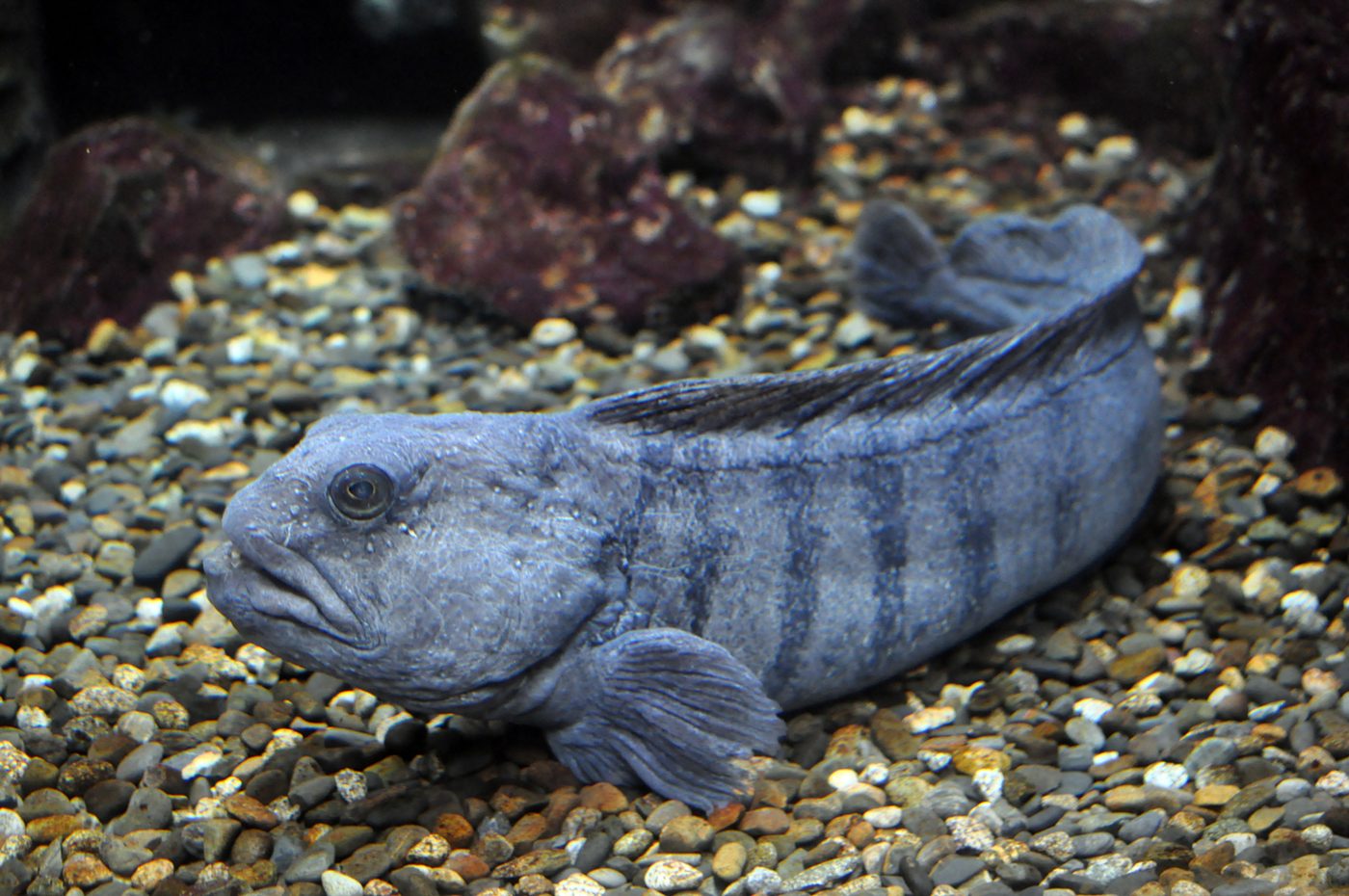
Photo: This illustration was made by Citron You must credit this : Citron / CC-BY-SA-3.0 · CC BY-SA 3.0
Atlantic wolffish
Anarhichas lupus
The Atlantic wolffish is a bottom-dwelling fish of the northern Atlantic, with a fierce look and strong teeth able to crush shells and mollusks.
Characteristics
Temperament
Benthic, solitary, shy
Diet
Carnivorous: urchins, mollusks, crabs and crustaceans
The fish with crushing teeth
The Atlantic wolffish, or seawolf, is a bony fish with an elongated, almost eel-like body that can exceed a metre in length. Its appearance is unmistakable and rather forbidding: a large head with powerful jaws armed with strong teeth, some conical and protruding like fangs, others molar-shaped. This dentition is a perfect tool for crushing the hard shells of its prey. The colour is grey-brown or bluish, with darker vertical bands.
Habitat and range
It lives in the cold seas of the North Atlantic, from the North Sea and the British and Norwegian coasts to Iceland, southern Greenland and the North American coasts. It frequents deep rocky bottoms, where it shelters in dens and crevices.
Behaviour and diet
It is a benthic predator, tied to the seabed, and a solitary hunter. It feeds mainly on hard-bodied invertebrates: sea urchins, mollusks, crabs and other crustaceans, which it crushes with its strong teeth. Despite its menacing look, it poses no danger to people and tends to stay hidden.
Notable facts
The wolffish produces a kind of natural antifreeze in its body, allowing it to survive in the frigid Atlantic waters. Its teeth wear down with use and are periodically replaced. Its firm white flesh is prized in cooking.
Conservation
The species is of concern in several areas, especially in US waters, where populations are declining rapidly due to overfishing and bycatch. Its slow growth and fidelity to breeding sites make it vulnerable to exploitation.
Pros
- Powerful shell-crushing teeth
- Natural antifreeze for cold waters
- Harmless to people despite its looks
Cons
- Slow-growing and vulnerable to fishing
- Declining populations in some areas