Photo: Diego Delso · CC BY-SA 4.0
Emperor angelfish
Pomacanthus imperator
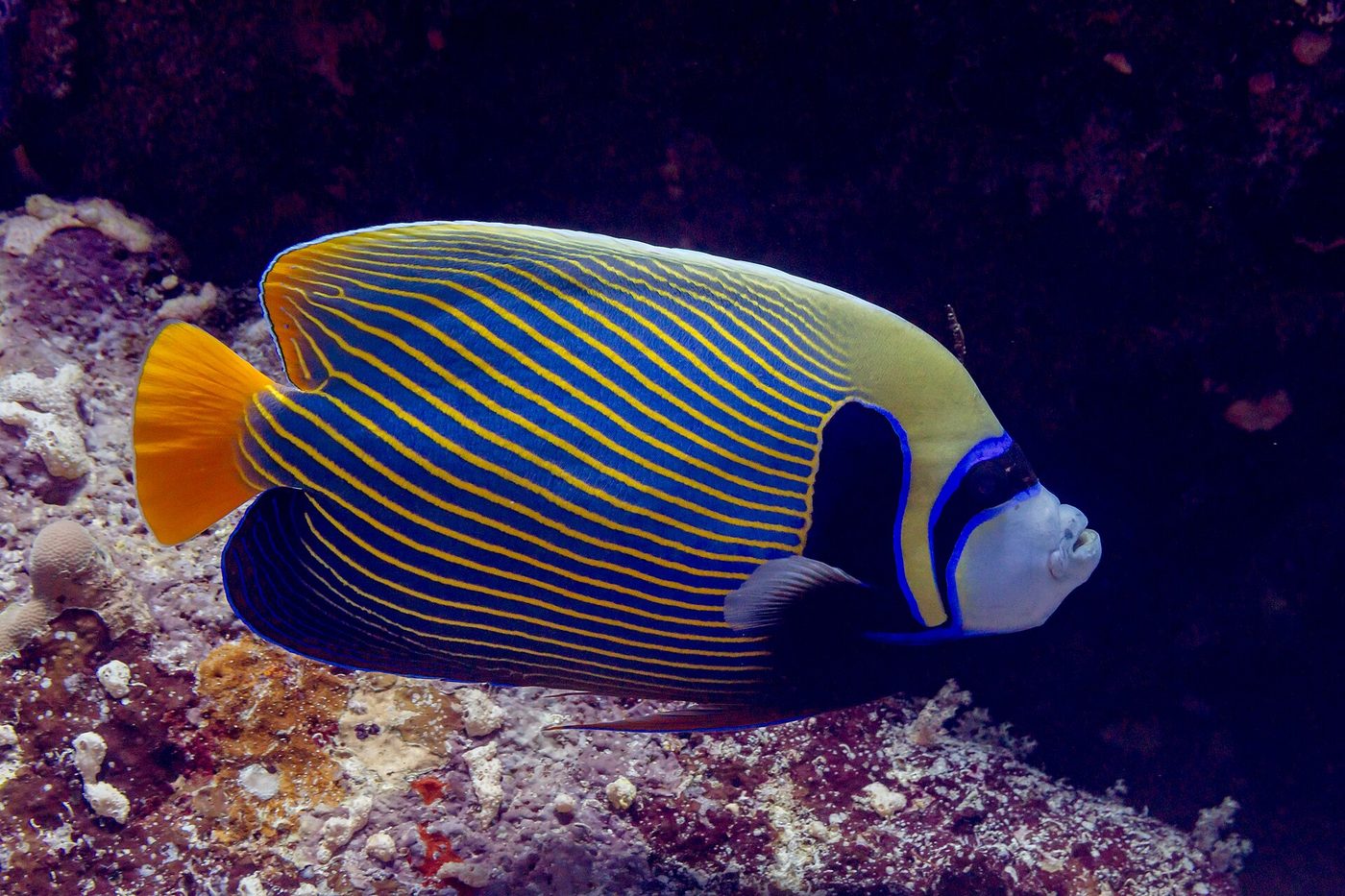
The emperor angelfish is a spectacular reef fish with vivid blue and yellow stripes, whose pattern changes radically from juvenile to adult.
Characteristics
Temperament
Diurnal, territorial, long-lived
Diet
Sponges, tunicates and algae
Description
The emperor angelfish is one of the most spectacular and photographed reef fish. The adult has an oval, flattened body crossed by a dense series of horizontal yellow and electric-blue stripes, with a pale face marked by a dark band across the eyes. It grows to about 40 centimetres. The juveniles, by contrast, have a completely different pattern: dark blue with concentric white and pale-blue circles.
Habitat and distribution
It lives on tropical coral reefs of the Indo-Pacific, from the Red Sea to Hawaii and the Austral Islands. It frequents reefs rich in crevices and shelters, where it finds refuge among rocks and corals, often at moderate depths.
Behaviour and diet
It is a diurnal, territorial fish that feeds mainly on sponges, tunicates and algae. Its change of pattern from juvenile to adult is so marked that the two forms were once described as different species. Adults also make clicking sounds when disturbed.
Aquarium care
It is a highly sought-after marine aquarium fish for its magnificent pattern, but demanding: it needs very large tanks, excellent water quality and a specialised diet, hard to reproduce in captivity. It is suitable only for experienced aquarists.
Conservation
It is classed as least concern, with stable populations and no major threats. Like all reef species, however, it depends on the health of the corals; collection for the aquarium trade should be managed sustainably.
Pros
- Spectacular blue-and-yellow striped pattern
- Dramatic colour change from juvenile to adult
- Long-lived, can exceed twenty years
Cons
- Demanding, needs very large tanks
- Specialised diet hard to reproduce
- Territorial with its own kind