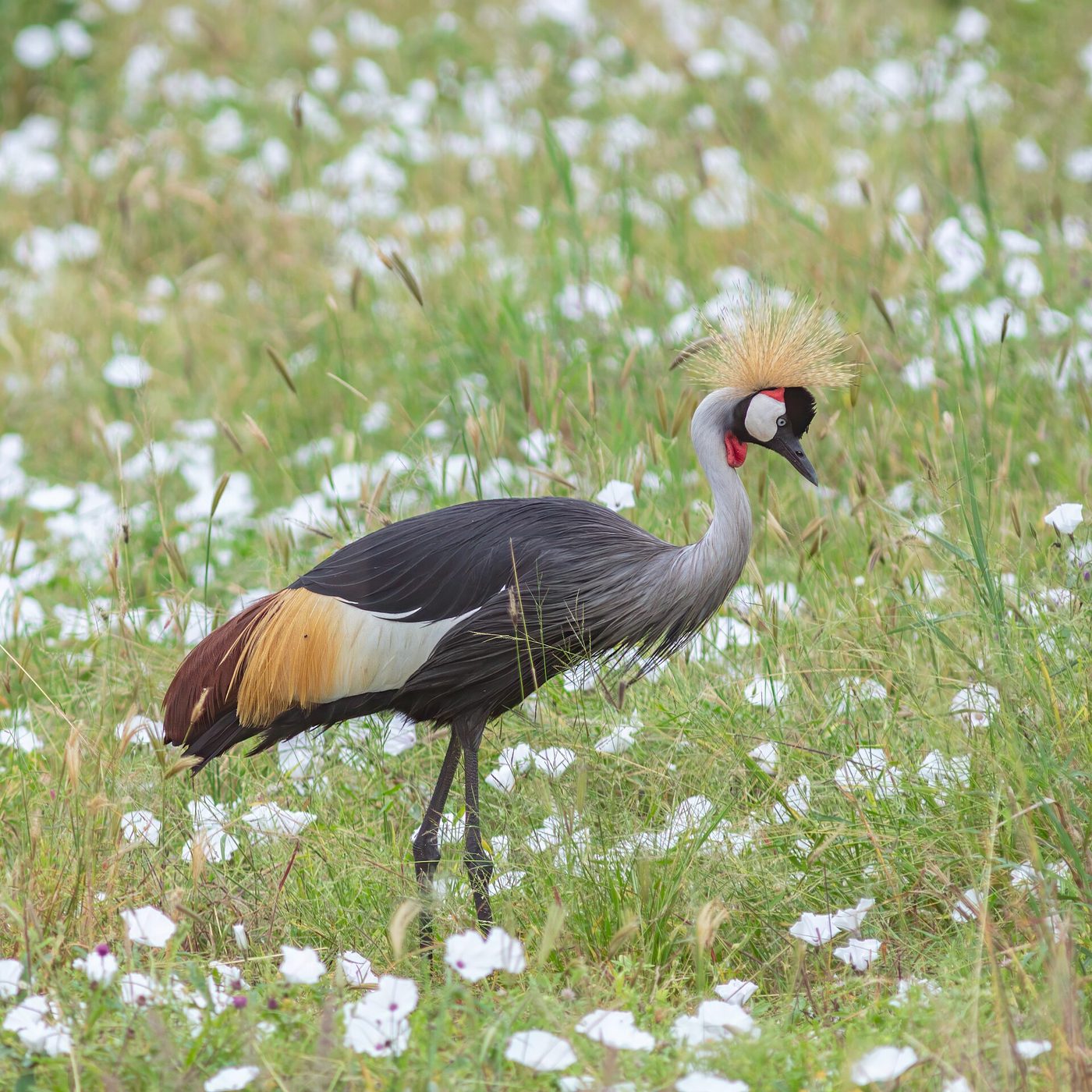
Photo: Diego Delso · CC BY-SA 4.0
Grey crowned crane
Balearica regulorum
With its striking crown of golden feathers on its head, the grey crowned crane is an elegant and majestic bird of the African wetlands, famous for its dances.
Characteristics
Temperament
Social, elegant, dances in courtship
Diet
Omnivore: seeds, grasses, insects, small invertebrates
The crane with a golden crown
The grey crowned crane is one of the most elegant and recognisable birds in Africa. Its most distinctive feature is a spectacular crown of thin, stiff, golden feathers radiating from the top of its head, like a diadem. The body plumage is mainly grey, with black and white wings and striking coloured patches on the cheeks, while a small red pouch hangs beneath the throat. Its long legs and upright neck give it a noble and slender bearing, typical of cranes.
Habitat and distribution
It lives in eastern and southern Africa, where it frequents wetlands, grasslands, grassy savannas and the edges of marshes and lakes. It is a bird tied to open, water-rich environments, but it can also adapt to areas modified by humans, such as cultivated fields, where it sometimes searches for food. Unlike other cranes, it is able to perch in trees, thanks to a well-developed hind toe.
Behaviour and dances
The grey crowned crane is famous for its courtship dances, among the most beautiful in the bird world: the pairs jump, bow, spread their wings and give calls, in displays full of grace that strengthen the pair bond. It is a social bird, often living in groups, and omnivorous: it feeds on seeds, grasses, insects, small invertebrates and other tiny animals it finds in the ground and shallow water.
Curiosities
The grey crowned crane is the national bird of Uganda, where it even appears on the national flag and coat of arms, a testament to its deep symbolic value. Its elegant image and golden crown make it a true emblem of African wildlife.
Conservation
The grey crowned crane is classified as an endangered species. Its populations are in decline due to the destruction and drainage of wetlands, the use of pesticides and illegal capture for trade. Protecting the African wetlands, crucial to its survival, is essential to save this splendid and symbolic bird.
Pros
- Spectacular crown of golden feathers
- Famous, fascinating courtship dances
- National bird of Uganda
- Elegant emblem of African wildlife
Cons
- Endangered species, declining populations
- Threatened by the drainage of wetlands
- Victim of illegal capture for trade