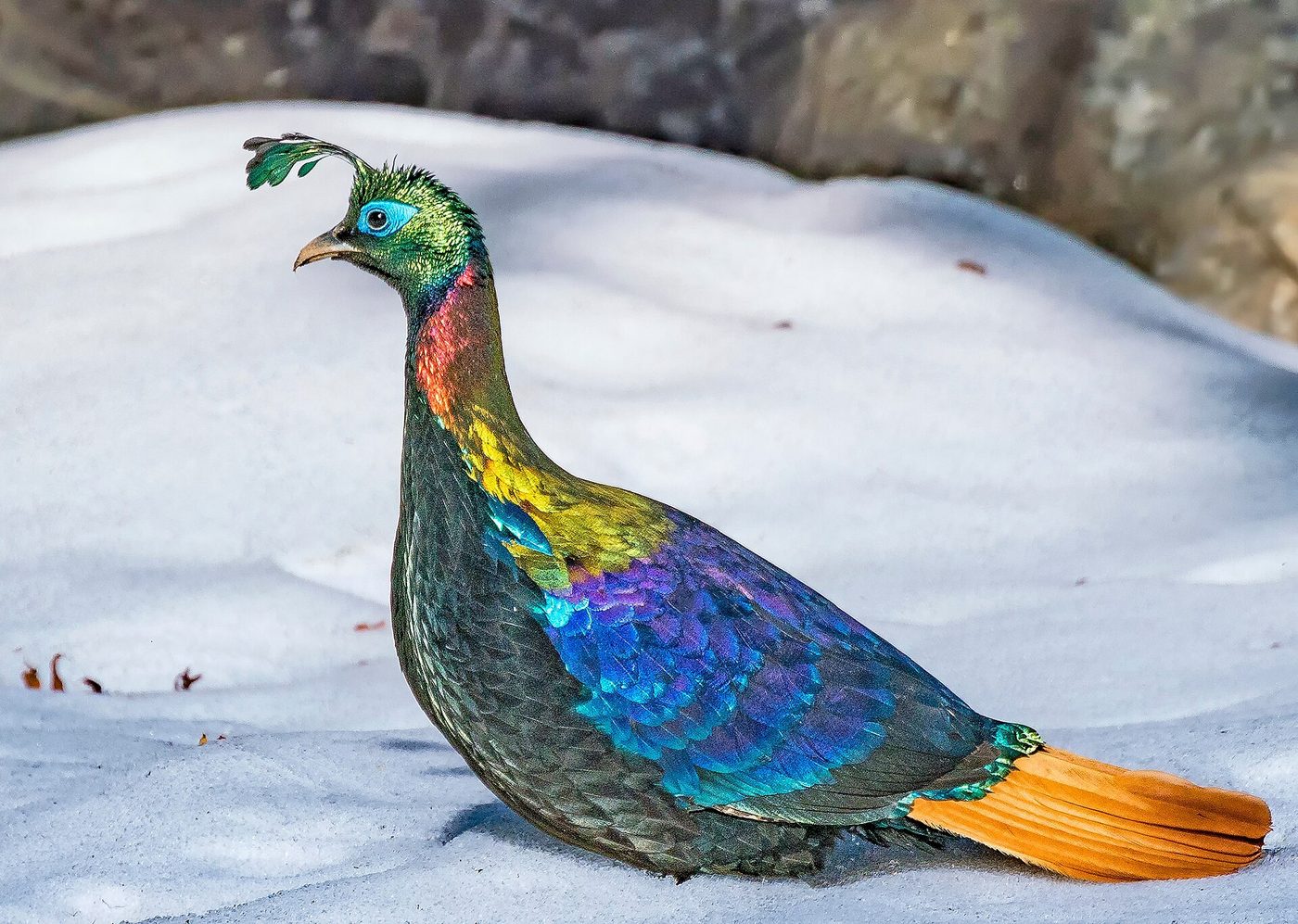
Photo: AJIT HOTA · CC BY-SA 4.0
Himalayan monal
Lophophorus impejanus
The Himalayan monal is a pheasant with dazzling iridescent, metallic plumage, the national bird of Nepal, living in high-altitude forests and meadows.
Characteristics
Temperament
Lively and vigorous; lives in small groups outside breeding.
Diet
Omnivorous: tubers, roots, bulbs, seeds, shoots and insects.
A pheasant with metallic sheen
The Himalayan monal (Lophophorus impejanus), also called the Impeyan monal, is a pheasant of the family Phasianidae famous for the male's plumage, which glows with metallic iridescence in every colour of the rainbow — green, blue, copper, purple — topped by a long green feathered crest. The female, as in many pheasants, is brown and cryptic, with a white throat. It is the national bird of Nepal, where it is known as the danphe, and the state bird of Uttarakhand in India.
Habitat and range
It lives along the Himalayas, from eastern Afghanistan to southwestern China, at elevations of 2,100 to 4,500 metres. It frequents conifer and rhododendron forests, clearings and alpine meadows, moving lower in winter to escape the snow.
Behaviour and diet
It feeds mainly on tubers, roots, bulbs, seeds and shoots, which it digs up with vigorous strokes of its sturdy bill, as well as insects and grubs. Outside the breeding season it lives in small groups. In spring the males perform courtship displays, showing off their iridescent plumage and calling loudly across the slopes.
Did you know?
Its scientific name commemorates Lady Mary Impey, wife of a British judge in eighteenth-century Bengal. Its spectacular plumage has made it a highly prized ornamental bird, kept in captivity around the world.
Conservation
The IUCN lists it as Least Concern. It remains relatively widespread, but hunting — once for its crest feathers — and habitat loss are local pressures in some areas.
Pros
- Spectacular iridescent plumage (male)
- National bird of Nepal
- Least Concern, still widespread
Cons
- Locally hunted in some areas
- Sensitive to loss of high-altitude habitat
- Strong dimorphism: the female is drab